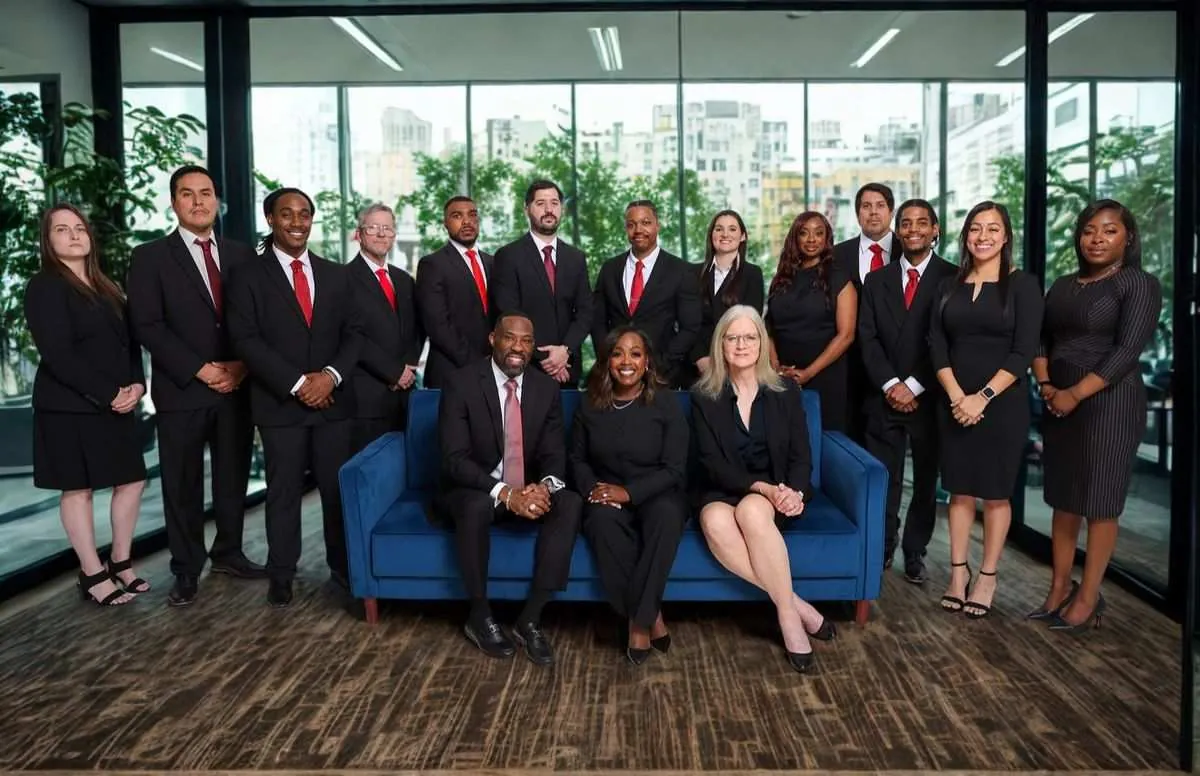
TEA & SBEC Educator Defense Attorney in Frisco, Texas
An educator accused of misconduct in Frisco fights two cases at once: the criminal charge in a Collin or Denton County courtroom, and the TEA/SBEC case against the teaching certificate under Education Code chapter 21. Below: the controlling statutes, penalty and sanction ranges, defenses that work on both tracks, and what to do first.
Free, Confidential Educator Case Review
Tell us what happened — arrest, TEA letter, or campus investigation. A defense attorney reviews every submission — usually within an hour, day or night.
Martindale-Hubbell® 2026 Honors
Independent peer-review ratings recognizing legal ability and ethical standards.


Awards reflect peer-reviewed ratings only. Past results do not guarantee future outcomes.
Criminal classification: § 21.12 is a second-degree felony — 2 to 20 years in prison and a fine up to $10,000
Certificate exposure: mandatory revocation under Educ. Code § 21.058 for listed convictions and deferred adjudications; discretionary sanctions up to permanent revocation under 19 TAC ch. 249 with no conviction required
What Law Governs TEA and SBEC Educator Discipline in Texas?
Three bodies of law control an educator case. First, Texas Education Code chapter 21, subchapter B creates the State Board for Educator Certification (SBEC) and gives it authority over every certificate, from issuance to revocation. The Texas Education Agency (TEA) staffs the system: its Educator Investigations Division screens complaints, investigates, and prosecutes the discipline cases that SBEC ultimately decides. Second, SBEC's disciplinary rules live in title 19, chapter 249 of the Texas Administrative Code, which defines the conduct standards — including the century-old phrase “unworthy to instruct or to supervise the youth of this state” — and sets out a sanction menu that runs from a non-inscribed reprimand to permanent revocation. Third, the Penal Code supplies the criminal exposure that usually starts the fire: § 21.12 (improper relationship between educator and student), § 33.021 (online solicitation of a minor), § 22.04 (injury to a child), and ordinary charges like assault and DWI that land differently when the defendant holds a certificate.
The hinge between the two systems is Education Code § 21.058. When a court clerk sends notice under Code of Criminal Procedure article 42.018 that a certificate holder was convicted of — or placed on deferred adjudication for — an offense requiring sex-offender registration, SBEC must revoke the certificate within five days. The same mandate covers conviction of any Penal Code Title 5 felony against a victim under 18, and conviction or deferred adjudication for § 43.24 (sale, distribution, or display of harmful material to a minor). The school district then has to pull the educator off campus immediately and void the contract. There is no hearing on those facts; the fight has to be won in the criminal case.
Why Do Frisco Educator Cases Run on Two Tracks at Once?
Because the law forces them to. Education Code § 21.006 requires a superintendent to report an educator to SBEC within seven business days after learning the educator resigned or was terminated following an alleged incident of misconduct — abuse or an unlawful act with a student or minor, a romantic relationship with or solicitation of a student or minor, drug offenses, misappropriation of district funds, or certificate fraud. Principals carry a parallel duty to alert the superintendent. The statute has teeth: an administrative penalty of $500 to $10,000 for a missed report, a hold on the administrator's own certificate renewal until it is paid, and a state jail felony when the failure to report is paired with intent to conceal. Districts do not gamble on those numbers, so the SBEC referral almost always happens whether or not charges are ever filed.
The two tracks use different burdens, different factfinders, and different rules of evidence. A Collin County jury must find guilt beyond a reasonable doubt; a SOAH administrative law judge decides the certificate case by a preponderance of the evidence. That asymmetry is the core strategic problem: testimony that helps in one forum can sink the other, and a quick plea that looks tolerable in criminal court can detonate the certificate under § 21.058. It is also why the Fifth Amendment calculus has to be managed by one defense team watching both dockets, not two lawyers working in silos.
One more wrinkle worth knowing before anyone talks to anyone: under § 21.12(d-1), a school generally may not release the name of an employee accused under that statute to the general public until the employee is indicted. Reporters and Facebook groups do not always observe the statute's spirit, but it gives a careful defense team room to work the pre-indictment window — grand jury packets, charge-selection advocacy, polygraph-supported presentations — while the client's name stays out of the district's public statements.
What Are the Penalties for the Criminal Charges Educators Face?
The table below pairs the criminal range with the certificate consequence, because for a teacher the second column often matters more than the first. Ranges come from Penal Code chapter 12; certificate consequences from Education Code § 21.058 and 19 TAC chapter 249.
| Charge | Classification & range | Fine cap | Certificate consequence |
|---|---|---|---|
| Improper relationship with student — PC § 21.12 | 2nd-degree felony · 2–20 years TDCJ | $10,000 | Title 5 felony: revocation mandatory on conviction if the student was under 18; no ch. 62 registration from this statute alone |
| Online solicitation of a minor — PC § 33.021 | 3rd-degree felony (explicit communications) · 2nd-degree for solicitation to meet or minor under 14 | $10,000 | Registrable → § 21.058 revocation is mandatory, and deferred adjudication counts |
| Indecency with a child — PC § 21.11 | 2nd-degree felony (contact) · 3rd-degree (exposure) | $10,000 | Registrable and Title 5 — both mandatory-revocation prongs apply |
| Injury to a child — PC § 22.04 | State jail felony up to 1st-degree, by mental state and harm | $10,000 | Felony conviction triggers § 21.058 (victim under 18); classroom-discipline cases also draw ch. 249 review |
| Harmful material to a minor — PC § 43.24 | Class A misdemeanor · up to 1 year county jail | $4,000 | The one misdemeanor with mandatory revocation — § 21.058(a)(3) reaches conviction or deferred adjudication |
| Assault (bodily injury) — PC § 22.01(a)(1) | Class A misdemeanor · up to 1 year county jail | $4,000 | No mandatory prong — discretionary discipline under 19 TAC ch. 249 conduct standards |
| DWI — PC § 49.04 | Class B misdemeanor (Class A at 0.15+ BAC) | $2,000 / $4,000 + state fines | Case-by-case under ch. 249; repeat or on-duty alcohol conduct draws sanctions far more often than a first offense |
Read the last column the way SBEC does. Mandatory-revocation offenses leave nothing to argue before the Board, so the entire defense investment belongs in the criminal courtroom — or in charge-selection negotiations that keep the conviction off the § 21.058 list. Discretionary cases flip the priority: the criminal exposure may be a misdemeanor, but the certificate fight at SOAH decides whether a twenty-year career continues.
What Must the State Prove Under Penal Code § 21.12?
Every element, beyond a reasonable doubt:
- 1. Employment status
- The accused was an employee of a public or private primary or secondary school. In Sutton v. State, 499 S.W.3d 434 (Tex. Crim. App. 2016), the Court of Criminal Appeals held the evidence legally insufficient under subsection (a)(1) where a school-district police officer was assigned to a different feeder system and officed at a command center — the statute's plain language requires sexual contact with a student enrolled at the school where the employee actually works, and district-wide duties were “too tenuous” to satisfy it.
- 2. Prohibited conduct
- Sexual contact, sexual intercourse, or deviate sexual intercourse — or, under subsection (a)(3), online-solicitation conduct described by § 33.021. Subsection (e) defines sexual contact by reference to intent to arouse or gratify sexual desire, which makes intent a live trial issue in ambiguous-touching cases.
- 3. The complainant's status — and the employee's knowledge
- Under (a)(1), enrollment at the employee's own school. Under (a)(2) — the subsection the Legislature broadened after Sutton — an employee who holds a position described by Education Code § 21.003(a) or (b) commits the offense with a person the employee knows is enrolled at any public or private primary or secondary school, or is a student participant in a school-sponsored activity. The knowledge element does real work in (a)(2) prosecutions involving students from other districts met outside school.
- 4. What the State does NOT have to prove
- Consent is irrelevant, and so is the student's age — an adult student is covered. The Legislature treated the educator-student power dynamic itself as the harm. The narrow statutory escape valves live in subsection (b-1): the actor was the student's spouse, or was no more than three years older and the relationship predated the school employment.
What Happens After a Teacher Is Arrested or Reported in Frisco?
Most Frisco educator cases start on campus, not at the jail. An outcry or a rumor reaches an administrator; the school resource officer opens a report; the district places the educator on administrative leave the same week. From there the tracks split and run in parallel:
- Campus report and forensic interview. Allegations involving a minor typically route through a children's advocacy center forensic interview, with Frisco police or the county agency observing. Nothing about that interview is on your side of the case — do not try to “clear it up” with investigators before counsel is involved.
- Arrest, magistration, and bond. On the Collin County side of Frisco, a warrant is typically executed by Frisco PD and the case is magistrated with bond conditions that matter for employment: no contact with the complainant, stay-away orders covering campuses, sometimes device monitoring. We push back on conditions that would make continued employment or even substitute work impossible while the case is pending.
- The district's § 21.006 report. Within days of a termination or resignation tied to alleged misconduct, the superintendent's report lands at SBEC. TEA opens an investigation file and the educator's public certificate record can reflect a pending review while the case is open — something recruiters check.
- Indictment or information. Felonies go to a Collin County grand jury sitting in McKinney. The pre-indictment window is where charge selection gets litigated quietly: whether conduct is presented as § 21.12, as § 33.021 with its registration consequence, or declined.
- Pretrial and resolution. Discovery under Code of Criminal Procedure article 39.14, device forensics, motions to suppress statements and searches, and — always — an eye on what any plea does to the certificate under § 21.058.
- The SBEC case catches up. TEA usually lets the criminal case lead. Whatever record the criminal defense builds — or concedes — becomes the raw material for the SOAH hearing that follows.
How Does an SBEC Investigation Unfold?
TEA's Educator Investigations Division works from the § 21.006 report, the criminal file, and its own interviews. The educator receives written notice of the allegations and, in most cases, an early fork in the road: accept an agreed order — anything from a non-inscribed reprimand (invisible on the public certificate) through an inscribed reprimand, suspension, or agreed revocation — or contest the case. Contested cases are docketed at the State Office of Administrative Hearings, tried to an administrative law judge under the Administrative Procedure Act, frequently by videoconference. TEA must prove its allegations by a preponderance of the evidence. The ALJ issues a proposal for decision; SBEC's board then adopts, modifies, or rejects it in a public meeting, and the final order is reviewable in a Travis County district court under the substantial-evidence standard.
Two doctrines from the Austin appellate courts shape every one of these cases. First, the Board does not need a conviction: in Gomez v. Texas Education Agency, Educator Certification & Standards Division, 354 S.W.3d 905 (Tex. App. 2011), the court upheld revocation where no criminal conviction existed, holding that nothing in Education Code subchapter B limits the “unworthy to instruct” ground to the offenses listed in §§ 21.058 and 21.060, and tracing the standard to Marrs v. Matthews, 270 S.W. 586 (Tex. App. 1925) — moral fitness, not criminal history, is the test. Second, Gomez also holds that an expunction of the criminal case does not bar witnesses from testifying about the underlying conduct from independent memory. An educator who wins an expunction has cleaned the record, not erased the event — plan the SBEC defense accordingly.
What Defenses Work in Educator Cases?
- Attack the employment-situs element. Sutton reversed a conviction because a district-level employee did not work at the complainant's school. The Legislature narrowed that lane by rewriting subsection (a)(2), but the works-at-the-school element still controls (a)(1) counts, and the knowledge element still controls (a)(2) — both are jury arguments, and both are charging-instrument issues we raise before indictment.
- Statutory defenses under (b-1). Marriage, or the three-year age window paired with a relationship that predates the school employment. The second one decides real cases involving young teachers and aides who knew the student socially first.
- No “sexual contact” as defined. Subsection (e) requires intent to arouse or gratify. Coaching adjustments, sideline contact, and horseplay allegations rise or fall on that intent element.
- Fabrication, motive, and the digital record. Grade disputes, discipline retaliation, and group-chat rumor cascades generate accusations; full phone extractions, app metadata, attendance and badge records, and witness timelines kill them. The same forensics that wins the criminal case becomes the SOAH exhibit list.
- Suppression. Device searches, campus interrogations by police without warnings where custody attaches, and statements squeezed out under job-loss pressure all draw motions. What is suppressed in district court may still surface at SOAH — another reason sequencing matters.
- On the certificate track: hold TEA to its preponderance burden, litigate the ch. 249 factors (seriousness, pattern, candor, remediation), and structure any agreed order so it avoids the do-not-hire registry triggers and preserves renewal eligibility. After Gomez, “the criminal case went away” is the start of the SOAH defense, not the end of it.
Should You Surrender Your Certificate or Fight?
TEA routinely offers voluntary surrender or an agreed sanction to close its file. Sometimes that is rational — an educator leaving the profession anyway may prefer a negotiated exit to two years of litigation. But surrender is treated as disciplinary action: it is permanent on the certificate record, it ends any reciprocity conversation with other states, and where the underlying finding involves abuse, an unlawful act with a student or minor, or a romantic relationship with a student or minor, it pairs with a do-not-hire listing that forecloses even non-certified school work. The decision is not “keep teaching or not” — it is “what does the written finding say, and which registries does it feed.” We model both outcomes before recommending either.
Two hypotheticals show the stakes. First: a 29-year-old Frisco high-school coach is accused of a relationship with an 18-year-old senior. Because the student is an adult, there is no ch. 62 registration and the § 21.058 mandatory-revocation prong for Title 5 felonies (victim under 18) does not apply — but § 21.12 is still a second-degree felony, and SBEC will still pursue the certificate under chapter 249's conduct standards. The criminal defense and the SOAH defense are genuinely separable, and charge outcome drives leverage. Second: a non-certified instructional aide is accused of grabbing a 9-year-old by the arm hard enough to bruise. There is no certificate to revoke, but Education Code § 22.094 lets the commissioner put non-certified staff on the registry, and the criminal exposure under § 22.04 ranges from state jail felony to first-degree depending on mental state and harm. Both are hypothetical composites, not client matters — but both fact patterns recur across Collin County every school year.
What Is the Do-Not-Hire Registry — and Who Ends Up on It?
Education Code § 22.092 requires TEA to maintain an internet-accessible registry of people not eligible for employment in Texas public schools, and districts must discharge or refuse to hire anyone listed. The statutory grounds include: a criminal-history determination that the person would be ineligible for certification; ineligibility flowing from a § 21.058 mandatory revocation; an SBEC revocation based on a finding of abuse, an unlawful act with a student or minor, or a romantic relationship with a student or minor; and a commissioner determination under § 22.094 for non-certified employees. Registry placement is a separate proceeding with its own notice and hearing rights — and it is frequently the consequence clients learn about last, after the plea papers are signed. Check the exposure before resolving either track, not after.
County-by-County Practice Notes: Collin, Denton, Dallas, Tarrant
Collin County. Most of Frisco sits in Collin County, so most Frisco educator cases are filed in McKinney: felonies in the district courts and Class A/B misdemeanors in the county courts at law, all at the Collin County Courthouse (the Russell A. Steindam Courts Building) on Bloomdale Road. Felony review runs through the grand jury, and bond conditions in cases involving minors are typically detailed and strictly enforced. Our office on Preston Road is minutes from the Frisco campuses involved and a short drive from the McKinney courthouse.
Denton County. West-side Frisco addresses fall in Denton County, where cases are heard at the Denton County Courts Building in Denton. Same statutes, different grand jury rhythm and docket pace — venue is a fact question we confirm from the offense address on day one, because it decides which DA's charging practices govern.
Dallas County. Educators who live in Frisco but teach in Dallas-side districts answer at the Frank Crowley Courts Building on Riverfront Boulevard. Dallas County's volume means longer indictment timelines in some courts — time a coordinated defense can use on the administrative track.
Tarrant County. Criminal cases are centralized at the Tim Curry Criminal Justice Center in Fort Worth. For any of the four counties, the SBEC case does not move: TEA investigates from Austin and SOAH sets the hearing, usually by videoconference, no matter where the criminal court sits.
Collateral Consequences Beyond the Courtroom and the Certificate
A felony conviction strips firearm rights under Penal Code § 46.04 and federal law, 18 U.S.C. § 922(g). Non-citizen educators face removal exposure because offenses against children and sexual-misconduct findings are treated harshly in immigration proceedings — get an immigration opinion before any plea. Texas's fingerprint-based clearinghouse (Government Code § 411.0845) means every district that ever runs the educator sees the arrest, not just the disposition. A registrable conviction adds chapter 62's residency, reporting, and internet-identifier rules. And the dominoes keep falling outside education: child-care licensing, foster and adoption approvals, coaching and volunteer clearances, and professional licenses in second careers all ask about the same event. Sequence matters — an expunction or nondisclosure at the right moment shuts down most of these inquiries, but as Gomez teaches, it will not silence eyewitnesses in a pending SBEC case.
How § 21.12 Differs From Neighboring Statutes
Prosecutors choose among overlapping statutes, and the choice changes everything. If the student is under 17, the same conduct is usually charged as sexual assault under § 22.011(a)(2) — registrable, and carrying its own enhancement ladder. Under 17 with contact short of penetration, indecency with a child (§ 21.11) applies — also registrable. Electronic communications alone support online solicitation (§ 33.021) — registrable, and chargeable even where no meeting ever happened. § 21.12 itself is the only one of the four that is not on the article 62.001(5) registration list — and § 21.12(c) expressly allows prosecution under multiple sections for the same conduct, so the indictment's architecture, not the police report, fixes the registration consequence. Below the criminal line entirely sits the boundary-violation discipline case — texting habits, social-media contact, closed-door meetings — where no offense is alleged but chapter 249 sanctions are very much in play. That is the case nobody hires a lawyer for until the SOAH notice arrives; it is also the most winnable.
Key Legal Terms
- SBEC (State Board for Educator Certification)
- The board created by Education Code chapter 21, subchapter B that issues, suspends, and revokes Texas educator certificates; TEA staff investigate and prosecute its disciplinary docket.
- Unworthy to Instruct
- The moral-fitness standard in 19 TAC ch. 249, in Texas law since Marrs v. Matthews (1925); under Gomez (2011) it supports revocation based on conduct alone, without any criminal conviction.
- Mandatory Revocation (§ 21.058)
- Automatic certificate revocation within five days of clerk notice for registrable-offense convictions or deferred adjudications, Title 5 felony convictions with a victim under 18, and § 43.24 dispositions.
- SOAH Contested Case
- The administrative trial of a disputed SBEC case before a State Office of Administrative Hearings ALJ, decided by a preponderance of the evidence under the Administrative Procedure Act.
- Do-Not-Hire Registry (§ 22.092)
- TEA's public list of people ineligible for Texas public-school employment; districts must discharge or refuse to hire anyone listed, certified or not.
Frequently Asked Questions
Is it a crime for a Texas teacher to date an adult student?
Does a § 21.12 conviction require sex-offender registration?
Can SBEC take my certificate without a criminal conviction?
Does deferred adjudication protect my teaching certificate?
My district offered to let me resign quietly. Should I?
What is the do-not-hire registry?
Can SBEC use an expunged criminal case against me?
What happens at a SOAH hearing on my certificate?
Who investigates first in Frisco — the police or TEA?
Is the school required to report me to police as well as TEA?
References & Authoritative Sources
- Texas Penal Code § 21.12 — Improper Relationship Between Educator and Student
- Texas Education Code § 21.058 — Revocation of Certificate for Certain Offenses
- Texas Education Code § 21.006 — Requirement to Report Misconduct
- Texas Education Code § 22.092 — Do-Not-Hire Registry
- Texas Code of Criminal Procedure ch. 62 — Sex Offender Registration (art. 62.001(5) list)
- Texas Education Agency — Educator Investigations
- State Office of Administrative Hearings
- Collin County — courts and district attorney
- Sutton v. State, 499 S.W.3d 434 (Tex. Crim. App. 2016); Gomez v. Texas Education Agency, Educator Certification & Standards Division, 354 S.W.3d 905 (Tex. App. 2011)
About the Authors
Reggie London
Co-Founding Partner · Texas Bar No. 24043514
Reggie London co-founded L and L Law Group with a focus on federal criminal defense, complex felony defense, and TEA/SBEC matters. Licensed in Texas, admitted to TXND and TXED.
Njeri London
Co-Founding Partner · Texas Bar No. 24043266
Njeri London co-founded L and L Law Group with a focus on DWI defense, family violence cases, and juvenile defense. Licensed in Texas, admitted to TXND and TXED.
Facing a TEA/SBEC Case or a Criminal Charge? Talk to L and L Law Group.
Co-founding partners Reggie London and Njeri London ensure attorney-level review at every stage. Free consultation. Frisco, Texas.
Call (972) 370-5060