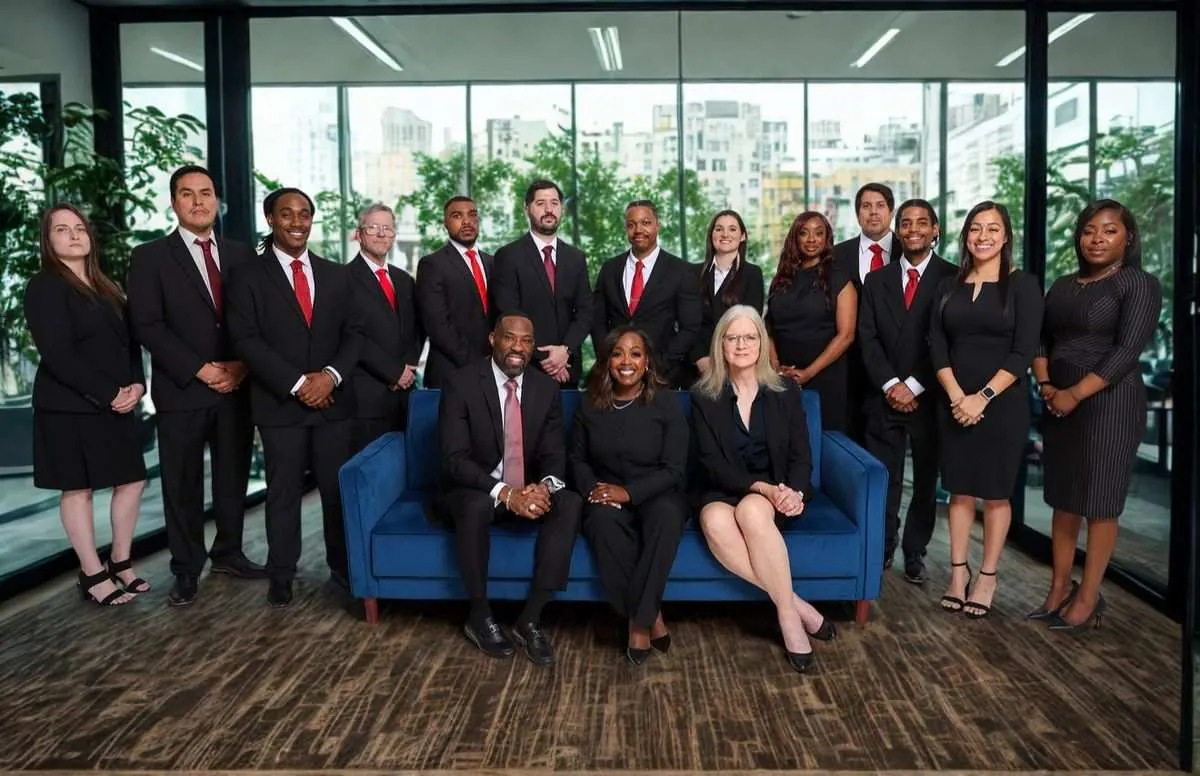
A defense team that knows how Dallas County prosecutes
Reggie London, a co-founding partner, is a former Dallas County Assistant District Attorney with felony trial experience, including DWI dockets. He knows how Dallas County prosecutors evaluate, charge and negotiate cases, and he uses that knowledge to find weaknesses in the State's case. (Texas Bar No. 24043514)
Njeri London, a co-founding partner, focuses on Fourth Amendment motions, drug-crime defense and federal cases. She is admitted in the Northern and Eastern Districts of Texas and before the Fifth Circuit, which matters when a Dallas case becomes a federal case. (Texas Bar No. 24043266)
Together, the firm's attorneys bring more than 40 years of combined criminal defense experience.
Criminal charges we defend in Dallas
How a Dallas County case moves forward
- Arrest and magistration: after booking, a magistrate sets bond and any bond conditions.
- Filing: the District Attorney's office reviews the case and decides what to file. Felonies also go to a grand jury.
- Court settings: the case is set in a county criminal court (misdemeanors) or a criminal district court (felonies) at Frank Crowley.
- Evidence and negotiation: your attorney reviews the evidence, files motions and negotiates with the prosecutor.
- Resolution: dismissal, a reduced charge, a diversion program, a plea agreement or a trial.
Getting released from jail in Dallas County
People arrested in Dallas are usually booked at the Lew Sterrett Justice Center. A magistrate sets the bond amount and any conditions, such as no contact with a witness or an ignition interlock device after a DWI. If the bond is too high, your attorney can ask the court to lower it. Breaking a bond condition can send you back to jail, so read the conditions carefully and ask us if anything is unclear.
Dallas criminal defense questions
Do I need a lawyer for a misdemeanor in Dallas?
A misdemeanor conviction can bring jail time, fines and a permanent record. An attorney can often find a path to dismissal, diversion or a reduced charge.
Does Dallas County have diversion programs?
Yes. Dallas County runs several specialty courts and diversion programs. Eligibility depends on the charge and your history, and we will tell you which ones may apply.
Will my case go to trial?
Most criminal cases in Texas are resolved without a trial, through a dismissal, a plea agreement or a diversion program. We prepare every case as if it will be tried, because that preparation leads to better outcomes.
How fast should I act after a DWI arrest?
Quickly. To request a hearing that can protect your driver's license, you usually have 15 days from the day the officer gives you the suspension notice, or 20 days if the notice is mailed after a blood test.
More Dallas questions
Which Dallas County court hears a Class A or Class B misdemeanor?
One of eleven County Criminal Courts, all housed at the Frank Crowley Courts Building at 133 N. Riverfront Boulevard. Frank Crowley is the single location for Dallas County criminal cases, so those courts and the seventeen Criminal District Courts that hear felonies sit in one building, as do the District Clerk and County Clerk criminal offices. That is convenient once you are inside and confusing before you are, because the clerk you need depends on whether the case is a misdemeanor or a felony rather than on which floor you happen to be standing on.
Can a Dallas Municipal Court conviction be appealed?
Yes, and Dallas County keeps courts dedicated to that work. Alongside its eleven County Criminal Courts, the county maintains two Criminal Courts of Appeals that hear appeals from justice of the peace courts and city municipal courts. So a fine-only conviction out of Dallas Municipal Court at 2014 Main Street is appealed within Dallas County to a dedicated appellate county court rather than to a general misdemeanor docket. Dallas Municipal Court is also a court of record, with Court and Detention Services describing itself as the Official Clerk of the Court of Record.
I am 22 and this is my first felony charge in Dallas County. Is there a program?
There may be two. The Youthful Offender Court is a Dallas County pre-trial diversion specialty court for 17-to-24-year-olds facing a first-time felony non-aggravated case. Separately, DIVERT Court is the county’s pre-trial diversion specialty court and adult drug court for first-time felony non-aggravated offenders with a substance use disorder diagnosis, so a case involving substance use can fit either track. Both are reached through the District Attorney’s felony pre-trial diversion referral, which carries the same cutoff: pre-indictment, or within 120 days of indictment. Raise it early rather than at a trial setting.
What if diagnosed mental illness is behind the charge?
Dallas County runs several dockets for exactly that. MHJD Court, the mental health jail diversion court, covers both felony and misdemeanor mental health dockets, and the county also operates AIM Court, for Achieve, Inspire, Motivate, and SET Court, for Stabilization, Engagement, Transition. The District Attorney’s Mental Health Division seeks alternatives to jail for defendants in custody because of diagnosed mental illness, using tailor-made Mental Health Pre-Trial Intervention Agreements rather than one fixed program. The services and eligibility line is 214-366-9407, or 877-653-6363 toll free. Documentation of the diagnosis is usually what moves an application forward.
What does Dallas County do with a prostitution or solicitation charge?
It handles them on a published track. All felony prostitution cases, regardless of criminal history, are offered a Pre-Trial Intervention Agreement conditioned on completing the STAR Court program, and all misdemeanor prostitution cases are offered a 90-to-120-day Pre-Trial Intervention Agreement. The county describes successful completion as ending in dismissal, with the participant then immediately eligible to apply for expunction. A separate STOP class is an eight-hour quarterly class for male consumers charged with solicitation. Our Texas expunction and record-clearing page explains what applying actually involves.
Where do I get Dallas County criminal records, and can they be cleared later?
Two offices, one building. Misdemeanor records are held by the County Clerk on the second floor of Frank Crowley at (214) 653-5767 or (214) 653-5762, and felony records by the District Clerk’s Felony Records Desk at 214-653-5950. Dallas County online criminal case information reaches back to 1975, and case record documents are available for most felony cases filed after 2009. On clearing a record, the county and the District Clerk run an annual Expunction Expo, announced as its tenth, reporting more than 3,300 expunctions granted since it began. Our expunction page covers eligibility.
Arrested in Dallas?
Free, confidential consultation — direct to attorney, 24/7. We pick up jail-release calls at all hours.
Call (972) 370-5060Why a Dallas charge runs through Frank Crowley
As the seat of Dallas County, Dallas sends its felony and Class A and B misdemeanor cases to one building: the Frank Crowley Courts Building, where the Dallas County District Attorney files and prosecutes them. If you are booked after an arrest in the city, pretrial detention runs through the county jail at the Lew Sterrett Justice Center before a case ever reaches a courtroom. Because this is the largest city in the region, the volume of matters moving through Frank Crowley is heavy, and which specific court a file is assigned to does a lot to shape how quickly it moves and how it gets handled.
That scale also changes how a case begins on the street. Dallas is patrolled by multiple Dallas Police Department divisions, each covering its own slice of the city, so the section of town where a stop happens often shapes who makes the arrest and how the report reads. Traffic and DWI enforcement clusters on the corridors that thread the city — I-30 and I-35E, US-75 up the Central Expressway spine, I-45 heading south, the I-635 LBJ loop along the north, and the Dallas North Tollway. A stop on one of these arteries is a routine starting point for a county-level charge.
Separate from all of that is the City of Dallas Municipal Court, which is a different track entirely. It handles only Class C, fine-only matters — traffic citations and city-ordinance offenses — and it never touches the felonies and jailable misdemeanors that go to Frank Crowley. Confusing the two is a common early mistake. Knowing in advance whether a charge belongs in municipal court or in the county system at Frank Crowley tells you which deadlines apply, what a first setting will look like how much is actually at stake.
For someone charged in Dallas, the practical reality is a large, fast-moving county system rather than a small-town docket. Our team works cases at Frank Crowley and tracks how the individual courts there differ in pace and practice, and we account for which patrol division and which highway corridor produced the stop. If you are facing a charge out of Dallas, you can reach us at (972) 370-5060 to talk through where your case is headed and what the next setting requires.
About the Authors


Criminal Charges We Defend in Dallas
L&L Law Group represents clients throughout Dallas and Dallas County against the full range of Texas criminal charges. These are the charges our defense team handles most often — or call (972) 370-5060 for a free, confidential consultation.