


Categories
Criminal Defense

Understanding Sex Crime Charges: A Guide By A Frisco Sex Crimes Attorney

Blog

Understanding Sex Crime Charges: A Guide By A Frisco Sex Crimes Attorney

Reggie London

Reggie London

Understanding Sex Crime Charges

Understanding sex crime charges is essential when facing accusations that can alter the course of your life. Being accused of a sex crime or an alcohol-related offense is a life-altering event.  Public perception often shifts against you before a single piece of evidence is evaluated in a courtroom. When your reputation, your career, and your freedom are on the line, having a clear understanding of sex crime charges and your rights is your first and best defense.  

Whether you are navigating Texas sex crime charges or facing aggressive prosecution for driving while intoxicated, the path forward requires strategic, proactive counsel. This guide breaks down the complexities of these offenses in Collin and Denton Counties, offering clarity on how a Frisco sex crimes attorney and a local alcohol offense lawyer Texas can help you reclaim your future under state law.

The Categorization Of Sex Crimes In Texas

Sexual offenses in Texas span a wide spectrum, ranging from misdemeanors to first-degree felonies that carry the possibility of life in prison. To build a defense, it is vital to begin by understanding sex crime charges and exactly what the prosecution is alleging. Common charges include:

  • Sexual Assault: Under the Texas Penal Code, this involves non-consensual sexual penetration. Consent is the primary battleground in these cases, and proving a lack of consent is the state’s burden.
  • Indecency with a Child: This involves alleged sexual contact or exposure with a minor. These cases are highly emotional and often rely on forensic interviews that must be meticulously analyzed for inconsistencies.
  • Continuous Sexual Abuse: Allegations of multiple incidents over time can trigger this charge, which carries some of the harshest penalties in the state.

Online Offenses And Digital Evidence

In the modern era, many sex crime investigations take place entirely online. Local and federal task forces actively monitor internet activity and run undercover stings.

  • Online Solicitation of a Minor: Online Solicitation of a Minor involves allegations of using chat rooms, social media, or texting applications to arrange meetings with minors or engage in sexually explicit conversations. Often, what looks like an open-and-shut case can be dismantled by analyzing digital chain-of-custody, intent, and entrapment defenses.
  • Possession of Child Pornography: Possession of Child Pornography includes downloading, viewing, or storing illegal visual materials. Many individuals do not realize that automated cache files, virus downloads, or shared drives can accidentally place illegal files on a computer’s hard drive without active intent.

When you are working toward understanding sex crime charges, you quickly realize that the state does not always need physical evidence to make an arrest. A thorough defense requires auditing device IP addresses, network logs, and metadata to prove that the accused was not the person actively downloading or viewing illicit files.

The Reality Behind Texas Sex Offender Registration Laws

Understanding Sex Crime Charges

Beyond the immediate threat of prison time, sex crime convictions carry collateral consequences that can follow you forever. Chief among these is mandatory inclusion in the Texas Sex Offender Registration Program.

Depending on the offense, registration can be required for ten years or for life. Registration affects:

  • Where You Live: Local ordinances restrict how close you can live to schools, parks, and daycares.
  • Employment: Many professional licenses are automatically revoked, and private employers are hesitant to hire anyone on a public registry.
  • Travel: International travel can be heavily restricted or monitored by governmental agencies.

A Frisco sex crimes attorney does not just fight the criminal charge; they fight to keep your name off public registries that impose a permanent social exile. Gaining a complete grasp of understanding sex crime charges means looking at these lifelong administrative penalties.

The Intersection Of DWI And Alcohol Offenses

While sexual allegations carry a heavy social stigma, alcohol-related offenses are some of the most frequently prosecuted crimes in North Texas. If you are pulled over in Frisco, Plano, or McKinney, a standard traffic stop can quickly turn into a custodial arrest.

For adults, driving while intoxicated is typically a Class B misdemeanor for a first offense, while a DWI attorney, Frisco TX, knows that breath test refusals trigger separate civil administrative penalties. For minors, Texas operates under a zero-tolerance policy where any detectable amount of alcohol triggers immediate citation and suspension.

When understanding sex crime charges and alcohol offenses, clients are often surprised to learn how both types of cases rely on subjective law enforcement observations. Whether it is an officer’s interpretation of a field sobriety test or a detective’s reading of an interrogation, having a local advocate is your best protection.

The Role Of A Frisco Sex Crimes Attorney In Pre-File Investigations

Many people assume that once a complaint is filed, an arrest is inevitable. In reality, there is often a window of time between an initial police interview and the formal filing of charges. This is known as the pre-file stage, and it is the most critical window for defense. During this time, your attorney can:

  • Intervene with Investigators: Direct all communication through counsel to prevent you from accidentally making self-incriminating statements.
  • Gather Exculpatory Evidence: Locate witnesses, text messages, receipts, and GPS data that contradict the accuser’s timeline.
  • Present a Defense Packet to the Grand Jury: Felony sex offenses must be presented to a grand jury. Presenting evidence of your innocence early can result in a “no-bill,” stopping the case in its tracks before it ever goes to trial.

If you or a loved one is under investigation, understanding sex crime charges early on can save you from making a statement that a prosecutor will twist later.

The Power Of Affirmative Defense In Legal Strategy

In standard criminal cases, the burden of proof is entirely on the prosecution to prove you committed a crime beyond a reasonable doubt. However, there are scenarios where the defense introduces an affirmative defense. When it comes to understanding sex crime charges, this distinction becomes especially important.

An affirmative defense does not deny that the act happened, but it introduces facts that negate the criminal liability. In sex crimes and intoxication offenses, this can include:

  • Mistake of Fact: Genuinely believing a person was of legal age based on false identification or visual misrepresentations.
  • Involuntary Intoxication: Proving that alcohol or a controlled substance was introduced into your system without your knowledge or consent.

If raised successfully, it forces the court to evaluate the context surrounding the event, which can lead to dismissals or severe reductions in penalties.

Legal Help For Alcohol-Related Offenses In Frisco

Understanding Sex Crime Charges

If you have been arrested for an alcohol-related offense, time is not on your side. You are fighting a two-front war: the criminal charges in court and the administrative suspension of your driver’s license by the Texas Department of Public Safety (DPS).

When you seek legal help for alcohol related offenses in Frisco, your legal team should immediately file for an Administrative License Revocation (ALR) hearing. You have only 15 days from the date of your arrest to request this hearing. Failure to do so results in an automatic suspension of your license.

An alcohol offense lawyer Texas trusts will use the ALR hearing to cross-examine the arresting officer. This provides an invaluable opportunity to preview the state’s evidence, find inconsistencies in field sobriety testing, and challenge the legality of the traffic stop. Just as in understanding sex crime charges, challenging the state’s timeline and evidence collection methods is the key to unlocking favorable plea negotiations or dismissals.

Why Choose L&L Law Group For Your North Texas Defense?

Facing the justice system in Collin County or Denton County requires local insight and a relentless posture. We understand that an arrest does not automatically mean a conviction.  

  • We Avoid Passive Defense: We do not wait for the District Attorney to hand over files. We track down body-cam footage, verify calibration records for breathalyzer machines, and analyze dispatch logs to identify procedural flaws.
  • We Protect Your Privacy: Sex crime allegations can destroy reputations overnight. We operate discreetly, shielding our clients from unnecessary media exposure while relentlessly attacking the credibility of false accusations.
  • We Analyze the Science: Whether it is forensic interviews of minors or blood-draw chromatography in a DWI case, we break down the lab science to identify human error and contamination.

Whether you are dealing with a DWI or seeking guidance in understanding sex crime charges, trust L&L Law Group to deliver a powerful, strategic defense across North Texas.

Frequently Asked Questions

Can A Sex Crime Charge Be Dropped If The Accuser Changes Their Story?

While a recantation or a change in a witness’s story is incredibly helpful to the defense, it does not mean the state will automatically drop the charges. In Texas, once charges are filed, the case belongs to the District Attorney, not the accuser. However, a lawyer focused on understanding sex crime charges can use shifting statements to expose reasonable doubt. If we can demonstrate to the prosecutor or a jury that the accuser’s narrative is inconsistent, it creates massive leverage for a dismissal or an acquittal at trial.

What Is The Difference Between A Breath Test And A Blood Test In A DWI Case?

A breath test measures alcohol content in your deep lung air, while a blood test directly measures alcohol concentration in your bloodstream. While both are used by a DWI attorney Frisco Tx to evaluate impairment, blood tests are generally considered more scientifically reliable by courts. However, blood draws are highly regulated. If the nurse who drew the blood was not properly certified, if the vials expired, or if the laboratory chain of custody was broken, the blood evidence can be thrown out of court.

Are There Alternatives To Jail For Alcohol-Related Offenses In Texas?

Yes, there are several alternatives to standard jail time for first-time offenders or those dealing with substance use disorders. These include deferred adjudication, community supervision (probation), mandatory alcohol treatment programs, and the installation of an Ignition Interlock Device (IID). Securing legal help for alcohol related offenses in Frisco ensures that if a complete dismissal isn’t an option, your attorney can negotiate terms that keep you out of a jail cell and allow you to maintain your employment.

What Should I Do If A Detective Contacts Me About A Sex Crime Allegation?

If a detective contacts you, do not answer their questions, even if you are completely innocent. Law enforcement officers are trained to build cases, and innocent statements can easily be taken out of context to establish a timeline or verify that you knew the accuser. Politely tell the detective that you are happy to cooperate but will not answer questions without your lawyer present. Immediately contact counsel to take over all communication and prevent you from accidentally providing the state with evidence.

Conclusion: Moving Forward With Strength And Dignity

Whether your goal is understanding sex crime charges to protect your career or fighting an aggressive DWI prosecution to keep your driver’s license, you do not have to walk this path alone. The local legal system is designed to process cases efficiently, but your defense team is there to ensure the focus remains on the truth.

Do not let fear dictate your future. Acting quickly, preserving digital evidence, and refusing to speak to law enforcement without counsel are the most powerful steps you can take today.By focusing on understanding sex crime charges and your rights under the law, you can build a shield against false narratives.

Contact L&L Law Group today. Our Trusted Legal Team – L and L Law Group is standing by to evaluate your case, shield your rights, and build a tailored defense strategy. Let us fight for your future.

Section Title

Simplifying Data Breach Liability Law And Your Legal Risks

In the current digital landscape, data breach liability law makes it clear that a breach is no...
What Impacts The Role Of DNA Evidence In Criminal Cases In Texas?

DNA evidence in criminal cases in Texas carries immense weight with modern juries, often viewed as...

Possession Of Prohibited Weapons In Texas: What You Need To Know?

Possession of prohibited weapons in Texas is taken very seriously under state law, even though Texas...
Tampering With Evidence Texas: Hidden Felony Risks And Defense Strategies

Facing accusations of tampering with evidence Texas can be overwhelming, especially when the...
Cryptocurrency Fraud Charges in Frisco, Texas: What You Need to Know?

The legal landscape is shifting as the cryptocurrency fraud charges Texas residents face become a...

Wire Fraud Charges In Texas: Risks, Penalties, And Defense Strategies

Facing wire fraud charges in Texas can feel like the world is crashing down around you. The...

Kidnapping Charges In Frisco, Texas: A Defense Lawyer’s Perspective

Facing kidnapping charges in Frisco is one of the most serious legal situations an individual can...
Capital Murder Charges In Frisco, Texas: A Defense Lawyer’s Guide To High-Stakes Cases

Capital murder charges in Texas represent the most serious legal category in the state’s judicial...

How To Get Frisco Family Violence Charges Dismissed Or Dropped?

Frisco Family Violence Charges can feel overwhelming from the moment an arrest happens in North...
Categories
Criminal Defense

Ignition Interlock Laws In Frisco: What You Need To Know

Blog

Ignition Interlock Laws In Frisco: What You Need To Know

Reggie London

Reggie London

Ignition Interlock Laws in Frisco

Ignition Interlock Laws in Frisco play a critical role the moment you are arrested for Driving While Intoxicated (DWI) in North Texas, triggering an immediate cascade of legal hurdles. Beyond the threat of jail time and heavy fines, one of the most immediate and tangible consequences affects your daily mobility.

Under Texas law, many individuals accused of a DWI are required to install an Ignition Interlock Device (IID) in their vehicles just to keep driving. Whether you are ordered to install one as a condition of your bond or as a requirement for an occupational driver’s license, understanding your responsibilities is vital. 

A single mistake or technical violation can land you back in front of a judge, facing bond revocation or increased penalties. Here is what you need to know about navigating Texas driving restrictions after DWI and keeping your driving privileges intact in Collin and Denton Counties.

What Is An Ignition Interlock Device (IID)?

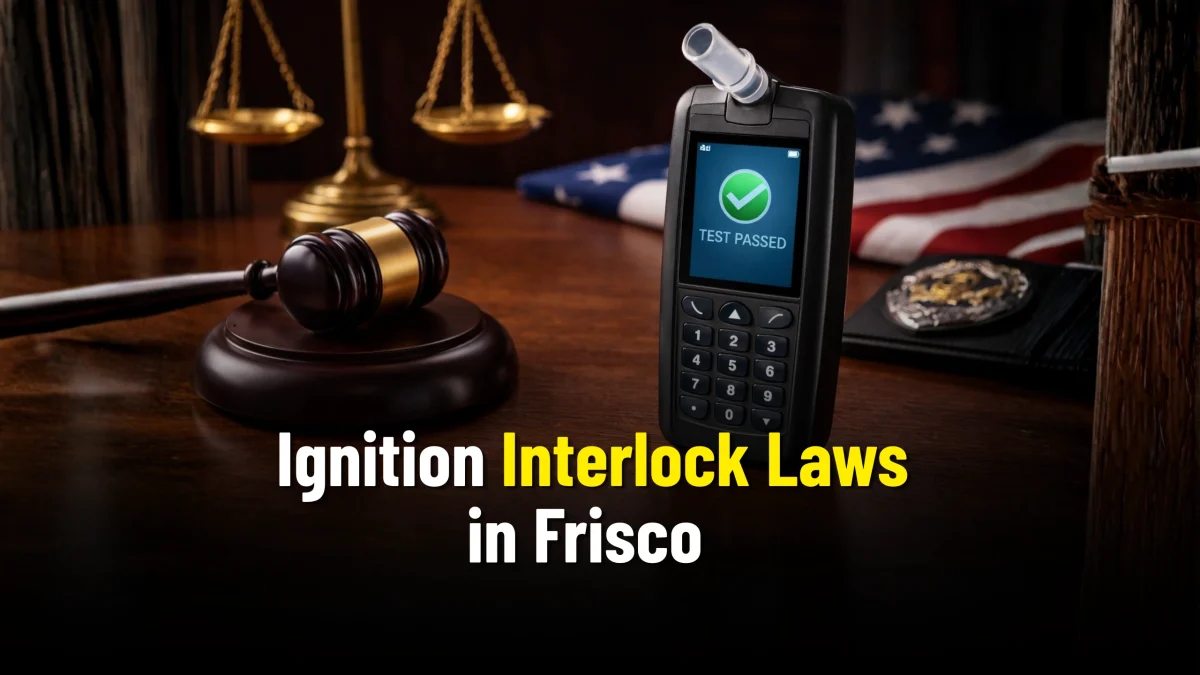
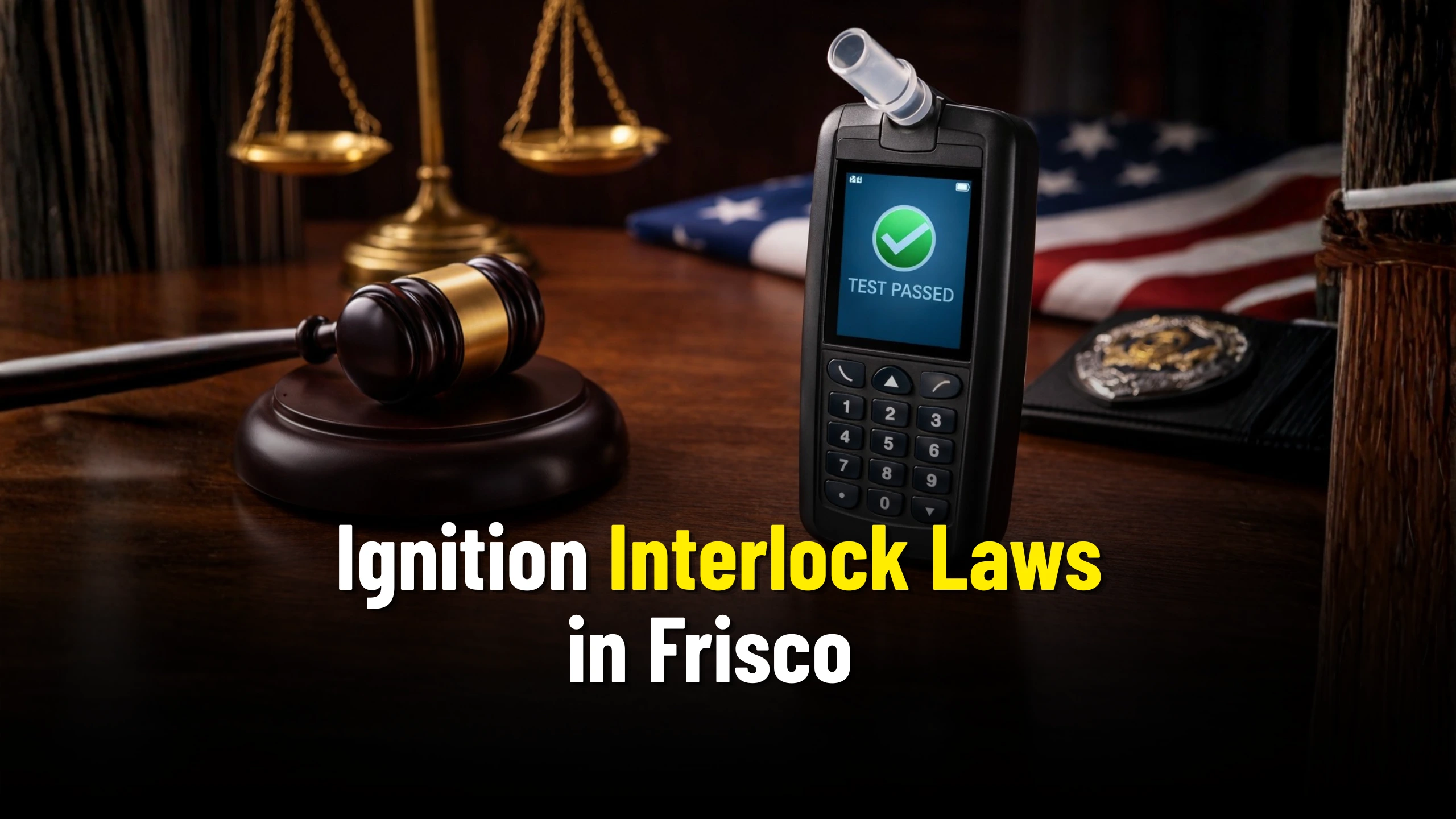
An Ignition Interlock Device is a mini-breathalyzer wired directly into your vehicle’s ignition system. Before the engine can start, the driver must blow into the device. If the unit detects an alcohol concentration above a preset limit (typically $0.02\%$ or $0.03\%$ in Texas, which is well below the legal impairment limit of $0.08\%$), the vehicle will not start.

Furthermore, the device requires “rolling retests.” While you are driving, the unit will randomly signal you to pull over safely and provide another breath sample. This prevents a driver from having a sober friend blow into the unit to start the car and then driving off while intoxicated.

All of this data, every startup, every rolling retest, and every lockout, is recorded and sent to the monitoring agency, the probation office, or the court. Understanding the ignition interlock laws in Frisco and how to manage this technology is critical to surviving the DWI process in North Texas. If you want to protect your ability to commute, mastering the daily mechanics of the DWI interlock device used in Texas is mandatory.

When Is An Interlock Device Mandatory In Frisco?

Under the current Texas ignition interlock law, there are two primary scenarios where a judge will order you to install a device: as a condition of your pre-trial bond, or as a condition of probation or license reinstatement.

Condition Of Bond (Pre-Trial)

In this, magistrate judges may require an ignition interlock device (IID) as a condition of release after a DWI arrest. Under Frisco’s ignition interlock laws, ignition interlock installation is mandatory for repeat offenses, a BAC of 0.15% or higher (an elevated Class A misdemeanor), or an arrest involving an accident causing injury.

Post-Conviction Probation

If your case results in community supervision (probation), the IID is often a mandatory condition. It must remain in your vehicle for the duration of your probation, and removing it without a court order is a direct violation of your probation.

Legal Insights Into Articles 17.441 And 17.40

The rules governing IID requirements are laid out in the Texas Code of Criminal Procedure. Two specific articles govern how North Texas judges enforce ignition interlock laws in Frisco.

Art. 17.441: Conditions Requiring Interlock

Art. 17.441 mandates that if a person is charged with a subsequent DWI offense, or if it is an intoxication assault/manslaughter case, the magistrate shall require the installation of an interlock device as a condition of release on bond. It removes judicial discretion for repeat offenses, making the device an automatic requirement.

Art. 17.40: General Conditions Of Bond

This Art. 17.40 allows judges to impose any reasonable condition on your bond to secure your appearance in court or to protect the safety of the community. This is the statute judges use to order an interlock device on a first-time DWI if they believe the circumstances of your arrest indicate you may be a danger to the public.

If a judge orders the device under these articles, you typically have 30 days from the date of release to have it installed and verify compliance with the court.

Occupational Driver's Licenses And Section 521.246

Learning to comply with ignition interlock laws in Frisco allows you to navigate Texas driving restrictions after DWI without losing your job. If your standard driver’s license is suspended because you failed or refused a breath/blood test, you can petition the court for an Occupational Driver’s License (ODL). ODL allows you to drive for essential purposes such as work, school, and household errands.

Under Section 521.246 of the Texas Transportation Code, if your license is suspended for an intoxication offense, the judge granting your ODL must require you to install an interlock device if you have a prior conviction, or if the court finds it is necessary.

Once the device is installed and verified, the restrictive hour and location limits on standard ODLs are often lifted. The IID essentially acts as your ticket to unrestricted driving, provided you remain completely sober behind the wheel.

Choosing An Approved Vendor

Ignition Interlock Laws in Frisco

You cannot simply buy a breathalyzer online and install it yourself. To comply with ignition interlock laws in Frisco, you must use a Texas-approved vendor. These vendors lease the equipment to you, install it, and calibrate it monthly. Popular approved vendors in the North Texas area include:

  • SmartStart: One of the most widely used ignition interlock vendors in Texas, SmartStart is known for its extensive network of service centers, making installation, calibration, and maintenance highly convenient for users.
  • Intoxalock: A popular choice among users, Intoxalock is known for its simple, button-free breathalyzer technology, reliable customer support, and flexible installation options.
  • LifeSafer: A well-established and reputable vendor, LifeSafer offers discreet, compact ignition interlock devices designed for user comfort, backed by years of industry experience and reliable monitoring services.
  • RoadGuard Interlock: Formerly known as Draeger, RoadGuard Interlock stands out for its advanced precision technology rooted in German engineering, delivering highly accurate readings and a strong reputation for safety and innovation.

When choosing a vendor, consider how close their calibration shop is to your home or office. You will need to take your vehicle to their shop every 30 to 60 days to have the data downloaded and the machine calibrated.

Understanding Soberlink In Alternative Monitoring Practices

What if you don’t own a car, or you share a vehicle with a spouse who doesn’t want to blow into a tube every time they run an errand? In some cases, your defense attorney can petition the court to allow portable alcohol monitoring instead of a vehicle-installed device.

A popular alternative in Frisco is Soberlink. Soberlink is a handheld breathalyzer that uses facial recognition to ensure the correct person is taking the test. The device sends cellular data directly to your monitoring officer at scheduled times of the day. It allows you to prove your sobriety without altering your vehicle’s mechanics.

Ignition Interlock Violation Penalties In Texas

The stakes of compliance are incredibly high. The device logs every attempt to start the car, every failed blow, and every missed rolling retest. These logs are sent to the court. If you register a “fail,” it is flagged as a violation. Ignition interlock violation penalties texas judges enforce include:

  • Bond Revocation: The judge can issue a warrant for your arrest and throw you back in jail until your trial.
  • Increased Sanctions: The judge can add more restrictions, such as continuous ankle monitoring (SCRAM) or house arrest.
  • Extension of Requirements: The court may extend the period you are required to keep the device installed.

It is important to understand that interlock devices are machines, and machines make mistakes. False positives are common. Everyday items like mouthwash, yeast-heavy breads, kombucha, energy drinks, and even certain cosmetic products contain trace alcohols that can trigger a failed test.

By working with a legal advocate who understands ignition interlock laws in Frisco, you can fight back against false positives. If you register a failure, you must act fast. Swish your mouth with water and retest immediately to confirm it was a temporary environmental reading. Then contact your attorney so they can file a preemptive defense explanation with the court.

Why You Need Aggressive Local Defense?

Ignition Interlock Laws in Frisco

North Texas prosecutors and judges take a zero-tolerance approach to interlock violations. If you are accused of tampering with a unit, skipping a test, or blowing a positive reading, you need an attorney who understands the science of false positives and how ignition interlock laws in Frisco are applied.

At L&L Law Group, we offer proactive defense tailored to local Collin and Denton County courtrooms.

  • We Understand Technical Defenses: We know how to challenge false readings caused by food, mouthwash, or mechanical failure.
  • We Navigate the Bureaucracy: We handle the paperwork for Occupational Driver’s Licenses and Section 521.246 compliance, keeping you legally on the road.
  • We Fight for Removal: As soon as you are legally eligible under the Texas ignition interlock law to have the device removed, we file the motions to have it removed from your car, saving you hundreds of dollars in lease fees.

Frequently Asked Questions

How Much Does An Ignition Interlock Device Cost In Frisco?

While the court orders the device, the state does not pay for it. You are responsible for all costs associated with Texas driving restrictions after DWI. Generally, installation fees range from $70 to $150. Monthly rental and lease fees typically range from $70 to $100. Additionally, you must pay for monthly or bimonthly calibration appointments. When budgeting for your DWI defense, it is important to factor in these recurring operational costs, as failure to pay the vendor can result in the vendor reporting you to the court. Strict adherence to ignition interlock laws in Frisco requires staying current on these fees.

Can Someone Else Drive My Car If It Has An Interlock Device Installed?

Yes, anyone can drive your car, but they must use the breathalyzer just like you do. This is a common point of anxiety for families sharing a single vehicle. If your spouse, teenager, or friend drives your car and registers a failed blow or misses a rolling retest, the violation is logged under your name, and you will be held accountable by the judge. It is vital that anyone driving your vehicle is thoroughly trained on how to use the device and knows exactly what foods or drinks to avoid before blowing.

What Happens If I Use Mouthwash And Fail A Startup Test?

Alcohol-based mouthwash is one of the most common culprits of false-positive readings in DWI interlock device Texas cases. The device measures breath alcohol, and mouthwash creates high concentrations of alcohol trapped in your mouth cavity, which can spike the reading. If this happens, do not turn the car off and walk away. Rinse your mouth vigorously with water, roll down your windows to clear the cabin, and wait the few minutes required for the machine to let you retest. Passing the immediate second test proves the first reading was mouth-alcohol, not blood-alcohol impairment.

How Long Do I Have To Keep The Interlock Device In My Car?

The duration depends entirely on the specific posture of your case. If ordered as a condition of bond, the device usually must remain in the vehicle until your case is completely resolved by a plea, trial, or dismissal. If ordered as part of post-conviction probation, it may be required for the entire length of your probation, though some judges allow for removal halfway through if you have perfect compliance. If ordered for an Occupational Driver’s License, it must remain until your suspension period ends and your standard license is reinstated.

Conclusion: Reclaiming Your Road To Freedom

An interlock device can feel like an invasion of privacy and a constant reminder of a difficult event. However, it is also a powerful tool that keeps you driving to work, picking up your kids, and living your life while your criminal case resolves.

By understanding ignition interlock laws in Frisco and partnering with a legal team that can defend you against false readings, you can survive this process without losing your livelihood. Master the DWI interlock device Texas uses so you do not suffer from sudden license revocations.

Contact L&L Law Group today. Our Trusted Legal Team is ready to take aggressive action to defend your rights and keep you on the road. Schedule your consultation now.

Section Title

Simplifying Data Breach Liability Law And Your Legal Risks

In the current digital landscape, data breach liability law makes it clear that a breach is no...

What Impacts The Role Of DNA Evidence In Criminal Cases In Texas?

DNA evidence in criminal cases in Texas carries immense weight with modern juries, often viewed as...

Possession Of Prohibited Weapons In Texas: What You Need To Know?

Possession of prohibited weapons in Texas is taken very seriously under state law, even though Texas...

Tampering With Evidence Texas: Hidden Felony Risks And Defense Strategies

Facing accusations of tampering with evidence Texas can be overwhelming, especially when the...

Cryptocurrency Fraud Charges in Frisco, Texas: What You Need to Know?

The legal landscape is shifting as the cryptocurrency fraud charges Texas residents face become a...

Wire Fraud Charges In Texas: Risks, Penalties, And Defense Strategies

Facing wire fraud charges in Texas can feel like the world is crashing down around you. The...

Kidnapping Charges In Frisco, Texas: A Defense Lawyer’s Perspective

Facing kidnapping charges in Frisco is one of the most serious legal situations an individual can...

Capital Murder Charges In Frisco, Texas: A Defense Lawyer’s Guide To High-Stakes Cases

Capital murder charges in Texas represent the most serious legal category in the state’s judicial...

How To Get Frisco Family Violence Charges Dismissed Or Dropped?

Frisco Family Violence Charges can feel overwhelming from the moment an arrest happens in North...
Categories
Criminal Defense

DWI vs. DUI In Texas: Which One Are You Facing In Frisco?

Blog

DWI vs. DUI In Texas: Which One Are You Facing In Frisco?

Reggie London

Reggie London

Difference between DWI and DUI Texas

If you have been pulled over in North Texas after a night out, you likely saw the terms DUI and DWI used interchangeably. However, under State law, these are two distinct offenses with different legal thresholds, penalties, and long-term consequences. Understanding the difference between DWI and DUI in Texas is critical to your defense.

Whether you are a college student home for the summer or a professional commuting through Collin County, an arrest for drunk driving can jeopardize your license, your career, and your freedom. This guide breaks down the complexities of DUI and DWI in Texas, helping you understand exactly what you are up against and how a Frisco DWI Lawyer can help you navigate the system.

The Fundamental Difference: DWI Vs. DUI Texas

To the average person, DUI vs. DWI in Texas sounds like a matter of semantics. In many other states, they are the same thing. In Texas, the distinction is based primarily on the driver’s age.

  • DWI (Driving While Intoxicated): This is the charge applied to adults (21 and older). It requires the state to prove you were “intoxicated,” meaning you lost the normal use of mental or physical faculties or had a Blood Alcohol Concentration (BAC) of 0.08% or higher.
  • DUI (Driving Under the Influence): This charge applies only to minors (under 21). Because of the Texas law against underage drinking, any detectable amount of alcohol in a minor’s system while operating a vehicle is enough for an arrest.

The difference between DWI and DUI Texas is significant: a DUI is a “Zero Tolerance” offense, while a DWI requires proof of actual impairment or a specific BAC level.

DWI Conviction In Texas: What Adults Need To Know?

Difference between DWI and DUI Texas

A DWI conviction in Texas is a serious mark on a criminal record. For an adult, a first-offense DWI is typically classified among Class B misdemeanors in Texas.

To secure a conviction, the prosecution must prove beyond a reasonable doubt that you were operating a motor vehicle in a public place while intoxicated. Intoxication can be proven through:

  • Breath or Blood Tests: A BAC of 0.08% or higher is “per se” intoxication.
  • Field Sobriety Tests: Observations of poor balance, slurred speech, or lack of coordination.
  • Officer Testimony: Observations of the smell of alcohol or bloodshot eyes.

Because the burden of proof is on the state, an experienced attorney will look for ways to suppress this evidence, particularly if your Miranda rights were not properly explained during the custodial interrogation.

DUI Charges In Texas: The Zero Tolerance Policy For Minors

For those under 21, DUI charges in Texas are handled differently. You do not have to be “drunk” to be charged with a DUI; you only need to have a “detectable amount” of alcohol in your system. This could be as little as the scent of alcohol on your breath.

A first-offense DUI for a minor is a Class C misdemeanor. While this may sound less severe than an adult DWI, it still carries mandatory alcohol awareness classes, community service, and a driver’s license suspension. Furthermore, if a minor is heavily intoxicated (over 0.08%), the state has the discretion to charge them with a full DWI, triggering adult-level penalties regardless of their age.

Standardized Procedures: From The Traffic Stop To The Station

Every drunk driving investigation follows a set of standardized procedures. Understanding these can help identify where the police may have made a mistake.

  1. The Stop: The officer must have “reasonable suspicion” to pull you over.
  2. Observation: The officer looks for “clues” of intoxication.
  3. Field Sobriety Tests: These include Horizontal Gaze Nystagmus (HGN), Walk-and-Turn, and One-Leg Stand.
  4. The Arrest: If the officer believes they have “probable cause,” you will be handcuffed and taken to the station.

At this point, your Miranda rights become crucial. You have the right to remain silent and the right to an attorney. Invoking your Fifth Amendment’s protection against self-incrimination is often the smartest move you can make during a roadside investigation.

Texas DWI Consequences: Fines, Jail, and Licenses

The Texas DWI Consequences for adults are designed to be punitive. A first-time conviction can result in:

  • Jail Time: Up to 180 days in county jail.
  • Fines: Up to $2,000 (plus state traffic fines that can reach $3,000–$6,000).
  • License Suspension: Up to one year.
  • Annual Surcharges: Fees required to keep your license active for three years following the conviction.

The long-term drunk driving penalties in Texas also include an increased insurance premium and a permanent criminal record that can affect future job opportunities.

Protecting Your Rights: The Fifth Amendment And Miranda

Difference between DWI and DUI Texas

Many people feel pressured to “prove” their sobriety by talking to the officer or performing tests. However, you are protected by the Fifth Amendment’s right to avoid self-incrimination.

If you are in custody and the police begin questioning you, they are required to read your Miranda rights. If they fail to do so, any statements you make might be inadmissible in court. A Frisco DWI Lawyer will meticulously review the police bodycam and dashcam footage to ensure your constitutional protections were upheld. If the police overstepped, it could lead to a significant reduction in charges or a total dismissal.

Drunk Driving Penalties In Texas: Administrative Vs. Criminal

It is a common misconception that you only have to worry about the judge. In reality, you face two different battles:

  • The Criminal Case: Handled in the court system, focusing on jail and fines.
  • The Administrative Case (ALR): Handled by the Department of Public Safety (DPS). This focuses solely on your driver’s license.

If you refuse a breath or blood test, or if you fail one, your license is subject to automatic suspension. You have only 15 days from the date of your arrest to request an Administrative License Revocation (ALR) hearing. If you miss this deadline, your license will be suspended automatically, regardless of what happens later in your criminal case.

Why Do You Need A Frisco DWI Lawyer?

North Texas prosecutors in Collin and Denton Counties are known for their aggressive stance on intoxication offenses. Navigating the DUI and DWI landscape in Texas requires more than just showing up to court. You need a defense that challenges the science and the procedure.

A dedicated lawyer will:

  • Review the calibration records of the breathalyzer machine.
  • Analyze the blood draw procedure for medical errors.
  • Challenge the officer’s interpretation of your field sobriety performance.
  • Represent you at the ALR hearing to keep you on the road.

Frequently Asked Questions

Is A DWI A Felony In Texas?

Typically, a first or second DWI is classified as one of the Class B misdemeanors in Texas. However, a DWI can be elevated to a felony if certain “aggravating factors” are present. These include having a child passenger under the age of 15 in the vehicle, causing serious bodily injury (Intoxication Assault), or causing a death (Intoxication Manslaughter). Additionally, a third DWI conviction is automatically a third-degree felony. Because the Texas DWI Consequences for a felony include years in prison, securing a Frisco DWI Lawyer early is vital.

What Happens If I Refuse A Breathalyzer Test In Frisco?

Under Texas “Implied Consent” laws, by driving on state roads, you have already agreed to provide a sample of your breath or blood if arrested for DWI. If you refuse, the drunk driving penalties in Texas include an automatic driver’s license suspension of 180 days for a first offense. While the police can often get a warrant to draw your blood anyway, refusing the roadside breath test prevents the officer from having immediate “per se” evidence of your BAC at the scene, though it does trigger the administrative suspension.

Can A DUI For A Minor Be Expunged?

Yes, Texas is somewhat more lenient with its law against underage drinking when it comes to long-term records for minors. If a minor is convicted of a single DUI, they may be eligible to have the conviction expunged from their record once they turn 21, provided they have not had any other alcohol-related convictions. This is a critical step in ensuring that DUI charges in Texas do not prevent a young adult from getting into college or securing their first professional job.

Will I Lose My License Immediately After A DWI arrest?

Not necessarily. At the time of arrest, the officer will likely take your plastic license and give you a paper temporary permit. This permit is valid for 40 days. However, you only have 15 days to request an ALR hearing to challenge the suspension. If you or your Frisco DWI Lawyer requests the hearing within that window, your driving privileges remain active until the hearing takes place. If you win the hearing, your license will not be suspended administratively.

Conclusion: Building Your Defense Strategy

Whether you are facing DUI charges in Texas as a minor or a DWI conviction in Texas as an adult, the path forward starts with a strategic defense. The difference between DWI and DUI Texas law means that your defense must be tailored to the specific charge and the specific facts of your stop.

Do not let a single night define your future. Protecting your rights under the Fifth Amendment and ensuring the police follow state law are the only ways to safeguard your reputation.

Contact L&L Law Group today. Our Trusted Legal Team – L and L Law Group is ready to review your case and provide the aggressive representation you need in Frisco. Reach out now to schedule your consultation.

Section Title

Simplifying Data Breach Liability Law And Your Legal Risks

In the current digital landscape, data breach liability law makes it clear that a breach is no...

What Impacts The Role Of DNA Evidence In Criminal Cases In Texas?

DNA evidence in criminal cases in Texas carries immense weight with modern juries, often viewed as...

Possession Of Prohibited Weapons In Texas: What You Need To Know?

Possession of prohibited weapons in Texas is taken very seriously under state law, even though Texas...

Tampering With Evidence Texas: Hidden Felony Risks And Defense Strategies

Facing accusations of tampering with evidence Texas can be overwhelming, especially when the...

Cryptocurrency Fraud Charges in Frisco, Texas: What You Need to Know?

The legal landscape is shifting as the cryptocurrency fraud charges Texas residents face become a...

Wire Fraud Charges In Texas: Risks, Penalties, And Defense Strategies

Facing wire fraud charges in Texas can feel like the world is crashing down around you. The...

Kidnapping Charges In Frisco, Texas: A Defense Lawyer’s Perspective

Facing kidnapping charges in Frisco is one of the most serious legal situations an individual can...

Capital Murder Charges In Frisco, Texas: A Defense Lawyer’s Guide To High-Stakes Cases

Capital murder charges in Texas represent the most serious legal category in the state’s judicial...

How To Get Frisco Family Violence Charges Dismissed Or Dropped?

Frisco Family Violence Charges can feel overwhelming from the moment an arrest happens in North...

Categories
Criminal Defense

Falsely Accused Of Domestic Violence? Frisco Defense Lawyer Advice

Blog

Falsely Accused Of Domestic Violence? Frisco Defense Lawyer Advice

Reggie London

Reggie London

Falsely accused of domestic violence in Texas

An allegation of domestic abuse can turn your world upside down in a matter of minutes. In Texas, law enforcement officers often operate under “must-arrest” mentalities when called to a domestic disturbance. This means that even if you have been falsely accused of domestic violence in Texas, you may find yourself in handcuffs before you have a chance to explain your side of the story.

The social stigma and legal repercussions of a domestic violence charge are severe. Beyond the immediate threat of jail time, a conviction can result in a permanent criminal record, the loss of your right to own a firearm, and restricted access to your children. Navigating this crisis requires more than just a general legal defense; it requires specific Texas domestic violence criminal defense strategies tailored to the unique landscape of North Texas courts.

If you or someone close to you is facing this situation in Dallas, Frisco, or elsewhere in Texas, it is important to understand the legal process and to seek professional guidance from a criminal defense attorney in Texas as early as possible.

The Reality Of False Allegations In North Texas

Falsely accused of domestic violence in Texas

While domestic violence is a serious issue that requires protection for true victims, the legal system is unfortunately prone to misuse. Being falsely accused of domestic violence in Texas often happens during high-stress life transitions, such as:

  • Divorce or Custody Battles: One party may fabricate an assault to gain an advantage in family court.
  • Retaliation: A partner may call the police out of anger following a verbal argument.
  • Self-Defense Misidentification: In a physical struggle where you were defending yourself, the police may mistakenly identify you as the primary aggressor.

In Frisco and the surrounding Collin County areas, prosecutors are aggressive. They often pursue cases even if the alleged victim later signs an affidavit of non-prosecution. This is why having a Texas domestic violence defense lawyer is critical from day one.

Understanding Texas Law And Domestic Violence Classifications

Domestic violence is governed by Texas law under the Family Code and the Penal Code. Unlike a standard assault, “Family Violence” involves a specific relationship between the parties, such as:

  • Current or former spouses.
  • Individuals who have a child together.
  • Current or former dating partners.
  • Members of the same household (roommates).

Under State law, an assault occurs if a person intentionally, knowingly, or recklessly causes bodily injury to another. Even “offensive contact” where no physical injury occurs can lead to an arrest if the relationship qualifies as family violence.

Penalties For Class A Misdemeanors And Beyond

Most first-time domestic violence charges are filed as Class A Misdemeanors. However, the penalties for Class A misdemeanors are far from minor. A conviction can result in:

  • Up to one year in the county jail.
  • A fine of up to $4,000.
  • Permanent loss of Second Amendment rights.
  • Ineligibility for future record sealing (non-disclosure) in many cases.

If the state alleges that the assault involved “impeding breath” (choking) or if you have a prior conviction, the charge is elevated to a third-degree felony, which carries a prison sentence of 2 to 10 years.

The Immediate Fallout: Protective Orders And Bond Conditions

When you are arrested for domestic violence in Frisco, the court will likely issue a Magistrate’s Order for Emergency Protection (MOEP). This order typically prevents you from:

  • Communicating with the accuser in any way.
  • Going near the accuser’s home or workplace.
  • Possessing a firearm while the order is in effect.

Violating these bond conditions can lead to your bond being revoked and new criminal charges being filed. A Frisco, Texas domestic assault defense attorney can work to modify these conditions so you can return to your home or see your children if the facts of the case warrant it.

Texas Domestic Violence Criminal Defense Strategies

Falsely accused of domestic violence in Texas

If you have been falsely accused of domestic violence in Texas, we utilize several Texas domestic violence criminal defense strategies to fight for a dismissal:

  • Self-Defense: Proving that you only used force to protect yourself from an initial attack.
  • Lack of Evidence: Demonstrating that the “bodily injury” alleged by the accuser did not actually occur.
  • Motive to Fabricate: Uncovering evidence (texts, emails, or witness statements) that shows the accuser had a reason to lie, such as an upcoming custody hearing.
  • Inconsistent Statements: Carefully analyzing the 911 call, the officer’s bodycam footage, and the written statement to find contradictions in the accuser’s story.

Why Do You Need A Frisco Domestic Violence Lawyer Immediately?

The moments following an arrest are a race against time. A Frisco domestic violence lawyer acts as a buffer between you and the state. We take over all communication with law enforcement to ensure you don’t inadvertently say something that can be used against you.

In Collin and Denton Counties, cases move quickly. We focus on getting into the prosecutor’s office early to present our side of the story before a formal indictment or “information” is filed. Our goal is always to have the case “no-billed” by a grand jury or dismissed by the prosecutor before it ever reaches a courtroom.

Challenging The Evidence: From 911 Calls To Medical Records

In many domestic cases, the evidence is purely testimonial. However, we dig deeper. We review:

  1. Forensic Evidence: If an assault allegedly caused injury, are there photos? Do the medical records support the claim?
  2. Digital Footprints: Text messages sent before and after the incident often reveal the true nature of the dispute.
  3. Witness Statements: Were there neighbors or children present who saw what really happened?

A Texas domestic violence defense lawyer knows that the “truth” presented in a police report is often just a one-sided narrative. Our job is to provide the full context.

Frequently Asked Questions

Can The Victim Drop The Charges In A Texas Domestic Violence Case?

In Texas, the victim does not have the authority to “drop” the charges. Once the police make an arrest, the case belongs to the State of Texas, represented by the District Attorney. Even if the accuser signs an “Affidavit of Non-Prosecution” stating they no longer wish to pursue the case, the prosecutor may still proceed if they believe they have sufficient evidence. This is why a Texas domestic violence lawyer is essential to negotiate directly with the state and highlight the weaknesses in their evidence.

What Happens If I am Convicted Of A Class A Misdemeanor For Family Violence?

The penalties for Class A misdemeanors involving family violence are unique. Unlike other misdemeanors, a family violence conviction carries a lifelong ban on firearm possession under federal law (the Lautenberg Amendment). Additionally, you will be ineligible to ever have your record sealed via a petition for non-disclosure. This means the conviction will be visible to any employer or landlord for the rest of your life, making it one of the most damaging “minor” offenses in State law.

Will I Be Forced To Move Out Of My House If I’m Accused Of Domestic Violence?

Frequently, yes. When a Magistrate’s Order for Emergency Protection is issued, it often includes a provision requiring you to stay a certain distance away from the accuser’s residence—even if your name is the only one on the deed or lease. This can effectively “kick you out” of your own home for up to 61 or 91 days. A Texas domestic violence defense lawyer can sometimes file a motion to modify these orders, but until then, violating the order is a separate criminal offense.

How Long Does A Domestic Violence Case Take In Frisco?

Domestic violence cases in Collin and Denton Counties can range from a few months to over a year. The process involves multiple stages, including the initial appearance, discovery (in which we review the state’s evidence), and pretrial hearings. If the case cannot be dismissed or resolved through a plea bargain for a non-violent offense, it may proceed to a jury trial. Your Frisco, Texas, domestic assault defense attorney will work to resolve the matter as quickly as possible while ensuring your rights are fully protected.

Conclusion: Reclaiming Your Reputation

Being falsely accused of domestic violence in Texas is a terrifying experience, but it does not have to be the end of your story. The most dangerous thing you can do is wait and hope the truth comes out on its own. The system is designed to process cases, not necessarily to find the truth, which is the job of your defense. 

By acting quickly and securing a Frisco, Texas domestic assault defense attorney, you can challenge the allegations and protect your future. The consequences of a conviction are permanent, but with the right defense, you can fight to keep your record clean and your rights intact.

Contact L&L Law Group today. Our Trusted Legal Team – L and L Law Group is ready to stand by your side and provide the aggressive, strategic defense you deserve.

Section Title

Simplifying Data Breach Liability Law And Your Legal Risks

In the current digital landscape, data breach liability law makes it clear that a breach is no...

What Impacts The Role Of DNA Evidence In Criminal Cases In Texas?

DNA evidence in criminal cases in Texas carries immense weight with modern juries, often viewed as...

Possession Of Prohibited Weapons In Texas: What You Need To Know?

Possession of prohibited weapons in Texas is taken very seriously under state law, even though Texas...

Tampering With Evidence Texas: Hidden Felony Risks And Defense Strategies

Facing accusations of tampering with evidence Texas can be overwhelming, especially when the...

Cryptocurrency Fraud Charges in Frisco, Texas: What You Need to Know?

The legal landscape is shifting as the cryptocurrency fraud charges Texas residents face become a...

Wire Fraud Charges In Texas: Risks, Penalties, And Defense Strategies

Facing wire fraud charges in Texas can feel like the world is crashing down around you. The...

Kidnapping Charges In Frisco, Texas: A Defense Lawyer’s Perspective

Facing kidnapping charges in Frisco is one of the most serious legal situations an individual can...

Capital Murder Charges In Frisco, Texas: A Defense Lawyer’s Guide To High-Stakes Cases

Capital murder charges in Texas represent the most serious legal category in the state’s judicial...

How To Get Frisco Family Violence Charges Dismissed Or Dropped?

Frisco Family Violence Charges can feel overwhelming from the moment an arrest happens in North...

Categories
Criminal Defense

How To Defend Against False Sexual Assault Allegations In Frisco & North Texas

Blog

How To Defend Against False Sexual Assault Allegations In Frisco & North Texas

Reggie London

Reggie London

sexual assault defense lawyer texas

Being accused of a crime you did not commit is a nightmare scenario, but when that accusation involves sexual misconduct or domestic violence, the impact is instantaneous and devastating. In the digital age, a single allegation can jeopardize your career, your social standing, and your freedom long before a jury ever hears the facts. If you are facing this crisis, knowing how to defend against false sexual assault allegations in Frisco with the help of sexual assault defense lawyer, Texas is the most important information you will ever acquire.

North Texas prosecutors take these cases very seriously. In cities like Frisco, McKinney, and Plano, law enforcement is trained to prioritize victim statements, which unfortunately means that a false or exaggerated claim can lead to an immediate arrest. Navigating the road back to your reputation requires a sophisticated strategy and the guidance of a seasoned sexual assault defense lawyer Texas residents trust to uncover the truth.

The Anatomy Of A False Allegation In North Texas

False allegations do not happen in a vacuum. In our experience as a sexual assault defense lawyer Texas firm, we often see these claims emerge from high-conflict life events. Common motivators include:

  • Child Custody Disputes: A parent may fabricate an allegation to gain the upper hand in family court.
  • Retaliation: A disgruntled partner may use an accusation as a weapon following a breakup.
  • Mental Health Issues: Complex psychological factors can sometimes lead to “misremembered” or entirely fabricated events.

Regardless of the motive, the Frisco, Texas, domestic assault defense attorney you hire must treat the allegation as a technical puzzle that needs to be dismantled piece by piece.

Immediate Steps: What To Do After An Accusation

If you learn that someone has made a report against you, your actions in the first 24 hours are critical.

  1. Maintain Absolute Silence: Do not call the accuser to “clear the air.” Anything you say can be twisted into an admission or used to charge you with witness tampering.
  2. Stay Off Social Media: Do not post about your innocence or the accuser’s character. Prosecutors monitor these platforms.
  3. Preserve Everything: Save all texts, emails, and GPS location data. These are often the “silent witnesses” that prove your innocence.
  4. Hire Counsel Immediately: Before talking to a detective, ensure you have a Texas domestic violence lawyer to act as your shield.

The Intersection Of Sexual Assault And Domestic Violence

sexual assault defense lawyer texas

In Frisco and across Collin County, sexual assault allegations frequently overlap with domestic disputes. When an accuser is a family member, household member, or someone you are dating, the state may apply a “Family Violence” enhancement.

This is where the role of a Texas domestic violence defense lawyer becomes dual-purpose. Not only must they fight the sexual nature of the charge, but they must also navigate the specific “No Contact” orders and bond conditions that accompany domestic cases. A Frisco, Texas, domestic assault defense attorney understands that these cases move fast and require a defense that addresses both the criminal and domestic aspects of the law.

Texas Penal Code: Understanding The Charges

The Texas Penal Code is the rulebook for these cases. Most sexual assault charges fall under Section 22.011, while domestic violence issues are often covered under Section 22.01 (Assault).

Understanding the Texas Penal Code is vital because it outlines exactly what the state must prove. For instance, in a sexual assault case, the state must prove a lack of consent. If we can prove that the encounter was consensual or, better yet, that the encounter never occurred, the state’s case fails under the very laws they are using to prosecute you.

Texas Domestic Violence Criminal Defense Strategies

When we represent clients in these high-stakes cases, we utilize specific Texas domestic violence criminal defense strategies to expose the truth:

  • The “Affidavit of Non-Prosecution”: While the DA ultimately decides to drop charges, a voluntary statement from an accuser admitting the claim was false is powerful evidence.
  • Inconsistent Statements: We compare the initial 911 call, the police statement, and the forensic interview. Lies often fall apart when the details change over time.
  • Alibi and Timeline Defense: Using cell tower data or surveillance footage to show you weren’t even present at the time of the alleged incident.

The Role Of Digital Evidence And Forensic Investigation

Texas domestic violence lawyer

To effectively defend against false sexual assault allegations in Frisco, we go beyond the police report. We employ private investigators to:

  • Review Digital Forensics: Did the accuser send a “normal” text five minutes after the alleged assault? Digital footprints rarely lie.
  • Analyze Medical Records: In cases alleging physical harm, medical exams (SANE kits) often show a lack of physical evidence consistent with the claim.
  • Background Checks: We look into the accuser’s history of similar reports or motives for financial or legal gain.

Challenging Credibility And Identifying Motive

In a “he-said, she-said” scenario, credibility is everything. A Texas domestic violence lawyer must be skilled at cross-examination. We look for the “Why.”

  • Is there a pending divorce?
  • Was there a recent threat made by the accuser?
  • Does the accuser have a history of making false statements?

Identifying the motive for a false allegation is the key to shifting the jury’s perspective from “accuser vs. defendant” to “truth vs. fabrication.”

Why L&L Law Group Is Your Choice For Frisco Defense?

Facing a life-altering felony requires a team that knows the Frisco and North Texas legal landscape intimately. At L and L Law Group:

  • We Are Local: We understand how Collin and Denton County prosecutors operate.
  • We Are Proactive: We don’t wait for the trial to start our defense. We work on “no-bill” cases at the grand jury stage.
  • We Protect the Whole Person: We know this affects your family and job. We work discreetly to protect your privacy while fighting the charges.

Frequently Asked Questions

How Can I Prove A Sexual Assault Allegation Is False?

Proving a negative is difficult, which is why we focus on evidence that contradicts the accuser’s story. To effectively defend against false sexual assault allegations in Frisco, we look for “objective” evidence like text messages, social media interactions, or GPS data that proves an alibi or shows a consensual relationship. Additionally, we look for a motive to lie, such as a pending custody battle. A sexual assault defense lawyer Texas can use these inconsistencies to create “reasonable doubt,” which is the legal standard required for an acquittal.

Can I Be Charged With Domestic Violence If There Was No Physical Injury?

Yes. Under the Texas Penal Code, an assault can occur if there is “offensive or provocative” contact or even a threat of imminent bodily injury. In Frisco, if the parties are in a “dating relationship” or live together, police will often make an arrest based solely on a verbal threat. This is why you need a Texas domestic violence defense lawyer who can argue that the contact was accidental, defensive, or that no threat actually occurred.

What Is A "No-Bill" And How Does It Help My Case?

A “No-Bill” occurs at the Grand Jury stage, before a case ever goes to a full trial. In Texas, every felony must be presented to a Grand Jury to determine whether there is sufficient evidence to move forward. Your Frisco, Texas, domestic assault defense attorney can often present a “defense packet” to the Grand Jury containing evidence of your innocence. If the Grand Jury issues a No-Bill, the charges are effectively dismissed, and you can often seek to have the arrest records expunged immediately.

Will I Lose My Job If I Am Falsely Accused Of Sexual Assault In Texas?

Texas is an “at-will” employment state, meaning an employer can often fire someone just based on an arrest or an allegation, especially in sensitive industries like education or healthcare. This makes the work of a Texas domestic-violence criminal-defense strategies firm even more urgent. We often work with our clients’ employers to explain the legal status of the case and emphasize that an accusation is not a conviction, helping to preserve your livelihood while we fight the criminal battle.

Conclusion: Reclaiming Your Life

A false allegation is a trauma, but it does not have to be your permanent reality. By acting quickly, preserving evidence, and securing a sexual assault defense lawyer Texas relies on for aggressive representation, you can fight back. You have rights under the Texas Penal Code, and we are here to ensure they are enforced.

The most dangerous thing you can do is wait and hope the truth comes out on its own. The system is designed to process cases, not necessarily to find the truth, which is the job of your defense.

Contact L and L Law Group today. Our Trusted Legal Team – L and L Law Group is ready to stand between you and these false accusations. Let us start building your defense now.

Section Title

Simplifying Data Breach Liability Law And Your Legal Risks

In the current digital landscape, data breach liability law makes it clear that a breach is no...

What Impacts The Role Of DNA Evidence In Criminal Cases In Texas?

DNA evidence in criminal cases in Texas carries immense weight with modern juries, often viewed as...

Possession Of Prohibited Weapons In Texas: What You Need To Know?

Possession of prohibited weapons in Texas is taken very seriously under state law, even though Texas...

Tampering With Evidence Texas: Hidden Felony Risks And Defense Strategies

Facing accusations of tampering with evidence Texas can be overwhelming, especially when the...

Cryptocurrency Fraud Charges in Frisco, Texas: What You Need to Know?

The legal landscape is shifting as the cryptocurrency fraud charges Texas residents face become a...

Wire Fraud Charges In Texas: Risks, Penalties, And Defense Strategies

Facing wire fraud charges in Texas can feel like the world is crashing down around you. The...

Kidnapping Charges In Frisco, Texas: A Defense Lawyer’s Perspective

Facing kidnapping charges in Frisco is one of the most serious legal situations an individual can...

Capital Murder Charges In Frisco, Texas: A Defense Lawyer’s Guide To High-Stakes Cases

Capital murder charges in Texas represent the most serious legal category in the state’s judicial...

How To Get Frisco Family Violence Charges Dismissed Or Dropped?

Frisco Family Violence Charges can feel overwhelming from the moment an arrest happens in North...

Categories
Criminal Defense

Penalties for Sex Crimes in Texas: Frisco Criminal Defense Insights

Blog

Penalties for Sex Crimes in Texas: Frisco Criminal Defense Insights

Reggie London

Reggie London

Sex crime penalties Texas

In the Texas legal system, few accusations carry a heavier social and legal burden than those involving sexual misconduct. A conviction for a sex-related offense doesn’t just result in a prison sentence; it creates a lifelong label that affects your ability to work, live, and maintain relationships. Because the stakes are so high, understanding the sex crime penalties Texas laws enforce is a necessity for anyone facing an investigation or arrest in North Texas.

Navigating these cases requires a nuanced approach that addresses both the immediate criminal charges and the long-term administrative hurdles like the sex offender registry. Whether you are dealing with allegations of sexual assault or improper sexual contact, having a proactive criminal defense attorney Frisco residents can rely on is the first step in protecting your future.

The Classification Of Sex Crimes Under Texas Law

Texas classifies sex crimes based on the nature of the act, the age of the parties involved, and the presence of force or coercion. Common charges range from misdemeanors to first-degree felonies.

  • Indecency with a Child: Often charged under Section 21.11, this involves specific physical contact or exposure.
  • Sexual Assault: Defined broadly as non-consensual penetration.
  • Aggravated Sexual Assault: Involves the use of a deadly weapon, serious bodily injury, or victims under a certain age.

The legal definitions of sexual contact are often the pivot point upon which a case turns. A Texas sex crime defense lawyer will meticulously review the prosecution’s evidence to determine if the legal threshold for these specific definitions was actually met.

Texas Sexual Assault Laws And Penalties

Sex crime penalties Texas

When discussing Texas sexual assault laws and penalties, it is important to recognize that these are rarely simple cases. Texas law prioritizes the protection of victims, which means the prosecution often has significant resources at its disposal.

For a standard sexual assault charge, the state typically classifies the offense as a second-degree felony. However, if aggravating factors are present, such as the victim being elderly, disabled, or if the act involved a “date rape” drug, the charge can be elevated to a first-degree felony. The goal of a frisco texas sexual assault defense attorney is to identify inconsistencies in the complainant’s story or procedural errors in the investigation that could lead to a reduction or dismissal of these charges.

21.11 And 22.011 Sections Of The Texas Penal Code

The backbone of sex crime prosecution in Texas rests on specific statutes.

Section 21.11: Indecency with a Child

This section covers both contact and “exposure.” Because “contact” can be interpreted broadly by law enforcement, many innocent interactions are sometimes mischaracterized as criminal. Under Section 21.11, the state must prove intent to arouse or gratify sexual desire.

Section 22.011: Sexual Assault

This is the primary statute for non-consensual acts. It covers a wide range of scenarios, including those where consent cannot be legally given due to intoxication or mental incapacity. A criminal defense attorney Frisco will often look for evidence of “affirmative consent” or challenge the state’s claim regarding the defendant’s knowledge of the victim’s capacity.

The Impact Of Criminal Penalties For Sexual Assault In Texas

The criminal penalties for sexual assault texas imposes are among the harshest in the country.

  • Second-Degree Felony: 2 to 20 years in the Texas Department of Criminal Justice and a fine of up to $10,000.
  • First-Degree Felony: 5 to 99 years (or life) in prison and a fine of up to $10,000.

Unlike many other crimes, sex crime convictions often carry a “deadly weapon finding” or specific “special movements” that can limit a person’s eligibility for parole. This makes the initial defense stage the most critical part of the process.

The Texas Sex Offender Registry: A Lifelong Consequence

Perhaps the most daunting aspect of sex crime penalties Texas enforces is mandatory sex offender registration. Under Chapter 62 of the Texas Code of Criminal Procedure, many convictions require the individual to register for 10 years or, in many cases, for life. Registration affects:

  • Housing: Restrictions on how close you can live to schools, parks, or daycares.
  • Employment: Many employers are prohibited from hiring registered offenders.
  • Travel: Mandatory check-ins and public notification when moving to a new area.

A Texas sex crime defense lawyer understands that avoiding the registry is often just as important to a client as avoiding jail time.

Defense Strategies: How A Frisco, Texas Sexual Assault Defense Attorney Fights Back

Sex crime penalties Texas

Defending against sex crime allegations requires a combination of forensic science and aggressive cross-examination. Common strategies include:

  • Challenging Forensic Evidence: DNA evidence is not always as conclusive as the prosecution claims. Contamination, improper storage, or “transfer DNA” can all lead to false positives.
  • False Allegations: In high-conflict divorces or custody battles, false accusations sometimes arise. We investigate the motives behind the report.
  • Consent: If the encounter was consensual, we gather digital evidence (texts, social media) to demonstrate the nature of the relationship.
  • Procedural Errors: If the police conducted a search without a warrant or interrogated you without reading your rights, we move to suppress that evidence.

Collateral Consequences Beyond The Courtroom

The criminal penalties for sexual assault in Texas aren’t the only thing you have to worry about. The “collateral consequences” can destroy a reputation overnight. This includes the loss of professional licenses, expulsion from educational institutions, and the permanent digital footprint of an arrest record.

Because Frisco is a tight-knit and rapidly growing community, the social stigma of an allegation can be felt immediately. This is why our firm focuses on “discreet but aggressive” advocacy to protect your name while we fight the legal battle.

Why Choose L&L Law Group For Your Frisco Criminal Defense?

When searching for a criminal defense attorney in Frisco, you need more than just a legal representative; you need a team that understands the specific culture and prosecutorial tendencies of Collin and Denton Counties.

  • Proactive Investigation: We don’t wait for the state to hand over discovery. We begin our own investigation to find the facts that help you.
  • Constitutional Focus: We are dedicated to ensuring that your rights under the Fourth and Fifth Amendments are never trampled.
  • Personalized Strategy: Every case is unique. Whether your case involves complex digital forensics or witness testimony, we tailor our approach to your specific needs.

Frequently Asked Questions

Can A Sex Crime Charge Be Dropped If The Victim Doesn't Want To Prosecute?

In Texas, the decision to drop charges lies solely with the District Attorney, not the complainant. While a victim’s desire not to proceed (often expressed through an Affidavit of Non-Prosecution) is a strong factor, the state may still proceed if it believes it has sufficient evidence to prevail at trial. A Texas sex crime defense lawyer can use a complainant’s lack of cooperation to highlight the weaknesses in the state’s case, often leading to a dismissal or a reduction in charges during the pre-trial phase.

What Is The Difference Between "Sexual assault" And "Sexual contact" In A Criminal Case?

The distinction is vital for sex crime penalties Texas sentencing. Sexual assault (Section 22.011) generally refers to non-consensual penetration and is typically a second-degree felony. Sexual contact is a broader term often used in Indecency with a Child (Section 21.11) or Sexual Assault cases to describe any touching of the anus, breast, or any part of the genitals with the intent to arouse or gratify. While “contact” may sound less severe, in the context of a minor, it carries significant felony penalties and mandatory registry requirements.

Is It Possible To Avoid The Sex Offender Registry In Texas?

Avoiding the registry is one of the most common goals for a criminal defense attorney Frisco. There are limited ways to avoid it: securing an acquittal (Not Guilty) at trial, having the charges dismissed, or negotiating a plea to a non-registrable offense (such as simple assault or disorderly conduct). In some specific “Romeo and Juliet” cases involving teenagers, or through specific deferred adjudication outcomes for certain lower-level offenses, a person may be eligible for “deregistration” later, but the safest way to avoid the registry is through an aggressive defense at the outset.

How Long Do Sexual Assault Investigations Usually Last In Frisco?

Investigations for sex crimes can last anywhere from a few days to several months. Because these cases often rely on forensic evidence (DNA, computer forensics) and forensic interviews with complainants, the process is rarely fast. During this time, it is vital to have a frisco texas sexual assault defense attorney acting as a buffer between you and law enforcement. Engaging an attorney during the investigation phase, before an arrest is even made, can sometimes prevent a formal charge from being filed by presenting exculpatory evidence to the detective early on.

Conclusion: Immediate Action For Your Freedom

The moment you become aware of a sex crime investigation, the clock is ticking. Admissions made during an “initial interview” or “voluntary statement” to the police are often used as the foundation for a conviction. By understanding the sex crime penalties Texas laws mandate and securing a Frisco, Texas sexual assault defense attorney early, you give yourself the best chance at a favorable resolution. Don’t let an allegation define the rest of your life. Protect your rights, your reputation, and your future starting today.

Contact L and L Law Group today. Our Trusted Legal Team – L and L Law Group is ready to provide the sophisticated defense you need to navigate these serious allegations.

Section Title

Simplifying Data Breach Liability Law And Your Legal Risks

In the current digital landscape, data breach liability law makes it clear that a breach is no...

What Impacts The Role Of DNA Evidence In Criminal Cases In Texas?

DNA evidence in criminal cases in Texas carries immense weight with modern juries, often viewed as...

Possession Of Prohibited Weapons In Texas: What You Need To Know?

Possession of prohibited weapons in Texas is taken very seriously under state law, even though Texas...

Tampering With Evidence Texas: Hidden Felony Risks And Defense Strategies

Facing accusations of tampering with evidence Texas can be overwhelming, especially when the...

Cryptocurrency Fraud Charges in Frisco, Texas: What You Need to Know?

The legal landscape is shifting as the cryptocurrency fraud charges Texas residents face become a...

Wire Fraud Charges In Texas: Risks, Penalties, And Defense Strategies

Facing wire fraud charges in Texas can feel like the world is crashing down around you. The...

Kidnapping Charges In Frisco, Texas: A Defense Lawyer’s Perspective

Facing kidnapping charges in Frisco is one of the most serious legal situations an individual can...

Capital Murder Charges In Frisco, Texas: A Defense Lawyer’s Guide To High-Stakes Cases

Capital murder charges in Texas represent the most serious legal category in the state’s judicial...

How To Get Frisco Family Violence Charges Dismissed Or Dropped?

Frisco Family Violence Charges can feel overwhelming from the moment an arrest happens in North...

Categories
Criminal Defense

Texas DUI Penalties: What To Expect In Frisco And Collin County?

Blog

Texas DUI Penalties: What To Expect In Frisco And Collin County?

Reggie London

Reggie London

Texas DUI Penalties

An evening out in Frisco or a commute through Collin County can change in an instant when flashing lights appear in the rearview mirror. If you have been arrested for driving under the influence, you are likely overwhelmed by one pressing question: What happens next? Texas DUI Penalties are among the most rigorous in the United States, designed to deter intoxicated driving through a combination of incarceration, heavy fines, and long-term administrative hurdles.

Understanding DUI charges in Texas is the first step toward protecting your future. Whether you or a loved one is charged with a Texas Law DUI First Offense, or if you are a seasoned veteran of the system, seeking early legal advice will allow you to review the facts of the case, protect your rights, and understand the benefits of working with a defense attorney to create a roadmap of what to do next.

The Legal Definition Of DUI Vs. DWI In Texas

In many states, DUI and DWI are used interchangeably. However, under Texas law, there is a distinct difference.

  • DWI (Driving While Intoxicated): This is the standard charge for adults (over 21) who have a Blood Alcohol Concentration (BAC) of 0.08% or higher, or who have lost the normal use of their mental or physical faculties due to alcohol or drugs.
  • DUI (Driving Under the Influence): In Texas, “DUI” is a term reserved specifically for minors (under age 21). Because Texas has a “zero tolerance” policy, a minor can be charged with a DUI for having any detectable amount of alcohol in their system.

While this blog focuses on the broader spectrum of drunk driving penalties in Texas, it is essential to know which statute applies to your specific situation.

Texas Law DUI First Offense

For most adults, a Texas Law DUI First Offense (technically a first-offense DWI) is classified as a Class B Misdemeanor. While this is the lowest level of criminal offense that carries jail time, the “collateral consequences” can be devastating.

A first-time arrest often feels like a blur of field sobriety tests, breathalyzers, and booking procedures. In Frisco and Collin County, prosecutors are known for being thorough, meaning you need a defense strategy that addresses both the criminal charges and the preservation of your driving privileges.

DUI Punishment Texas: Jail Time And Financial Costs

The statutory DUI punishment Texas provides for a first-offense conviction, which includes:

  • Jail Time: A minimum of 72 hours and up to 180 days in the Collin County Jail. If there was an open container in the vehicle at the time of arrest, the minimum jail time increases to six days.
  • Fines: A fine not to exceed $2,000.
  • Community Service: Typically ranging from 24 to 100 hours.
  • Probation: Community supervision may be an option, but it comes with strict requirements, including drug and alcohol testing and potential installation of an ignition interlock device (IID).

Drunk Driving Penalties In Texas For Underage Drivers

Texas DUI Penalties

Because of the zero-tolerance policy, Texas DUI Penalties for minors are unique. A first-offense DUI for a minor is a Class C Misdemeanor, which typically does not carry jail time but includes:

  • A fine of up to $500.
  • 20 to 40 hours of community service related to alcohol education.
  • Mandatory attendance in an alcohol awareness program.
  • A 60-day driver’s license suspension.

If the minor is over 17 and has a high BAC, the state may elevate the charge to DWI, triggering the much harsher penalties for adults.

The Penalty For First DUI In Texas: Administrative Consequences

Beyond the courtroom, the Penalties for a first DUI in Texas include administrative actions taken by the Texas Department of Public Safety (DPS).

Administrative License Revocation (ALR)

When you are arrested, the officer will likely confiscate your plastic license and issue a temporary paper permit. You have exactly 15 days from the date of arrest to request an  Administrative License Revocation hearing. If you fail to do so, your license will be automatically suspended for 90 days (if you failed a breath/blood test) or 180 days (if you refused the test).

Maximum Fine For Drinking And Driving Over 21 In Texas

Many people ask about the maximum fine for drinking and driving over 21 in Texas. While the standard Class B Misdemeanor fine is $2,000, the true financial burden is much higher.

In addition to the court-ordered fine, Texas previously utilized a “surcharge” system. While the surcharge system was repealed, it was replaced by state traffic fines. For a first-time DWI conviction within a 36-month period, you may face an additional fine of $3,000. If your BAC was 0.15% or higher, that fine jumps to $6,000.

When you factor in legal fees, increased insurance premiums, and court costs, a single conviction can easily cost upwards of $15,000.

Enhancements: When Penalties Become More Severe

Not all DUI charges in Texas are created equal. Specific factors can “enhance” a misdemeanor to a felony:

  • DWI with Child Passenger: If a passenger under 15 is in the car, you face a State Jail Felony, punishable by up to 2 years in a state jail facility and a $10,000 fine.
  • High BAC (0.15%+): If your breath or blood test results are nearly double the legal limit, the charge is elevated to a Class A Misdemeanor, doubling the potential jail time to one year and the fine to $4,000.
  • Intoxication Assault/Manslaughter: If the accident resulted in injury or death, the penalties escalate to 2nd or 3rd-degree felonies.

Navigating The Collin County Court System

Frisco sits primarily in Collin County, a jurisdiction known for its “law and order” reputation. The Collin County District Attorney’s office rarely dismisses DUI charges in Texas without a significant legal fight.

Cases are heard at the Russell A. Steindam Courts Building in McKinney. Success in these courtrooms requires a defense team that understands judges’ local preferences and the specific evidentiary standards required by Collin County prosecutors. From challenging the calibration of the Intoxilyzer 9000 to questioning the officer’s administration of the Walk-and-Turn test, local insight is indispensable.

Frequently Asked Questions

What Is The Total Cost Of A First-Time DUI In Texas?

While the penalty for a first DUI in Texas includes a statutory fine of up to $2,000, the actual cost is much higher. Once you account for the mandatory state traffic fine (up to $3,000 or $6,000), court costs, bail, vehicle impound fees, and the significant increase in auto insurance premiums, the total often exceeds $10,000 to $15,000. This doesn’t include the potential loss of income if your license is suspended or if you are forced to spend time in jail. Investing in defense is often the most cost-effective way to mitigate these long-term financial hits.

Can I Refuse A Breathalyzer Test In Frisco?

Technically, you can refuse, but Texas has an “implied consent” law. By operating a motor vehicle on Texas roads, you have already consented to a breath or blood test if arrested for DWI. If you refuse, the DUI punishment Texas becomes more certain in one area: your driver’s license will be automatically suspended for 180 days. Furthermore, Frisco police can often obtain a “no-refusal” blood warrant within minutes, meaning they will take your blood regardless of your consent. Refusal is a strategic decision that should be discussed with a legal representative immediately following an arrest.

Will I Lose My Job Over A Texas Law DUI First Offense?

Texas is an “at-will” employment state, meaning an employer can generally terminate an employee for any reason that isn’t illegal. A DWI conviction can be particularly damaging if your job requires a commercial driver’s license (CDL), involves operating a company vehicle, or requires a professional license (such as for nurses, pilots, or teachers). Even if you aren’t fired, the drunk driving penalties in Texas often include probation terms that could interfere with your work schedule. This is why fighting for a dismissal or a reduction to a non-alcohol-related charge is critical for professionals.

How Long Do DUI Charges Stay On My Record In Texas?

In Texas, a DWI or DUI conviction stays on your criminal record permanently. Unlike some other states, Texas does not have a “washout” period where old convictions disappear. However, recent changes in Texas DUI Penalties laws have made “non-disclosure” orders more accessible. If you successfully complete probation for a first-offense DWI and meet specific criteria (like having an ignition interlock for a certain period), you may be able to petition the court to seal your record from public view, though it will still be visible to law enforcement and certain state agencies.

Conclusion: Building A Strategic Defense

A DUI or DWI arrest does not have to result in a conviction. By understanding the Texas DUI Penalties and acting quickly to request your ALR hearing, you can begin to dismantle the state’s case against you. Whether it is through a motion to suppress evidence arising from an illegal traffic stop or by negotiating a reduction in charges, there are always avenues for advocacy.

The clock is ticking on your 15-day window to save your license. Don’t leave your reputation and your freedom to chance in the Collin County legal system.

Contact L and L Law Group today. Our Trusted Legal Team – L and L Law Group is ready to review the details of your arrest and build an aggressive, tailored defense to protect your future.

Section Title

Simplifying Data Breach Liability Law And Your Legal Risks

In the current digital landscape, data breach liability law makes it clear that a breach is no...

What Impacts The Role Of DNA Evidence In Criminal Cases In Texas?

DNA evidence in criminal cases in Texas carries immense weight with modern juries, often viewed as...

Possession Of Prohibited Weapons In Texas: What You Need To Know?

Possession of prohibited weapons in Texas is taken very seriously under state law, even though Texas...

Tampering With Evidence Texas: Hidden Felony Risks And Defense Strategies

Facing accusations of tampering with evidence Texas can be overwhelming, especially when the...

Cryptocurrency Fraud Charges in Frisco, Texas: What You Need to Know?

The legal landscape is shifting as the cryptocurrency fraud charges Texas residents face become a...

Wire Fraud Charges In Texas: Risks, Penalties, And Defense Strategies

Facing wire fraud charges in Texas can feel like the world is crashing down around you. The...

Kidnapping Charges In Frisco, Texas: A Defense Lawyer’s Perspective

Facing kidnapping charges in Frisco is one of the most serious legal situations an individual can...

Capital Murder Charges In Frisco, Texas: A Defense Lawyer’s Guide To High-Stakes Cases

Capital murder charges in Texas represent the most serious legal category in the state’s judicial...

How To Get Frisco Family Violence Charges Dismissed Or Dropped?

Frisco Family Violence Charges can feel overwhelming from the moment an arrest happens in North...

Categories
Criminal Defense

Aggravated Assault With A Deadly Weapon: Frisco, TX Defense Tips

Blog

Aggravated Assault With A Deadly Weapon: Frisco, TX Defense Tips

Reggie London

Reggie London

Aggravated assault with a deadly weapon sentence

An allegation of assault is serious, but when the state adds a “deadly weapon” enhancement, the legal stakes escalate instantly. In Texas, this charge is a high-level felony that carries the potential for decades in prison, even for those with a clean criminal record. For residents in Frisco and the surrounding North Texas areas, understanding the mechanics of an aggravated assault with a deadly weapon charge is the first step in building a defense that protects your freedom.

The transition from a misdemeanor to a felony often hinges on the presence of an object the state deems “deadly.” Because Texas law defines this term broadly, many individuals find themselves facing an aggravated assault with a deadly weapon sentence for actions they believed were mere self-defense or a simple, heated physical altercation.

If you or a loved one is facing an aggravated assault charge, do not wait for the situation to escalate further. Schedule a free consultation today and get clear, strategic guidance on your next steps. The sooner you act, the more options you may have to protect your record, your reputation, and your future.

Defining Aggravated Assault With A Deadly Weapon In Texas

Under the Texas Penal Code, a person commits aggravated assault if they commit a “simple” assault and either:

  1. Cause serious bodily injury to another person; or
  2. Use or exhibit a deadly weapon during the commission of the assault.

An aggravated assault with a deadly weapon charge is particularly dangerous because the state does not necessarily have to prove that the victim was actually injured. The mere act of “exhibiting” or brandishing a weapon while threatening someone is enough to trigger the aggravated status. This is often the case in domestic disputes or road rage incidents in Frisco, where a firearm or knife is shown but not used.

What Qualifies As A "Deadly Weapon"?

Aggravated assault with a deadly weapon sentence

In many jurisdictions, people think of “deadly weapon” as guns or knives. However, Texas law uses a much wider lens. A deadly weapon is defined as:

  • A firearm or anything manifestly designed, made, or adapted for the purpose of inflicting death or serious bodily injury; or
  • Anything that, in the manner of its use or intended use, is capable of causing death or serious bodily injury.

This means that common household items, such as a baseball bat, a heavy kitchen utensil, or even a motor vehicle, can lead to an aggravated assault with a weapon charge. If the prosecutor can argue that the object was used in a way that could have caused death, the enhancement applies.

Aggravated Assault Vs. Simple Assault With A Deadly Weapon

There is often confusion between a simple assault with a deadly weapon and the aggravated version. In reality, under Texas law, the use of a deadly weapon automatically “aggravates” the assault.

While some states might use the term battery with a deadly weapon sentence to describe the physical striking of a victim, Texas folds these actions into the assault statute. Furthermore, the prosecution may attempt to prove a premeditated assault with a deadly weapon if they believe there was a prior plan to cause harm, which can influence the judge’s leanings during the sentencing phase.

Sentencing And Punishment: What To Expect?

The aggravated assault with a deadly weapon punishment is governed by the rules for second-degree felonies, though it can be elevated to a first-degree felony in specific circumstances, such as domestic violence involving a weapon or an assault against a public servant.

  • Second-Degree Felony Sentence: 2 to 20 years in the Texas Department of Criminal Justice and a fine of up to $10,000.
  • First-Degree Felony Sentence: 5 to 99 years or life in prison.

Crucially, an aggravated assault with a deadly weapon sentence often comes with a “deadly weapon finding.” This is a massive blow to parole eligibility. Under Texas law, a deadly weapon finding requires the defendant to serve at least 50% of their sentence (or 30 years, whichever is less) before they are even eligible to be considered for parole.

The First-Time Offender: Aggravated Assault With A Deadly Weapon

If you are a first-time offender for aggravated assault with a deadly weapon, you may feel that your clean record will lead to leniency. While a lack of criminal history is a strong mitigating factor, the “deadly weapon” element makes these cases difficult.

The penalty for aggravated assault with a deadly weapon for a first-time offender still starts with the possibility of prison. However, an aggressive defense from an experienced criminal defense attorney can aim for:

  • Deferred Adjudication: A form of probation that, if completed successfully, results in the case being dismissed without a formal conviction.
  • Reduction of Charges: Working to get the “deadly weapon” language removed so the charge becomes a lower-level misdemeanor or a non-aggravated felony.

Defense Strategies: Intent And Self-Defense

Aggravated assault with a deadly weapon sentence

Building a defense against an aggravated assault with a deadly weapon charge requires looking at the specific facts of the encounter. Our criminal defense strategies are designed to challenge every aspect of the prosecution’s case.

  • Lack of Intent: In some cases, the defense focuses on aggravated assault with a deadly weapon without intent to kill. If we can show that the “weapon” was handled accidentally or that there was no intent to threaten or cause harm, the foundation of the state’s case begins to crumble.
  • Self-Defense and Defense of Others: Frisco residents have the right to defend themselves and others. If you exhibited a weapon because you reasonably believed it was necessary to protect yourself against someone else’s use of unlawful force, the law provides a justification.
  • Challenging the “Deadly” Nature of the Object: If the object used was not a firearm, we can often challenge whether its “manner of use” truly rose to the level of being capable of causing serious bodily injury.

Why Choose L&L Law Group For Your Frisco Defense?

Navigating the Collin and Denton County court systems requires a team that understands the local nuances of felony prosecution. At L&L Law Group, we offer:

  • Sophisticated Investigation: We don’t just take the police report at face value. We look for surveillance footage, witness statements, and forensic evidence.
  • Tailored Advocacy: Whether you are facing an aggravated assault with a deadly weapon first offense or a more complex situation, we build a strategy specific to your life.
  • Focus on Results: Our goal is always to avoid prison time and, whenever possible, secure a dismissal or a “no-bill” from the grand jury.

Frequently Asked Questions

Is Probation Possible For An Aggravated Assault With A Deadly Weapon, First Offense?

Yes, probation (specifically deferred adjudication) is a possibility for a first-time offender for aggravated assault with a deadly weapon. However, because it is a “3g” offense (serious felony), a judge is the only one who can grant community supervision if the case goes to trial and a deadly weapon finding is made. If a plea agreement is reached, the prosecutor can recommend deferred adjudication. Securing this outcome requires demonstrating to the court that the incident was an isolated incident and that the defendant is not a danger to the community.

What Is The Difference Between Assault And Battery With A Deadly Weapon Sentence?

While some states use the term “battery” to describe physical contact, the Texas Penal Code uses the term “Assault” to cover both the threat of harm and the actual physical contact. Therefore, a battery with a deadly weapon sentence in Texas is technically categorized as Aggravated Assault. If the assault causes “serious bodily injury” or involves the use of a weapon, it carries the same heavy felony penalties. The “deadly weapon” finding is what typically triggers the more severe sentencing requirements and parole restrictions.

Can I Be Charged With Aggravated Assault With A Deadly Weapon Without Intent To Kill?

Absolutely. You do not need an “intent to kill” to be charged with aggravated assault in Texas. The state only needs to prove that you acted intentionally, knowingly, or recklessly. For example, if you brandish a firearm to scare someone during an argument (reckless behavior) and they fear for their safety, that is an aggravated assault with a deadly weapon charge. The lack of intent to kill may help prevent the charge from being upgraded to Attempted Murder, but the penalty for aggravated assault with a deadly weapon remains a second-degree felony.

How Does A "Deadly Weapon Finding" Affect My Sentence?

A deadly weapon finding is a specific entry in a court’s judgment that has a massive impact on the aggravated assault with a deadly weapon sentence. Under Texas Government Code Section 508.145, if a deadly weapon finding is made, you are not eligible for parole until your actual calendar time served equals one-half of the sentence or 30 years. This means “good time” or “work time” credits do not count toward your parole eligibility. This makes the stakes of your defense even higher, as removing this finding is often a top priority for your legal team.

Conclusion: Protecting Your Future

An aggravated assault with a deadly weapon punishment can follow you for the rest of your life, affecting your right to own a firearm, your employment opportunities, and your freedom. The moment you are aware of an investigation or an arrest, you must act.

A charge is an allegation, not a final judgment. With the right approach and an early intervention, it is possible to navigate the aggravated assault with a deadly weapon sentence guidelines and reach a resolution that keeps your future intact.

Contact L and L Law Group today. Our Trusted Legal Team is ready to stand by your side and fight for your rights in Frisco and throughout North Texas.

Section Title

Simplifying Data Breach Liability Law And Your Legal Risks

In the current digital landscape, data breach liability law makes it clear that a breach is no...

What Impacts The Role Of DNA Evidence In Criminal Cases In Texas?

DNA evidence in criminal cases in Texas carries immense weight with modern juries, often viewed as...

Possession Of Prohibited Weapons In Texas: What You Need To Know?

Possession of prohibited weapons in Texas is taken very seriously under state law, even though Texas...

Tampering With Evidence Texas: Hidden Felony Risks And Defense Strategies

Facing accusations of tampering with evidence Texas can be overwhelming, especially when the...

Cryptocurrency Fraud Charges in Frisco, Texas: What You Need to Know?

The legal landscape is shifting as the cryptocurrency fraud charges Texas residents face become a...

Wire Fraud Charges In Texas: Risks, Penalties, And Defense Strategies

Facing wire fraud charges in Texas can feel like the world is crashing down around you. The...

Kidnapping Charges In Frisco, Texas: A Defense Lawyer’s Perspective

Facing kidnapping charges in Frisco is one of the most serious legal situations an individual can...

Capital Murder Charges In Frisco, Texas: A Defense Lawyer’s Guide To High-Stakes Cases

Capital murder charges in Texas represent the most serious legal category in the state’s judicial...

How To Get Frisco Family Violence Charges Dismissed Or Dropped?

Frisco Family Violence Charges can feel overwhelming from the moment an arrest happens in North...

Categories
Criminal Defense

Facing Felony DWI Charges In Frisco? Local Defense Strategies

Blog

Facing Felony DWI Charges In Frisco? Local Defense Strategies

Reggie London

Reggie London

Felony drunk driving charges Texas

A DWI arrest in North Texas is a high-stakes event, but when that charge is elevated to a felony, the consequences shift from inconvenient to life-altering. Texas is notorious for having some of the most stringent intoxication laws in the country. For those facing felony drunk driving charges, Texas law enforcement and prosecutors do not take these cases lightly.

In Frisco, where local police are proactive in monitoring traffic safety, a felony designation usually stems from specific aggravating factors, such as having multiple prior convictions or having a child passenger in the vehicle. Navigating this legal minefield requires a deep understanding of DWI charges in Frisco and local defense strategies to protect your rights, your driver’s license, and your freedom.

What Elevates A DWI To A Felony In Texas?

Most people assume a DWI is a misdemeanor, but a Texas felony DWI criminal defense becomes necessary when certain thresholds are crossed. Under state law, a DWI becomes a felony if:

  • Third Offense (or More): If you have two prior DWI convictions on your record, the third is automatically charged as a Third-Degree Felony.
  • DWI with Child Passenger: Operating a vehicle while intoxicated with a passenger under the age of 15 is a State Jail Felony.
  • Intoxication Assault: If the DWI resulted in serious bodily injury to another person.
  • Intoxication Manslaughter: If the DWI resulted in a fatality.

For individuals facing felony drunk driving charges, Texas prosecutors often seek maximum penalties. This is why immediate intervention from a legal team familiar with Frisco courtrooms is vital.

Texas Penal Code Chapter 49: The Legal Foundation

All intoxication offenses in the state are governed by Texas Penal Code Chapter 49. This chapter defines “intoxicated” as either having a blood alcohol concentration (BAC) of 0.08 or more, or not having the normal use of mental or physical faculties by reason of the introduction of alcohol or drugs.

The statute is broad, meaning a dwi lawyer frisco must scrutinize every detail of the stop. The prosecution must prove that you were intoxicated at the time of driving, not just at the time the blood or breath test was administered. If you are a younger driver facing these complexities, it is important to look into Underage DWI in Texas: Don’t Panic, Get L&L Law Group on Your Side to see how age impacts these specific statutes.

The Administrative Side: ALR Hearings And The DPS

A DWI case is actually two separate battles: the criminal case and the administrative case. When you are arrested, the Texas Department of Public Safety (DPS) will attempt to suspend your driver’s license.

Administrative License Revocation (ALR)

You have only 15 days from the date of your arrest to request an Administrative License Revocation (ALR) hearing. If you miss this deadline, your license will be automatically suspended.

The ALR hearing is a critical component of DWI defense strategies in Frisco. It allows your attorney to cross-examine the arresting officer and gather evidence that can be used later in the criminal portion of your case.

Challenging The Evidence: Field Sobriety Tests

Felony drunk driving charges Texas

Most DWI arrests begin with field sobriety tests. These usually consist of the Horizontal Gaze Nystagmus (HGN), the Walk-and-Turn, and the One-Leg Stand. While police present these as definitive evidence of intoxication, they are often flawed.

Officers must follow standardized procedures when administering these tests. If the officer was not properly trained, or if environmental factors such as uneven pavement, wind, or passing traffic interfered with the results, the reliability of the test can be called into question. A knowledgeable dwi lawyer Frisco will review the bodycam and dashcam footage to identify any deviations from these protocols.

DWI Charges In Frisco: Local Defense Strategies

Effective Texas felony DWI criminal defense requires a multi-pronged approach tailored to the specific court handling your case.

  • Motion to Suppress Evidence: If the initial traffic stop lacked “reasonable suspicion” or the arrest lacked “probable cause,” your attorney can file a motion to have the evidence, including blood or breath samples, thrown out.
  • Challenging Blood Draws: Blood tests are not infallible. Issues with the chain of custody, the calibration of the testing machines, or the qualifications of the person who drew the blood can lead to the suppression of evidence.
  • Rising BAC Defense: If your BAC was rising between the time of the stop and the time of the test, we can argue that you were not legally intoxicated while you were actually behind the wheel.

The Impact Of A Felony Conviction: Why Defense Matters?

Felony drunk driving charges Texas

The stakes for felony drunk driving charges in Texas are incredibly high. A conviction can lead to:

  • Prison Time: 2 to 10 years for a Third-Degree Felony.
  • Fines: Up to $10,000.
  • Loss of Civil Rights: You lose the right to vote and the right to own or possess a firearm.
  • Professional Impact: Many professional licenses are revoked upon a felony conviction.

Because the consequences are so permanent, it is essential to explore post-case options, such as L&L Expungement vs. Sealing Records, if your case resulted in a dismissal or deferred adjudication.

Choosing A DWI Lawyer In Frisco

When searching for Frisco DWI Defense Attorneys, you need a team that understands the local nuances of Collin and Denton Counties. While many firms claim to handle these cases, a felony charge requires a high level of technical proficiency.

Whether you are looking for Frisco first offense DWI attorneys to keep a mistake from escalating, or you need a defense against a third-time felony, your legal team must be prepared to go to trial. We focus on dismantling the prosecution’s case piece by piece, from the initial stop to the final lab results.

Frequently Asked Questions

What Is The Difference Between A DUI And A DWI In Texas?

In Texas, a DUI (Driving Under the Influence) is a charge specifically for minors (under age 21) who have any detectable amount of alcohol in their system. It is a Class C misdemeanor. A DWI (Driving While Intoxicated) applies to anyone, regardless of age, who meets the legal definition of intoxication. Because DWI is a more serious charge that can escalate to a felony, finding an experienced dwi lawyer Frisco is essential to ensure you are not overcharged and that your rights are protected throughout the process.

Can I Get A Felony DWI Off My Record In Texas?

Getting a felony DWI removed from your record is challenging, but it depends on the outcome. If your case was dismissed or you were found not guilty, you may be eligible for an expunction. If you completed deferred adjudication (available for certain offenses), you might be eligible to seal the record through a Petition for Non-Disclosure. For more information on your specific eligibility, it is helpful to review “L&L Expungement vs. Sealing Records” to understand the long-term options for clearing your criminal history.

What Happens If I Refuse The Breathalyzer Test In Frisco?

If you refuse a breath or blood test, the officer will likely apply for a search warrant to take your blood forcibly. Additionally, under “Implied Consent” laws, a refusal triggers an automatic license suspension by the Texas Department of Public Safety. You must request an ALR hearing within 15 days to fight this suspension. While a refusal can sometimes limit the evidence available to the state, it also creates immediate administrative hurdles that require strategic DWI defense strategies in Frisco to overcome.

How Long Does A DWI Stay On Your Record In Texas?

In Texas, a DWI conviction stays on your criminal record permanently unless it is successfully expunged or sealed. It never “drops off” like a traffic ticket might. Furthermore, Texas has a “look-back” period that lasts a lifetime for DWI enhancements. This means an arrest from 20 years ago can still be used to elevate a current charge to felony drunk driving charges Texas. This permanence is why securing a strong defense early is the most important step you can take for your future.

Conclusion: Taking The Next Step

A felony DWI charge is a threat to your future, but it is not a guaranteed conviction. By utilizing sophisticated DWI charges in Frisco local defense strategies and acting quickly to preserve your rights at the ALR stage, you can fight back against these allegations.

If you or someone close to you is facing felony DWI charges in Dallas, Frisco, or elsewhere in Texas, it is important to understand the legal process and to seek professional guidance from a criminal defense attorney in Texas as early as possible. Being informed about what options are available can make a significant difference in navigating the criminal justice system and protecting your future.

Contact L&L Law Group today. Our Trusted Legal Team – L and L Law Group is ready to provide the aggressive and strategic defense you need to navigate the North Texas court system.

Section Title

Simplifying Data Breach Liability Law And Your Legal Risks

In the current digital landscape, data breach liability law makes it clear that a breach is no...

What Impacts The Role Of DNA Evidence In Criminal Cases In Texas?

DNA evidence in criminal cases in Texas carries immense weight with modern juries, often viewed as...

Possession Of Prohibited Weapons In Texas: What You Need To Know?

Possession of prohibited weapons in Texas is taken very seriously under state law, even though Texas...

Tampering With Evidence Texas: Hidden Felony Risks And Defense Strategies

Facing accusations of tampering with evidence Texas can be overwhelming, especially when the...

Cryptocurrency Fraud Charges in Frisco, Texas: What You Need to Know?

The legal landscape is shifting as the cryptocurrency fraud charges Texas residents face become a...

Wire Fraud Charges In Texas: Risks, Penalties, And Defense Strategies

Facing wire fraud charges in Texas can feel like the world is crashing down around you. The...

Kidnapping Charges In Frisco, Texas: A Defense Lawyer’s Perspective

Facing kidnapping charges in Frisco is one of the most serious legal situations an individual can...

Capital Murder Charges In Frisco, Texas: A Defense Lawyer’s Guide To High-Stakes Cases

Capital murder charges in Texas represent the most serious legal category in the state’s judicial...

How To Get Frisco Family Violence Charges Dismissed Or Dropped?

Frisco Family Violence Charges can feel overwhelming from the moment an arrest happens in North...

Categories
Criminal Defense

Arrested In Dallas County Or Frisco? A Step-by-Step Timeline

Blog

Arrested In Dallas County Or Frisco? A Step-by-Step Timeline

Reggie London

Reggie London

Dallas County jail arrest process

Whether you are navigating the vibrant, high-traffic streets of Dallas or the rapidly expanding suburbs of Frisco, an arrest is a disorienting interruption that can leave you feeling powerless. In an instant, the weight of the Texas legal system feels personal, and the path forward can seem obscured by procedural fog. However, you do not have to walk this path alone or uninformed.

Understanding the Dallas County Jail arrest process and the specific Frisco, Texas, arrest procedure is the first vital step in reclaiming your agency and protecting your future. From the moment the handcuffs click to the critical 48-hour magistrate window, every second counts. This guide is designed to provide a clear, professional roadmap through the North Texas criminal justice system. We are here to transform your uncertainty into a strategic plan, ensuring your rights remain a priority as we work toward the fastest possible resolution and release.

The Immediate Arrest: Your Rights And The Initial Encounter

Every arrest in Texas must adhere to the Texas Code of Criminal Procedure. From the moment an officer detains you, you are protected by constitutional safeguards. Understanding your rights during arrest is paramount:

  • The Right to Remain Silent: Anything you say can and will be used against you.
  • The Right to an Attorney: You have the right to legal counsel before and during any questioning.
  • Protection Against Unlawful Search: Under the Texas Code of Criminal Procedure Article 38.23, evidence obtained in violation of the law or the Constitution cannot be used against you in court.

In Dallas and Frisco, law enforcement must follow these protocols. If an officer fails to respect these boundaries, it can become a primary pillar of your defense strategy.

The Dallas County Jail Arrest Process: Booking And Processing

Once you are transported to the Dallas County Jail (often the Lew Sterrett Justice Center), the booking phase begins. This is an administrative process in which jail staff record your information.

What Happens During Booking?

  • Inventory of Personal Property: Your belongings are taken and stored.
  • Fingerprinting and Photographs: Standard identification procedures.
  • Health Screening: A brief assessment to ensure you are fit for confinement.
  • Database Check: Staff will check for any outstanding warrants in other jurisdictions.

The Dallas County arrest process, Texas style, can be slow. Depending on how busy the facility is, booking can take several hours. During this time, you are processed into the system, and your specific charges are entered into the database used by the Dallas County District Courts.

The Frisco, Texas, Arrest Procedure: Local Nuances

Dallas County jail arrest process

If you are arrested within the city limits of Frisco, the Frisco, Texas, arrest procedure often begins at the Frisco Police Department’s holding facility. Unlike the massive central processing in Dallas, the Frisco jail is smaller, which can sometimes lead to faster initial processing.

However, depending on the severity of the charge (specifically felonies), you may eventually be transferred to the Collin County Jail in McKinney or the Denton County Jail, as Frisco sits within both counties. It is essential to know which county has jurisdiction over your case, as the Specific bail guidelines may differ between Collin and Denton.

The 48-Hour Rule And Magistrate Warnings (Art. 15.17)

Under Texas criminal law (Art. 15.17), you must be taken before a magistrate “without unnecessary delay,” but no later than 48 hours after arrest. This is often referred to as a “Magistrate Hearing” or “Initial Appearance.” During this hearing, the judge will:

  1. Formally inform you of the charges against you.
  2. Remind you of your rights.
  3. Set a bail amount.

It is important to note that, in specific circumstances, the state can technically hold a person for up to 72 hours without filing charges, but the magistrate hearing usually occurs much sooner. If the state fails to file a case within the window dictated by Article 17.151, you may be entitled to a bond reduction or a personal recognizance bond.

Understanding Bail And Bond In Dallas County

Dallas County jail arrest process

Securing a release is the top priority for any family. In Dallas County, a bail hearing determines the financial conditions of your release. The judge considers the nature of the offense and the safety of the community.

Types Of Bonds:

  • Cash Bond: Paying the full amount to the court, which is refunded (minus fees) after the case is resolved.
  • Bail Bond: Paying a percentage (typically 10%) to a bondsman who guarantees the full amount to the court.
  • Personal Recognizance (PR) Bond: A release based on a promise to appear, often reserved for non-violent, first-time offenders.

According to the State Bar of Texas and the American Bar Association, the primary purpose of bail is to ensure the defendant appears in court, not to serve as pre-trial punishment.

Arraignment And Formal Charges

Following the initial release or continued detention, the next major step in the Texas criminal case process after arrest is the Arraignment. This is the formal reading of the indictment or information.

During arraignment, which is governed by the Texas Rules of Criminal Procedure, you will enter a plea: Guilty, Not Guilty, or No Contest (Nolo Contendere). For most defendants, a plea of “Not Guilty” is entered at this stage to allow their legal team time to conduct an investigation and review the state’s evidence.

The Timeline After Arrest In Dallas, Texas: A Visual Summary

Understanding the timeline after arrest in Dallas, Texas, helps manage expectations. While every case varies, the standard flow is:

  1. Arrest & Transport: 1-3 hours.
  2. Booking (Dallas County Jail): 4-12 hours.
  3. Magistrate Hearing (Art. 15.17): Within 24-48 hours.
  4. Bail Posting & Release: 2-6 hours after the bond is set.
  5. First Court Appearance/Arraignment: 30-60 days later.

Why L&L Law Group Is Your Choice For North Texas Defense?

Navigating the Dallas County arrest process, Texas laws, and the complex Dallas County District Courts system is not something you should do alone. At L and L Law Group, we provide a sophisticated and aggressive approach to criminal defense.

  • Local Knowledge: We are intimately familiar with both the Dallas County Jail system and the Frisco police protocols.
  • Constitutional Advocacy: We leverage Article 38.23 of the Texas Code of Criminal Procedure to challenge the suppression of illegally obtained evidence.
  • Speedy Intervention: We work to get our clients before a magistrate and bonded out as quickly as possible, often utilizing Article 17.151 to challenge excessive detention.

Frequently Asked Questions

How Long Can Someone Be Held In The Dallas County Jail Without Being Charged?

In Texas, there is a distinction between being “arrested” and being “formally charged.” Generally, law enforcement can hold a person for up to 72 hours without filing charges with the District Attorney. However, under the Texas Code of Criminal Procedure, a person must be brought before a magistrate for a warning within 48 hours. If the state fails to file a formal “information” or “indictment” within certain timeframes (often 30 to 90 days depending on the level of the offense), Article 17.151 may require that the defendant be released on a reduced bond or personal bond.

What Is The Difference Between An Arrest In Frisco Vs. Dallas?

The main difference lies in the initial facility and the county jurisdiction. The Dallas County Jail Arrest Process takes place at the Lew Sterrett Justice Center. The Frisco, Texas, arrest procedure typically starts at the Frisco municipal jail. However, because Frisco is located in both Collin and Denton Counties, a defendant may be transferred to McKinney or Denton for long-term holding. While the Texas criminal case process after arrest is governed by state law, the specific administrative timelines and bond schedules can vary across county court systems.

What Happens At A Magistrate Hearing (Art. 15.17)?

A magistrate hearing is the first time a defendant sees a judge after their arrest. The judge will read the statutory “Magistrate Warnings,” which include the right to remain silent and the right to counsel. This is not a trial; the judge does not decide guilt or innocence. Instead, the primary function is to ensure the defendant understands their rights and to set a bail amount. If you have an attorney present or hired before this stage, they can argue for lower Specific bail guidelines to be applied, potentially saving you thousands in bond costs.

Can Evidence Be Thrown Out If The Police Didn't Read My Rights?

If police conduct a “custodial interrogation” without reading your Miranda rights, any statements you make may be inadmissible in court. Furthermore, Texas Code of Criminal Procedure Article 38.23 is even broader, stating that no evidence obtained in violation of any provisions of the Constitution or laws of the State of Texas shall be admitted in evidence against the accused. This means if the arrest itself was illegal or a search was conducted improperly, your defense attorney can file a motion to suppress that evidence, which often leads to a dismissal of the charges.

Conclusion: The Importance Of Immediate Action

The hours following an arrest are when the prosecution begins building its case. Statements made without an attorney, missed opportunities for bond reduction, and a lack of early investigation can haunt a case for months or years. Whether you are navigating the Dallas County Jail Arrest Process or a Frisco, Texas, arrest procedure, having an advocate who knows the local courtrooms is your greatest asset.

A criminal charge is an accusation, not a conviction. By understanding the timeline and exercising your rights, you can begin the journey toward a successful resolution.

Contact L and L Law Group today. Our Trusted Legal Team – L and L Law Group is ready to step in, protect your rights, and start fighting for your freedom in Dallas and Frisco.

Section Title

Simplifying Data Breach Liability Law And Your Legal Risks

In the current digital landscape, data breach liability law makes it clear that a breach is no...

What Impacts The Role Of DNA Evidence In Criminal Cases In Texas?

DNA evidence in criminal cases in Texas carries immense weight with modern juries, often viewed as...

Possession Of Prohibited Weapons In Texas: What You Need To Know?

Possession of prohibited weapons in Texas is taken very seriously under state law, even though Texas...

Tampering With Evidence Texas: Hidden Felony Risks And Defense Strategies

Facing accusations of tampering with evidence Texas can be overwhelming, especially when the...

Cryptocurrency Fraud Charges in Frisco, Texas: What You Need to Know?

The legal landscape is shifting as the cryptocurrency fraud charges Texas residents face become a...

Wire Fraud Charges In Texas: Risks, Penalties, And Defense Strategies

Facing wire fraud charges in Texas can feel like the world is crashing down around you. The...

Kidnapping Charges In Frisco, Texas: A Defense Lawyer’s Perspective

Facing kidnapping charges in Frisco is one of the most serious legal situations an individual can...

Capital Murder Charges In Frisco, Texas: A Defense Lawyer’s Guide To High-Stakes Cases

Capital murder charges in Texas represent the most serious legal category in the state’s judicial...

How To Get Frisco Family Violence Charges Dismissed Or Dropped?

Frisco Family Violence Charges can feel overwhelming from the moment an arrest happens in North...