Categories
Criminal Defense

Federal Criminal Lawyer for Mortgage Fraud

Blog

Federal Criminal Lawyer Tips for Mortgage Fraud Defense

Reggie London

Reggie London

Federal Criminal Lawyer

A federal criminal lawyer plays a crucial role in defending individuals accused of mortgage fraud, a serious offense that can lead to substantial penalties. With federal laws governing financial crimes, mortgage fraud charges often involve complex legal issues and require skilled legal representation. These cases often involve deceptive practices such as falsifying loan applications, misrepresenting income, or engaging in fraudulent property transactions. 

Understanding the intricacies of mortgage fraud and how a federal criminal lawyer can strategically navigate these challenges is essential for anyone facing such charges. This article will provide key insights and defense strategies that a seasoned federal criminal lawyer might employ to protect clients’ rights.

Understanding Mortgage Fraud

What is Mortgage Fraud?

Mortgage fraud is the act of intentionally misrepresenting or falsifying information on a mortgage application to obtain a loan or property under pretenses. This can involve inflating income, providing false documents, or using misleading information to secure a mortgage.

Common Types of Mortgage Fraud

Mortgage fraud schemes vary, but several types are commonly prosecuted federally:

  • Income Misrepresentation

Claiming higher wages, commissions, or other income than actually earned to qualify for loans. This can include doctored pay stubs or falsified tax returns. Income misrepresentation is among the most common causes of federal prosecution.

  • Appraisal Fraud

Inflating the value of a property to obtain a larger loan than it is worth. In Dallas Fort Worth, inflated appraisals have been linked to multi-million-dollar schemes, especially in high-demand residential markets.

  • Straw Buyer Schemes

Using another person’s identity, credit, or assets to secure a mortgage with no intent to repay. Straw buyers may be compensated or coerced, and all parties can face criminal liability.

  • Foreclosure Rescue Fraud

Misleading homeowners in distress by claiming they can prevent foreclosure in exchange for fees or falsified documents. The federal government prosecutes these schemes vigorously in Texas.

  • Equity Skimming

Acquiring a property through pretenses and collecting rental income without paying the mortgage leaves lenders at a loss.

Federal statutes such as 18 U.S.C. § 1014 (false statements to influence a financial institution) and 18 U.S.C. § 1344 (bank fraud) are commonly used in prosecution.

How Mortgage Fraud Is Prosecuted in Federal Court?

When a mortgage fraud scheme involves federally insured institutions, the case is typically handled in federal court, which follows strict procedural rules. Investigations are often conducted by agencies such as the FBI, HUD-OIG, and IRS Criminal Investigation, which examine loan documents, financial records, and communications to uncover evidence of wrongdoing. In Dallas Fort Worth, federal prosecutors pay close attention to misstatements that could materially affect lending decisions, the intent behind those statements, and the financial impact on lenders or investors.

Elements Prosecutors Must Prove

To secure a federal conviction, the government must prove several elements beyond a reasonable doubt:

  • A False or Fraudulent Statement

The defendant provided inaccurate, misleading, or incomplete information on loan applications, tax documents, or other financial records.

  • Knowledge and Intent

Prosecutors must show that the defendant knowingly submitted false information with the intent to defraud the lender or institution.

  • Materiality

The false statement must be significant enough to influence the bank’s decision to approve the loan. Minor mistakes or clerical errors usually do not meet this threshold.

  • Connection to a Federally Insured Institution

The mortgage or loan must involve a federally regulated bank or financial institution, which gives federal courts jurisdiction over the case.

Successfully defending a federal mortgage fraud case requires carefully challenging one or more of these elements.

Federal vs. State Charges in Texas

Mortgage fraud can also be prosecuted under Texas state law, particularly Texas Penal Code § 32.32, which covers making materially false statements to obtain mortgage benefits. Understanding the difference between federal and state prosecutions is critical for Dallas Fort Worth defendants.

Aspect Federal Charges Texas State Charges
Jurisdiction
Federally insured banks, cross-state schemes
State lenders, non-federal loans
Prison Time
Up to 30 years per count
Up to 99 years for high-value fraud
Fines
Up to $1 million per count
Up to $10,000
Restitution
Often mandatory
Possible
Court System
U.S. District Court
Texas State Court

Federal cases carry harsher penalties, require stricter proof of intent, and often involve federal investigative resources, making local legal expertise vital.

Penalties for Federal Mortgage Fraud

Convictions or guilty pleas carry severe consequences:

  • Imprisonment: Up to 30 years per federal statute.
  • Fines: Up to $1 million per count.
  • Restitution: Payment to victims is frequently required.
  • Professional Consequences: Real estate, finance, and business licenses may be revoked.

In Dallas Fort Worth, multi-million-dollar schemes often result in lengthy prison sentences and restitution obligations that can exceed millions.

Mortgage Fraud Cases in Dallas Fort Worth

Federal authorities have pursued numerous cases in Dallas Fort Worth, illustrating the seriousness of mortgage fraud enforcement:

  • Five defendants in a Dallas scheme were indicted for falsifying loan documents, resulting in over $22 million obtained fraudulently.
  • Individuals in Fort Worth and Flower Mound have faced mortgage fraud conspiracy charges, often resulting in multi-year federal sentences.
  • Courts regularly order substantial restitution alongside incarceration, emphasizing the financial consequences of federal convictions.

Defending Against Federal Mortgage Fraud Charges

Federal mortgage fraud defense requires early, strategic intervention. Common approaches include:

  1. Lack of Knowledge or Intent: Demonstrating that the defendant did not know the statements were false.
  2. Good Faith Belief: Showing reliance on third-party documentation or advice.
  3. Challenging Materiality: Arguing the alleged false statements did not materially affect the lender’s decision.
  4. Procedural Defenses: Raising motions to suppress improperly obtained evidence or addressing statute of limitations issues.

Local knowledge is critical. Experienced Dallas Fort Worth attorneys understand federal court tendencies, judges’ rulings, and prosecutorial strategies.

Role of a Federal Criminal Lawyer in Dallas Fort Worth

A federal criminal lawyer in Dallas Fort Worth plays a critical role in defending individuals accused of mortgage fraud. These cases involve complex financial transactions, multiple parties, and strict federal regulations, making professional legal guidance essential. Here’s how a skilled attorney can help:

Early Case Assessment

The lawyer reviews the government’s case at the outset to evaluate strengths, weaknesses, and potential defenses. By identifying issues early, they can develop a strategic approach tailored to the specifics of the DFW federal court system.

Evidence Review

In federal mortgage fraud investigations, attorneys frequently examine comprehensive financial documentation, including loan applications, appraisal reports, bank records, and tax filings. A lawyer carefully analyzes these documents to identify inconsistencies, errors, or gaps that could support the defense.

Pretrial Motions

Before trial, the attorney can file motions to dismiss charges, suppress improperly obtained evidence, or challenge procedural errors. These motions are critical in limiting the scope of the prosecution and protecting the defendant’s legal rights.

Negotiation

Experienced lawyers can negotiate with federal prosecutors to reduce charges, secure plea agreements, or explore alternative resolutions. In Dallas Fort Worth, familiarity with local federal courts and prosecutors can make these negotiations more effective.

Trial Representation

If the case proceeds to trial, the lawyer advocates for the defendant in court, presenting evidence, questioning witnesses, and challenging the government’s claims. Skilled representation ensures that the defendant’s rights are protected and increases the likelihood of favorable outcomes.

In all, having a federal criminal lawyer in Dallas Fort Worth is essential for navigating the complexities of mortgage fraud cases, from pretrial motions to trial strategy and potential negotiation opportunities.

Federal Mortgage Fraud: Possible Outcomes

Outcome Description
Dismissal
Prosecutors may dismiss charges when the available evidence does not convincingly prove the alleged crime.
Plea Agreement
Defendants may agree to plead guilty to lesser charges in return for reduced sentences or fines.
Conviction
Guilty verdict at trial with imprisonment and fines
Sentencing
Prison term, restitution, and fines based on federal guidelines

Each case is unique, and outcomes depend on evidence, prior history, and defense effectiveness.

Relevant Mortgage Fraud Statistics

Category Dallas Fort Worth / Texas / Federal Context
Historic Dallas Fort Worth federal indictments
Multiple schemes totaling millions in fraudulent loans
Maximum federal prison sentence
Up to 30 years
Fines per federal count
Up to $1 million
Average federal sentence nationwide
~2 years (varies)
Restitution amounts in Dallas Fort Worth cases
Often $1M–$25M+ depending on scheme size

Why Local Defense Matters in Dallas Fort Worth?

Dallas Fort Worth is within active federal jurisdictions. Judges, prosecutors, and court procedures vary by district, making local knowledge critical. Lawyers familiar with the area can advise on strategies, anticipate procedural hurdles, and leverage relationships with local legal personnel to benefit defendants.

Conclusion

If you or a loved one faces federal mortgage fraud charges in Dallas Fort Worth, securing an experienced federal criminal lawyer is crucial. Effective defense requires analyzing complex evidence, challenging government claims, and protecting legal rights throughout the process. Contact L & L Law Group to ensure skilled advocacy and a focused defense strategy.

Frequently Asked Questions

Q1. What Qualifies as Embezzlement Under Texas Law?

Federal mortgage fraud occurs when an individual knowingly provides false statements or omits important information to a federally insured bank or financial institution to influence a loan approval. In Dallas Fort Worth, this can involve falsifying income, inflating property appraisals, using straw buyers, or participating in foreclosure rescue schemes. Federal prosecutors must prove intent to deceive and material impact the lender’s decision. These cases are complex and often involve multi-million-dollar transactions. Having a federal criminal lawyer familiar with local courts and federal procedures is critical to building a strong defense and protecting legal rights.

Q2. What penalties exist for federal mortgage fraud in Texas?

Conviction for federal mortgage fraud in Texas carries severe consequences. Defendants may face imprisonment for up to 30 years per count, fines up to $1 million, and mandatory restitution to victims. Additionally, professional licenses in real estate, finance, or related fields can be revoked. Federal sentencing guidelines consider factors such as the total loss amount, the defendant’s role in the scheme, prior criminal history, and cooperation with authorities. In Dallas Fort Worth, multi-million-dollar schemes often result in long prison sentences combined with substantial financial obligations, emphasizing the need for immediate legal representation from an experienced federal criminal lawyer.

Q3. Can federal mortgage fraud charges be reduced or dismissed?

Yes, federal mortgage fraud charges can sometimes be reduced or dismissed depending on the case’s facts. A federal criminal lawyer may challenge elements such as intent, knowledge, or materiality. Defense strategies often include filing motions to suppress evidence obtained improperly, negotiating plea agreements, or presenting mitigating circumstances. Early legal intervention is crucial, as it allows attorneys to gather evidence, interview witnesses, and develop defenses before prosecutors strengthen their case. In Dallas Fort Worth, attorneys familiar with local federal courts and judges can leverage procedural knowledge and past case outcomes to increase the chances of reduced charges or alternative resolutions, potentially avoiding lengthy prison sentences.

Q4. How does a federal criminal lawyer help before trial?

A federal criminal lawyer plays a vital role before the trial begins. They review and analyze all evidence, interview witnesses, and investigate financial records to identify inaccuracies or procedural errors. Pretrial motions, such as motions to suppress evidence, may be filed to protect the defendant’s rights. Additionally, lawyers experienced in Dallas Fort Worth federal courts can negotiate with prosecutors to reduce charges or secure plea agreements. By assessing the strengths and weaknesses of the government’s case, a lawyer can create a strategic defense plan. Early legal guidance significantly improves the chances of favorable outcomes and helps clients understand potential risks and options.

Q5. Are mortgage fraud cases always federal?

No, not all mortgage fraud cases are prosecuted federally. If the loan involved is not federally insured, Texas state law may apply, and the case could be handled in state court. State prosecutions often carry different penalties, which may be less severe than federal sentences. However, federal cases generally involve stricter evidence requirements and harsher consequences, including longer prison terms and higher fines. In Dallas Fort Worth, understanding whether a case is federal or state is crucial for defense planning. Hiring a knowledgeable federal criminal lawyer ensures proper guidance, whether navigating federal procedures or advising on potential state-level implications.

Q6. What should I do if under investigation for mortgage fraud in Dallas Fort Worth?

If you are under investigation for mortgage fraud in Dallas Fort Worth, contact a federal criminal lawyer immediately. Avoid speaking with investigators or providing statements without legal counsel, as even minor misstatements can have serious consequences. A lawyer will review the evidence, advise on legal rights, and begin developing a defense strategy. Early intervention allows attorneys to interview witnesses, analyze documents, and file necessary motions to protect the client. Acting quickly is critical to reduce potential penalties, explore alternative resolutions, and ensure proper representation throughout pretrial, negotiation, or trial proceedings. Prompt legal action can significantly impact case outcomes.

Section Title

How To Identify And Avoid AI Scams In Texas, USA?

AI Scams in Texas are rising as cities like Frisco continue to grow and adopt new technology. The...

Legal Defense Strategies For Grooming Allegations In Texas

Grooming allegations in Texas carry serious legal weight. These cases move fast. They also involve...

What To Know When Facing Continuous Sexual Abuse Charges In Texas?

Continuous sexual abuse charges in Texas are taken very seriously under state law. In fact, these...

Drug Trafficking Charges In Texas: Legal Risks And Defense Strategies

Drug trafficking charges in Texas cases place you on the front line of federal and state drug...

Penalties And Legal Defense Strategies For Texas Federal RICO Charges

Facing federal RICO charges feels like a nightmare. Although Congress created these laws to target...

What to Do If Facing Embezzlement Charges in Texas?

Facing embezzlement charges in Texas is a serious and often life-altering situation. These cases...

Simplifying Data Breach Liability Law And Your Legal Risks

In the current digital landscape, data breach liability law makes it clear that a breach is no...

What Impacts The Role Of DNA Evidence In Criminal Cases In Texas?

DNA evidence in criminal cases in Texas carries immense weight with modern juries, often viewed as...

Possession Of Prohibited Weapons In Texas: What You Need To Know?

Possession of prohibited weapons in Texas is taken very seriously under state law, even though Texas...
Categories
Criminal Defense

White Collar Crime Federal Criminal Defense Attorney

Blog

Federal Criminal Defense Attorney White Collar Defense

Reggie London

Reggie London

Federal Criminal Defense Attorney

Facing white collar crime charges in Frisco can be overwhelming, but having a federal criminal defense attorney for white collar defense can make all the difference. Whether you’re facing fraud, embezzlement, or insider trading, the stakes are high, from your finances to your career and reputation. Without legal guidance, navigating federal law can feel impossible.

A skilled attorney will protect your rights, challenge the evidence, and build a strong defense strategy tailored to your case. In this article, we’ll explain the critical role of a federal criminal defense attorney in white collar cases and how they help clients fight complex charges effectively.

Understanding White Collar Crimes

White Collar crime encompasses a wide range of non-violent offenses committed for financial gain, typically involving fraud, deception, or the abuse of trust. These crimes often occur within corporate, governmental, or institutional settings, making them particularly complex and difficult to detect. Because of the nature of these offenses, they are often prosecuted at the federal level.

Federal White Collar Crime Charges

Federal White Collar crimes involve various illegal activities that generally target individuals or institutions for financial benefit. Below is a list of common offenses under federal law:

Charge Relevant Statute
Wire fraud
18 U.S.C. § 1343
Mail fraud
18 U.S.C. § 1341
Securities fraud
Federal Securities Laws
Bank fraud
18 U.S.C. § 1344
Healthcare fraud
18 U.S.C. § 1347
Tax evasion
26 U.S.C. § 7201
Money laundering
18 U.S.C. § 1956
Bribery and public corruption
18 U.S.C. § 201, § 666
Insider trading
15 U.S.C. § 78j(b)
Embezzlement
18 U.S.C. § 641, § 666
Conspiracy to commit any of the above
18 U.S.C. § 371

Federal Prosecution and Investigation

Due to their complexity and scope, white collar crimes often involve activities that span multiple states or impact federal institutions, leading to prosecution in federal court. These crimes are typically investigated by agencies such as the FBI, IRS, SEC, and U.S. Secret Service, which possess significant resources to uncover financial misconduct. Assistant U.S. Attorneys are responsible for prosecuting these cases, often facing the challenge of navigating intricate financial transactions and sophisticated fraud schemes.

Given the serious nature of these crimes and the federal resources behind their investigation, those facing federal White Collar charges should seek experienced legal representation to navigate the complex legal system and safeguard their rights.

The Federal White Collar Investigation Process

Federal white collar cases differ significantly from state-level prosecutions. Often, they begin quietly, with a grand jury investigation rather than immediate charges. You might first encounter the investigation through:

  • A target letter notifying you of scrutiny
  • A subpoena for documents or records
  • An unexpected visit from federal agents

In certain situations, a sealed indictment may lead to a sudden arrest, bringing public attention before you have a chance to respond.

How Federal Prosecutors Build Their Case?

By the time you become aware of the investigation, federal prosecutors may have already collected substantial evidence, including:

  • Financial statements and digital communications
  • Forensic accounting and proficient analysis
  • Bank records, emails, and other subpoenaed documents
  • Statements from co-defendants or cooperating witnesses

Understanding these procedures early is crucial for mounting a strategic defense and protecting your rights throughout the process.

The Role of a Federal Criminal Defense Attorney in White Collar Cases

Federal Criminal Defense Attorney

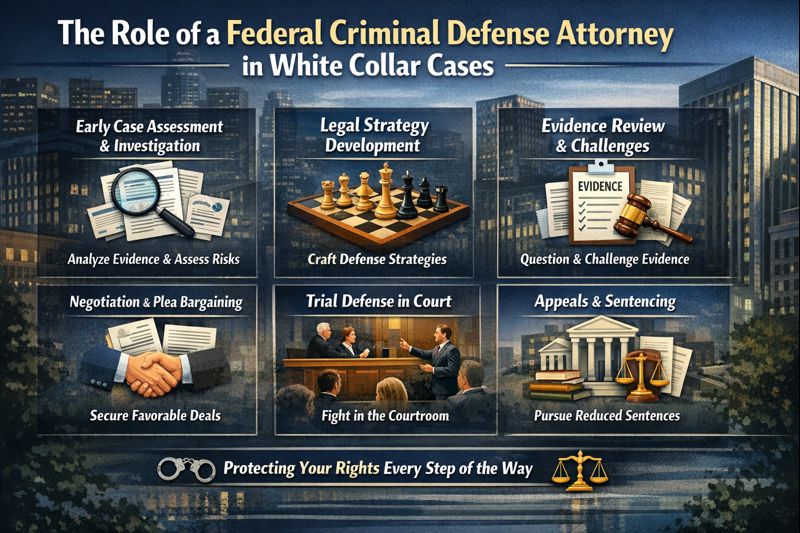
When facing white collar crime charges, a federal criminal defense attorney is crucial in safeguarding your rights and securing a fair defense. Their role spans the entire legal process, from early investigation through post-trial matters. Below is an overview of how an attorney helps throughout the case, including the common strategies they use to build a strong defense:

1. Early Case Assessment & Investigation

The first step a defense attorney takes is to thoroughly review the case. This includes analyzing all financial records, communications, and any information from government inquiries. Early intervention helps identify whether the defendant is a target or merely a witness, and enables the attorney to engage with investigators on the client’s behalf. This is key to avoiding mistakes or missteps that could harm the case.

Defense Strategy:
The attorney’s early involvement can help identify weaknesses in the government’s case, allowing for early evidence challenges or alternative strategies like negotiating to avoid full prosecution.

2. Legal Strategy Development

Once the facts are assessed, the federal criminal defense attorney creates a tailored strategy. This involves examining relevant federal laws, the likely prosecution approach, and crafting defense tactics to challenge the government’s case.

Defense Strategy:
A key strategy here is anticipating prosecution arguments and preparing to counteract them, especially by questioning financial records, forensic evidence, or the methods used by investigators to gather data.

3. Evidence Review and Challenge

A crucial part of defense work involves reviewing prosecution evidence for inconsistencies or flaws. The defense attorney scrutinizes the legitimacy of search warrants, financial data, and any evidence obtained.

Defense Strategy:
Challenging the evidence is vital; if the evidence is flawed, the defense can argue for its exclusion, weakening the prosecution’s case. This could lead to dismissing the case or reducing the severity of charges.

4. Negotiation and Plea Bargaining

In many cases, the attorney works out a plea agreement with the prosecution to reduce charges or penalties, such as opting for probation instead of prison time.

Defense Strategy:
Effective plea bargaining is essential when evidence is overwhelming, but the defendant’s cooperation can lead to reduced charges or a more lenient sentence.

5. Trial and Litigation Support

If the case proceeds to trial, the defense attorney is responsible for presenting the case in court, including challenging evidence, cross-examining witnesses, and crafting a narrative that raises reasonable doubt.

Defense Strategy:
During the trial, attorneys will highlight inconsistencies in testimony and question the credibility of key witnesses. The goal is to create doubt in the jury’s mind about the defendant’s guilt.

6. Post-Trial Matters (Appeals or Sentencing)

Even after a trial, the federal criminal defense attorney may continue advocating by appealing the verdict or seeking mitigating factors to reduce the sentence.

Defense Strategy:
Appeals or post-conviction motions can challenge legal errors or argue for a reduced sentence based on factors like the defendant’s cooperation or lack of intent.

Common Defense Strategies Used by Federal Attorneys

In addition to these fundamental steps, a federal criminal defense attorney relies on specific defense strategies tailored to the case. These strategies help to undermine the prosecution’s evidence and narrative:

1. Lack of Intent

In many white collar crime cases, the prosecution must prove intent. A defense strategy may focus on showing that the defendant did not intentionally commit the crime. This could be due to an honest mistake or a misunderstanding.

Example: A defendant accused of embezzlement may argue they were unaware of the wrongful action or thought they were entitled to the funds.

2. Insufficient Evidence

A common defense is that the prosecution has insufficient evidence to prove the defendant’s guilt beyond a reasonable doubt. If there are gaps in the evidence or the financial records are unclear, the defense can challenge the sufficiency of the case.

Example: If the prosecution’s case relies heavily on circumstantial evidence, the defense may argue that this doesn’t meet the standard of proof required for a conviction.

3. Procedural Errors

Federal cases are complex, and even small mistakes can impact the case. If investigators or the prosecution fail to follow proper procedures, such as violating the defendant’s rights or obtaining evidence unlawfully, the defense can seek to exclude that evidence.

Example: Improper handling of documents or evidence during investigation may lead to the case being dismissed or charges reduced.

4. Entrapment

Entrapment occurs when law enforcement induces the defendant to commit a crime they would not have committed otherwise. This defense is particularly relevant in cases involving undercover operations.

Example: A defendant in a bribery case might claim they were coerced by law enforcement agents into committing the offense.

5. Use of Specialist Witnesses

White collar crime cases often involve complex financial data. A defense attorney may use special witnesses, such as forensic accountants, to challenge the prosecution’s financial evidence or provide alternative interpretations of the data.

Example: A forensic accountant might testify that the financial transactions in question were legitimate or misinterpreted by the prosecution.

The Serious Consequences of a Federal Financial Crime

Federal white collar crime charges carry severe consequences that can drastically impact various aspects of an individual’s life. In addition to the potential for lengthy prison sentences, those convicted of federal financial crimes may face:

  • Substantial fines and restitution obligations to victims.
  • Asset seizure through forfeiture, including bank accounts, property, and business assets.
  • Revocation or suspension of professional licenses severely affects careers in law, finance, healthcare, and more.
  • Immigration repercussions for non-citizens, potentially leading to deportation or visa issues.
  • Loss of voting rights and the ability to possess firearms.
  • Severe damage to personal and professional reputation, which can tarnish an individual’s credibility and career prospects for years.

Federal courts rely on the U.S. Sentencing Guidelines, which factor in elements like the financial loss involved, the number of victims, the defendant’s role in the crime, and prior criminal history. These factors significantly influence sentencing and the severity of penalties imposed.

Given these far-reaching consequences, early intervention by an experienced federal criminal defense attorney is crucial. The sooner you seek legal help, the better equipped you’ll be to navigate these complex charges and protect your future.

The Importance of Early Legal Intervention

Facing federal white collar charges can be overwhelming, and the timeline from investigation to trial is often long and complex. Securing legal representation early is crucial for protecting your rights and building a strong defense.

From the moment you become a target, every action is scrutinized. Missteps, such as making statements or providing documents without guidance, can be used against you. A defense attorney ensures you handle interactions with investigators correctly and minimizes the risk of damaging errors.

Early involvement also allows your attorney to preserve and analyze evidence, interview witnesses, and review records before they are leveraged by prosecutors.

Key benefits of early legal intervention include:

  • Preventing costly mistakes: Guidance on how to respond to subpoenas, interviews, or document requests.
  • Strengthening your defense: Early evidence gathering and witness preparation to challenge the prosecution’s case.
  • Identifying weaknesses in the government’s case: Spotting procedural errors or gaps in evidence.
  • Exploring pre-charge negotiations: Potentially reducing charges, achieving alternative resolutions, or even dismissal.
  • Preparing for trial or plea negotiations: Ensuring you can make informed decisions and avoid hasty choices under pressure.

In federal White Collar cases, timing matters; the sooner you involve experienced counsel, the better your chances of safeguarding your freedom, assets, and reputation.

Conclusion

Facing white collar crime charges in Frisco can be a life‑changing experience, but with the help of a federal criminal defense attorney, you can protect your rights and work toward the best possible outcome. Whether you’re dealing with fraud, embezzlement, or insider trading, having the right legal representation is crucial. If you’re under investigation, act swiftly to secure the legal defense you need. Contact L & L Law Group today for a confidential consultation.

Frequently Asked Questions

Q1. What Are Common Examples of White Collar Crimes?

White collar crimes include non-violent, financially motivated offenses like fraud, embezzlement, insider trading, money laundering, and tax evasion. These crimes often involve deceit or violations of trust to gain financial advantages.

Q2. Why White Collar Crimes Are Federal Crimes?

White collar crimes are typically prosecuted at the federal level when they involve violations of federal statutes, such as securities laws or interstate activities, or when national agencies like the FBI, IRS, or SEC are involved in the investigation.

Q3. How Can a Federal Criminal Defense Attorney Help in White Collar Crime Cases?

A federal criminal defense attorney can challenge evidence, develop defense strategies, negotiate plea deals, and represent clients during trial to secure favorable outcomes. They will also navigate the complexities of federal law and the unique aspects of each case.

Q4. What Are the Consequences of a Federal White Collar Crime Conviction in Frisco?

A federal conviction for white collar crimes in Frisco can lead to significant penalties, including prison time, fines, restitution, and the loss of professional licenses. The consequences can deeply affect both personal and professional life.

Q5. How Long Does a Federal White Collar Crime Investigation Typically Last?

Federal investigations for white collar crimes can take several months to years, depending on the complexity of the case. Early legal intervention by a federal criminal defense attorney can help manage the investigation and ensure a proper defense strategy.

Section Title

How To Identify And Avoid AI Scams In Texas, USA?

AI Scams in Texas are rising as cities like Frisco continue to grow and adopt new technology. The...

Legal Defense Strategies For Grooming Allegations In Texas

Grooming allegations in Texas carry serious legal weight. These cases move fast. They also involve...

What To Know When Facing Continuous Sexual Abuse Charges In Texas?

Continuous sexual abuse charges in Texas are taken very seriously under state law. In fact, these...

Drug Trafficking Charges In Texas: Legal Risks And Defense Strategies

Drug trafficking charges in Texas cases place you on the front line of federal and state drug...

Penalties And Legal Defense Strategies For Texas Federal RICO Charges

Facing federal RICO charges feels like a nightmare. Although Congress created these laws to target...

What to Do If Facing Embezzlement Charges in Texas?

Facing embezzlement charges in Texas is a serious and often life-altering situation. These cases...

Simplifying Data Breach Liability Law And Your Legal Risks

In the current digital landscape, data breach liability law makes it clear that a breach is no...

What Impacts The Role Of DNA Evidence In Criminal Cases In Texas?

DNA evidence in criminal cases in Texas carries immense weight with modern juries, often viewed as...

Possession Of Prohibited Weapons In Texas: What You Need To Know?

Possession of prohibited weapons in Texas is taken very seriously under state law, even though Texas...
Categories
Criminal Defense

Child Sexual Assault Lawyer for Invasive Recording

Blog

Child Sexual Assault Lawyer for Invasive Visual Recording Cases

Reggie London

Reggie London

Child Sexual Assault Lawyer

A child sexual assault lawyer is essential when facing invasive visual recording charges in Texas, as these cases carry serious legal consequences. Under Texas Penal Code §21.15, it is illegal to secretly record or photograph someone’s private areas without consent, particularly in bedrooms, bathrooms, or changing areas. Recent amendments have expanded the law, including mandatory sex offender registration for convictions.

Navigating such cases can be complicated, involving privacy laws, consent issues, and handling electronic evidence. An experienced child sexual assault lawyer in Dallas Fort Worth helps protect your rights, challenge evidence, and explore possible defenses. 

Because these charges can result in severe penalties, especially when minors are involved, it is crucial to seek expert legal representation as early as possible. This blog will guide you through the legal framework, potential penalties, and defense strategies to understand why specialized counsel is so important.

Understanding Invasive Visual Recording in Child Sexual Assault Cases

Invasive visual recording cases in Texas involve highly sensitive situations and often include digital evidence, which makes them legally complex. Therefore, understanding the legal framework is crucial when addressing these offenses. Invasive visual recording is a specific crime under Texas Penal Code §21.15. 

Specifically, it occurs when someone secretly records or photographs another person’s intimate areas, such as their genitals, breasts, or buttocks, in private settings like bedrooms, bathrooms, or changing areas, without consent. Although the law applies to both minors and adults, the consequences are especially severe when minors are involved, including mandatory sex offender registration.

Additionally, these cases often involve creating, possessing, or distributing explicit images or videos of minors. Because digital content can be widely shared and permanently stored online, it can cause long-lasting emotional and psychological harm to the child.

How These Cases Differ from Other Forms of Child Sexual Abuse?

While all forms of child sexual abuse are devastating, invasive visual recording has its unique challenges due to its digital nature and the potential for widespread harm. Unlike physical abuse, which often has visible signs, invasive visual recording cases involve the creation and distribution of explicit material that can persist indefinitely. These images or videos can be shared across the internet, leading to continuous exposure and emotional distress for the victim.

Victims of visual recording crimes often experience long-term trauma, knowing their private images may be viewed repeatedly by strangers. The harm is compounded by the fact that, unlike physical abuse, the damage done in digital form is not as easily erased. The recordings can circulate on social media or other platforms, amplifying the victim’s suffering.

Moreover, these cases often require specialized technical expertise to investigate. Unlike physical abuse, where evidence is typically tangible, visual recording cases rely heavily on digital evidence, such as photos, videos, and metadata, which require expert analysis to ensure the proper handling and interpretation of the material.

Invasive Visual Recording Texas Legal Framework

Understanding the legal framework for invasive visual recording is essential for defending these charges. Texas Penal Code §21.15 makes it a crime to record or photograph someone’s intimate areas without their consent in a private setting, such as a bathroom, bedroom, or changing room.

Recent 2025 amendments have expanded the law to cover a wider range of private spaces, including hotel rooms, private homes, or any location where a person has a reasonable expectation of privacy. These changes have increased both the scope of the law and the severity of penalties.

Convictions under this statute can result in state jail felony charges, fines of up to $10,000, and mandatory sex offender registration for offenses occurring on or after September 1, 2025. By broadening the definition of “reasonable expectation of privacy,” the law now more effectively addresses digital exploitation and privacy violations, reflecting Texas’s growing focus on protecting individuals from invasive recordings.

Penalties for Invasive Visual Recording

The seriousness of an invasive visual recording charge is reflected in the penalties prescribed under Texas law.

Offense Jail Time / State Jail Sentence Fine Other Consequences
First offense (state jail felony)
180 days-2 years
Up to $10,000
Criminal record; effective Sept 1, 2025 ➝ sex‑offender registration applies
Distribution / Promotion of illicit visual material
Felony (as above) or other relevant statutes may apply
Fine & jail depending on severity
Registration and long-term consequences, especially if minors are involved

Recent changes (2025)

  • Offenses under §21.15 committed on or after September 1, 2025, now require registration under sex‑offender laws.
  • The “reasonable expectation of privacy” standard now covers all private places (not just bathrooms/changing rooms), broadening the law’s reach.

These changes elevate the seriousness of an Invasive Visual Recording charge. What may once have been handled as a lower-profile case now carries long-term consequences, including mandatory registration, public record, and implications for employment, housing, and personal reputation.

Understanding Defense Methods

Given the severe penalties and the complexity of the law, employing effective defense strategies is essential. An experienced child sexual assault lawyer can tailor the approach to the specific circumstances of each case. 

When defending clients against invasive visual recording charges in the Dallas Fort Worth area, a skilled child sexual assault lawyer carefully examines the evidence and uses a variety of strategies to protect the client’s rights. Some of the key defense strategies include:

1. Lack of Consent

One of the primary elements in an invasive visual recording case is whether the recording occurred without the individual’s consent. The defense may challenge the prosecution’s evidence by questioning whether consent was truly absent. 

For instance, the accused may argue that the individual in the recording gave permission, explicit or implicit, for the recording to take place, which could lead to a dismissal or reduction of charges.

2. Reasonable Expectation of Privacy

Under Texas law, for a recording to qualify as invasive, it must have been made in a place where the individual had a reasonable expectation of privacy, such as a bathroom, bedroom, or changing room. The defense can argue that the recording took place in a location that did not meet the legal definition of a private or protected space. 

For example, if the recording occurred in a semi-public area or a location where the person could not reasonably expect privacy, this argument could help reduce or eliminate the charges.

3. Evidence Integrity

In cases involving digital evidence, such as photos or videos, the defense will scrutinize the integrity of the evidence. This involves examining the chain of custody of the images or videos to ensure that they have not been tampered with or altered in any way. 

If there are discrepancies or concerns about how the evidence was handled or stored, this could cast doubt on the reliability of the prosecution’s case and potentially lead to the evidence being inadmissible in court.

4. Challenging the Intent

Texas law requires that the recording be made with the intent to invade someone’s privacy. The defense may argue that the accused did not have the intent to invade privacy or exploit the individual involved. 

For example, the lawyer might argue that the recording was made for a legitimate reason, such as for security purposes, or that the intent behind the recording was misunderstood. If the defense can create doubt about the accused’s intent, it could weaken the case against them.

These defense strategies can significantly impact the outcome of a case involving invasive visual recording charges in Dallas Fort Worth.  Depending on the facts of the case, a skilled attorney can challenge key aspects of the prosecution’s argument, helping to reduce the severity of the charges or potentially achieve a favorable resolution.

How a Child Sexual Assault Lawyer Helps?

Having discussed the complexities and defense strategies involved in invasive visual recording cases, it’s now crucial to understand the vital role a child sexual assault lawyer plays in navigating these legal challenges.

Invasive visual recording charges are complex, involving detailed legal principles and severe long-term consequences. When minors are involved, the stakes are even higher, as the law treats these offenses with particular gravity. A child sexual assault lawyer plays a crucial role in defending against such charges, offering specialized expertise to navigate the intricate aspects of these cases.

A skilled Dallas Fort Worth attorney will:

  • Thoroughly Investigate the Case: Investigating the facts and evidence is essential. A child sexual assault lawyer will carefully examine all elements of the case, including the location of the recording, the victim’s consent, and the privacy expectations involved.
  • Challenge Digital Evidence: In cases involving digital evidence, the integrity of the recordings is paramount. A child sexual assault lawyer will scrutinize the chain of custody of photos or videos, ensuring no tampering has occurred, and may argue that evidence should be excluded if mishandled.
  • Apply Recent Legal Changes: With the 2025 amendments to the law, a child sexual assault lawyer needs to understand how new definitions and requirements affect the case, such as mandatory sex offender registration and the expanded scope of “reasonable expectation of privacy.”
  • Assess Defense Strategies: A lawyer will tailor defense strategies to the unique facts of the case, potentially challenging consent, intent, and privacy, aiming to reduce or eliminate charges.

Beyond the legal aspects, being accused of invasive visual recording can have emotional and social repercussions, affecting a person’s reputation, career, and relationships. A child sexual assault lawyer offers not only legal defense but also critical support throughout the process. They ensure that their client’s rights are protected, guiding them through a difficult and stressful experience with professionalism and understanding.

With the high stakes and complexities involved, having a lawyer who is experienced in both child sexual assault and invasive visual recording cases is essential for anyone facing such charges.

Common Scenarios Leading to Invasive Visual Recording Charges

As previously discussed, invasive visual recording charges can stem from complex and sometimes ambiguous situations, making it vital for individuals to have a skilled child sexual assault lawyer. Understanding the real-world scenarios where these charges often arise can provide insight into how easily someone can face such allegations, and why expert legal defense is crucial.

Child Sexual Assault Lawyer

Common scenarios that lead to invasive visual recording charges include:

  • Hidden Cameras in Private Spaces: Secretly recording individuals in locations where they expect privacy, such as bathrooms, bedrooms, or changing rooms. This is a classic scenario where perpetrators install hidden cameras or use devices to capture intimate moments without the victim’s knowledge or consent.
  • Recording Minors in Private Settings: Even without explicit sexual acts involved, recording minors in private settings such as bedrooms, changing rooms, or locker rooms can result in invasive visual recording charges. These situations are particularly serious due to the involvement of vulnerable individuals, and the penalties are often more severe.
  • Sextortion and Coercion: Perpetrators may use manipulation or threats to coerce minors into producing explicit images or videos, leading to “sextortion.” These recordings can trigger invasive visual recording charges, as the victim’s privacy and consent are violated.
  • Sharing or Distributing Illicit Recordings: If the illegally obtained recordings are shared, transmitted, or uploaded to the internet or social media, the offender may face additional charges for distributing or promoting illicit visual material under Texas law.
  • Possession of Illicit Visual Material: Simply possessing recordings made without consent, even if they aren’t shared, can lead to invasive visual recording charges. In some cases, the mere act of capturing these images, without the intent to distribute them, can still trigger criminal liability.

Understanding these common scenarios emphasizes the importance of having a child sexual assault lawyer who can identify the unique aspects of the case and build a defense strategy based on the facts. The complexities involved in such cases require professional guidance to ensure a fair legal process.

Conclusion

If you or someone you know in Dallas Fort Worth is facing invasive visual recording allegations, whether alone or alongside other sexual offense charges, acting quickly is crucial. Engaging a dedicated child sexual assault lawyer can make the difference between a felony conviction and a more favorable outcome. Our firm carefully reviews every aspect of the case, including the recording circumstances, digital evidence, privacy context, age and consent considerations, and potential overlapping statutes. We work to protect clients from severe penalties, minimize long-term consequences, and defend their rights vigorously. You can contact a skilled child sexual assault lawyer from L & L Law Group to secure your rights and build a strong defense.

Frequently Asked Questions

Q1. What Exactly Qualifies as “Intimate Area” Under the Invasive Visual Recording Law?

Under Texas Penal Code §21.15, “intimate area” includes naked or clothed genitals, pubic area, anus, buttocks, and, in the case of females, any portion of the breast below the top of the areola. 

The law prohibits photographing, recording, or transmitting images of these areas without consent if the person has a reasonable expectation that the area is not subject to public view. This broad definition means that even clothed individuals may be protected under the statute depending on context and expectation of privacy.

Q2. Since 2025, Changes Broadened the Law; Does That Mean Any Private Place Is Covered?

Yes. As of the 2025 amendments, §21.15 now applies to recordings made anywhere a person reasonably expects privacy, not just bathrooms or changing rooms. That includes bedrooms, private residences, hotel rooms, changing areas, or any private place. 

This significantly expands the scope of the law, meaning that an accused cannot rely only on the argument that the recording took place outside a bathroom or locker room.

Q3. What Penalty Does a Conviction Under Invasive Visual Recording Carry in Texas?

A conviction for Invasive Visual Recording is a state jail felony. Punishment includes 180 days to 2 years in a state jail and a possible fine of up to $10,000.

In addition, if the offense occurred on or after September 1, 2025, the offender must register under sex-offender registration laws. These are serious consequences that can have long-term impacts on employment, housing, and personal life.

Q4. Is It Always Necessary to Register as a Sex Offender If Convicted?

For offenses committed on or after September 1, 2025, the amended statute makes Invasive Visual Recording a reportable conviction requiring registration under sex-offender laws. 

However, there might be exceptions depending on the exact offense date, jurisdiction, and whether deferred adjudication or plea deals are involved. Because these details matter a lot, having a lawyer who understands the 2025 changes is crucial.

Q5. Can a Defense Attorney Argue That What Was Recorded Didn’t Qualify Under the Statute?

Absolutely. A key defense strategy involves questioning whether the alleged recording truly captured an “intimate area,” or whether the person had a “reasonable expectation of privacy.” 

Consent, location, the nature of the recording, and the way evidence was obtained are all scrutinized. A skilled child sexual assault lawyer will review the facts, challenge the state’s evidence, and work to reduce or dismiss charges when possible.

Section Title

How To Identify And Avoid AI Scams In Texas, USA?

AI Scams in Texas are rising as cities like Frisco continue to grow and adopt new technology. The...

Legal Defense Strategies For Grooming Allegations In Texas

Grooming allegations in Texas carry serious legal weight. These cases move fast. They also involve...

What To Know When Facing Continuous Sexual Abuse Charges In Texas?

Continuous sexual abuse charges in Texas are taken very seriously under state law. In fact, these...

Drug Trafficking Charges In Texas: Legal Risks And Defense Strategies

Drug trafficking charges in Texas cases place you on the front line of federal and state drug...

Penalties And Legal Defense Strategies For Texas Federal RICO Charges

Facing federal RICO charges feels like a nightmare. Although Congress created these laws to target...

What to Do If Facing Embezzlement Charges in Texas?

Facing embezzlement charges in Texas is a serious and often life-altering situation. These cases...

Simplifying Data Breach Liability Law And Your Legal Risks

In the current digital landscape, data breach liability law makes it clear that a breach is no...

What Impacts The Role Of DNA Evidence In Criminal Cases In Texas?

DNA evidence in criminal cases in Texas carries immense weight with modern juries, often viewed as...

Possession Of Prohibited Weapons In Texas: What You Need To Know?

Possession of prohibited weapons in Texas is taken very seriously under state law, even though Texas...
Categories
Criminal Defense

Frisco Federal Lawyer for Insider Trading

Blog

Frisco Federal Lawyer for Insider Trading Defense

Reggie London

Reggie London

Federal Lawyer

A federal lawyer specializing in criminal defense plays a crucial role when navigating the complexities of insider trading charges. Insider trading involves the illegal buying or selling of securities based on non-public, material information, often leading to severe legal consequences. Given the seriousness of these charges, hiring a skilled federal criminal lawyer for insider trading defense is essential to protect your rights and ensure a fair trial. 

In Frisco, where the legal landscape can be particularly nuanced, a local professional familiar with federal court processes can make all the difference. This blog examines how a federal criminal lawyer handles insider trading charges. By the end, you’ll understand how a federal lawyer can help build a strong defense to minimize penalties and safeguard your future.

What Insider Trading Is?

Insider trading isn’t just a technical violation of securities law; it’s a serious offense that can destroy careers and reputations. At its core, it involves using confidential, non-public information for personal gain in the stock market. This can include corporate executives, employees, or even outsiders who receive tips from insiders.

The law treats insider trading as fraud, not just a poor business decision. Under the Securities Exchange Act of 1934 and SEC Rule 10b-5, anyone who trades securities based on non-public information obtained through a breach of trust can face criminal and civil penalties, including fines, disgorgement of profits, and even imprisonment.

Legal vs. Illegal Insider Trading

To better understand the differences between legal and illegal insider trading, let’s break down each type and provide examples of how they occur in the context of corporate transactions:

Type of Insider Trading Description Examples
Legal Insider Trading
Occurs when corporate insiders (executives, directors, major shareholders) buy or sell company stock following legal procedures.
Trades disclosed to the SEC. Executives use pre-arranged trading plans (Rule 10b5-1) based on publicly available information.
Illegal Insider Trading
Happens when an individual trades based on non-public, material information obtained through a breach of trust or fiduciary duty.
Executives use confidential financial data. Employees trading on knowledge of an upcoming merger. Individuals acting on tips from insiders.

How Insider Trading Works?

In both stock market and corporate settings, insider trading can occur when individuals with access to confidential information, such as earnings reports, upcoming mergers, or regulatory changes, use that knowledge to make informed stock trades before the information becomes public. This kind of trading can influence a company’s stock price significantly, giving an unfair advantage to those with insider knowledge.

Insider Trading Legal Framework in Texas

Although insider trading is mainly governed by federal law, Texas has its own securities regulations that can come into play. The Texas Securities Act oversees trading within the state and is often applied in prosecuting violations. Additionally, the Texas State Securities Board (TSSB) collaborates with federal authorities to ensure these laws are effectively enforced.

Defense Strategies Used by Federal Lawyers

Federal insider trading cases are intricate and require a tailored defense approach. In Frisco and across the U.S., federal lawyers use a variety of strategies to defend their clients. These strategies are designed to weaken the prosecution’s case, challenge evidence, and ultimately secure a favorable outcome for the defendant. Some common defense strategies include:

Lack of Knowledge or Intent

A primary defense involves proving that the defendant did not have the intent to commit fraud. Insider trading laws require proof that the defendant knowingly traded on non-public, material information. A federal lawyer may argue that the defendant lacked knowledge of the breach or did not intend to profit from insider information.

Information Was Public or Not Material

Another defense argues that the information used for the trade was either already publicly available or was not material to the stock price. If the information had not influenced an investor’s decision, the defense can argue that there was no violation of insider trading laws.

No Breach of Duty

Insider trading charges are often based on the idea that the defendant breached their fiduciary duty to the company or its shareholders. A defense lawyer may argue that the defendant did not owe such a duty, or that they did not misuse any non-public information that they had access to.

Use of Legal Trading Plans

Under SEC Rule 10b5-1, a defendant can argue that they traded based on a pre-arranged trading plan established before they had access to insider information. This is a legal defense that can help demonstrate that the defendant’s actions complied with SEC guidelines.

Challenging the Evidence

Federal lawyers often challenge the evidence presented by the prosecution. If the evidence is circumstantial or flawed, the defense may argue that it does not meet the required legal threshold. This can include questioning the timing of trades or the accuracy of witness testimony and digital evidence.

Improper Investigation or Procedure

If the investigation leading to the insider trading charges was flawed, federal lawyers may challenge the procedures used by investigators. For example, if improper methods were employed to gather evidence or if the investigation was based on unreliable sources, the defense may argue for the case to be dismissed.

The Importance of Hiring a Federal Lawyer

Understanding the defense strategies available is essential, but securing professional legal representation is equally important. In Frisco, hiring a federal lawyer can significantly impact the outcome of an insider trading case. Here’s why:

Professional Knowledge of Federal Laws

Insider trading cases are governed by federal securities laws and require a lawyer with specialized knowledge. A federal lawyer understands the Securities Exchange Act, as well as regulations from agencies like the SEC. Their professionalism ensures a strategic defense based on up-to-date legal standards.

Navigating Local Legal Procedures

A Frisco federal lawyer has critical insight into the federal court system in the Northern District of Texas. Their knowledge of local court procedures, federal judges, and specific legal nuances in the area enables them to better prepare and present the case, improving the chances of a positive outcome.

Defending Your Interests

A skilled federal lawyer works tirelessly to protect your legal and personal interests. They may negotiate plea deals or seek reduced sentencing options if a conviction seems inevitable. Their goal is to reduce the potential long-term impact of the charges on your life and career.

Protecting Your Reputation

Insider trading charges can severely damage your professional reputation. A federal lawyer ensures that the case is managed with discretion, reducing the potential for negative publicity. They help handle the legal process in a way that minimizes lasting damage to your career and professional relationships.

By hiring a federal criminal lawyer in Frisco, you ensure that your case is handled by a legal professional with the professionalism needed to navigate the complexities of insider trading charges. Their knowledge of federal law and local court procedures, along with their dedication to protecting your future, can significantly influence the outcome of your case.

Consequences of Insider Trading Convictions

After discussing the defense strategies and the importance of hiring a federal lawyer for insider trading cases, it’s crucial to understand the potential consequences of being convicted. 

The penalties for insider trading can be severe, and having a skilled lawyer can help reduce the risks. Here’s what you might face if convicted:

Severe Legal Penalties

Insider trading is a federal offense that carries substantial penalties. If convicted, individuals can face up to 20 years in prison, depending on the case’s specifics. Along with imprisonment, the court may impose heavy fines, potentially reaching $5 million for individuals, and even larger fines for corporate offenders. 

These penalties aim to deter illegal trading activities and protect the integrity of the financial markets. Additionally, those convicted may be required to pay restitution, returning any profits gained from the illegal trades to affected parties.

Civil Liabilities

Beyond criminal penalties, there are also civil penalties. The SEC may require a convicted individual to disgorge profits, which means returning any financial gains made from insider trading. 

Civil lawsuits can also be filed by affected investors, potentially leading to further financial liabilities. The combination of civil and criminal penalties can result in significant financial loss for the defendant.

Impact on Professional Reputation

A conviction for insider trading can cause irreversible damage to your professional reputation. For individuals working in the finance sector, such as stockbrokers or financial advisors, a conviction can lead to the revocation of licenses and the inability to work in the industry.

Even outside of the financial world, the negative publicity can harm career opportunities, as employers may hesitate to hire someone with a criminal record.

Personal and Family Consequences

The emotional and financial toll of an insider trading conviction can extend to your family and personal life. The stress of facing imprisonment or financial ruin can strain relationships and take a significant emotional toll on everyone involved. 

Moreover, defending such a case can be costly, adding to the financial burden.

What to Do If You Are Facing Insider Trading Charges?

Facing insider trading charges can be overwhelming, but taking the right steps early can significantly impact the outcome of your case. Below are the immediate actions you should take to protect your rights and build a solid defense.

Federal Lawyer
  • Stay Calm and Avoid Self-Incrimination: It’s crucial not to discuss the details of your case with anyone other than your lawyer. Anything you say could be used against you, so maintaining silence is essential.
  • Hire a Skilled Federal Criminal Lawyer Immediately: The first step after being charged is to hire a federal criminal lawyer experienced in insider trading cases. Their professionalization is vital for navigating the complexities of federal law and mounting an effective defense.
  • Gather Relevant Documents and Information: Start gathering any relevant documents, such as emails, trading records, or communications, that may help your lawyer. Having this information ready can strengthen your defense strategy.
  • Understand Your Legal Rights: You have the right to remain silent and the right to a fair trial. Understanding these rights will help you navigate the legal process with more confidence.
  • Cooperate With Your Lawyer: Communication with your lawyer is key. Be open and honest, and follow their advice carefully to ensure your defense is robust.

Conclusion

Facing insider trading charges can be overwhelming, but with the right federal lawyer in Frisco, you can protect your rights and minimize penalties. A skilled lawyer helps navigate the complexities of federal law, challenges the prosecution’s case, and employs effective defense strategies like proving a lack of intent or questioning material information. Whether negotiating plea deals or defending your reputation, having experienced legal counsel is crucial. If you’re under investigation, acting quickly is key. Contact L & L Law Group today for a confidential consultation and start safeguarding your future with professional legal representation.

Frequently Asked Questions

Q1. What Are The Penalties For Insider Trading In Texas?

Insider trading in Texas can result in severe penalties under federal law, including up to 20 years in prison and fines of up to $5 million for individuals. For corporations, fines can reach as high as $25 million. In addition, any illegal profits made from insider trading may need to be returned.

Q2. Can I Be Prosecuted for Insider Trading In Frisco If the Information Wasn’t Material?

Yes, even if the information is not deemed material or nonpublic by the defendant, they can still face prosecution if the prosecution can prove it was significant enough to affect an investor’s decision. A federal lawyer in Frisco will help challenge whether the information used was material under the law.

Q3. How Can I Defend Myself Against Insider Trading Charges In Frisco?

A Frisco federal lawyer can employ several defense strategies, such as proving that the information was not material or nonpublic, demonstrating that there was no intent to defraud, or showing that the trade was made based on non-insider information, such as a prearranged trading plan.

Q4. What Happens If I Receive a Subpoena from the SEC or DOJ?

If you receive a subpoena in Frisco, it’s crucial not to ignore it. A subpoena requires you to produce documents or testify under oath. A federal criminal attorney will review the subpoena, help you respond appropriately, and ensure that you don’t inadvertently provide sensitive information that could harm your defense.

Q5. How Long Does An Insider Trading Investigation Typically Last In Texas?

Insider trading investigations in Texas can last several months or even years, especially if the case involves complex financial transactions. It’s important to consult with a federal lawyer early to understand the process and how long the investigation may take based on the specifics of your case.

Q6. Can A Federal Criminal Lawyer Help Me Avoid Criminal Charges For Insider Trading In Texas?

Yes, a federal criminal attorney can help you navigate the complexities of insider trading charges and may be able to reduce the severity of the case. By challenging evidence, negotiating with prosecutors, and demonstrating a lack of intent or access to insider information, a skilled lawyer can potentially avoid criminal charges or lead to a more favorable outcome.

Section Title

How To Identify And Avoid AI Scams In Texas, USA?

AI Scams in Texas are rising as cities like Frisco continue to grow and adopt new technology. The...

Legal Defense Strategies For Grooming Allegations In Texas

Grooming allegations in Texas carry serious legal weight. These cases move fast. They also involve...

What To Know When Facing Continuous Sexual Abuse Charges In Texas?

Continuous sexual abuse charges in Texas are taken very seriously under state law. In fact, these...

Drug Trafficking Charges In Texas: Legal Risks And Defense Strategies

Drug trafficking charges in Texas cases place you on the front line of federal and state drug...

Penalties And Legal Defense Strategies For Texas Federal RICO Charges

Facing federal RICO charges feels like a nightmare. Although Congress created these laws to target...

What to Do If Facing Embezzlement Charges in Texas?

Facing embezzlement charges in Texas is a serious and often life-altering situation. These cases...

Simplifying Data Breach Liability Law And Your Legal Risks

In the current digital landscape, data breach liability law makes it clear that a breach is no...

What Impacts The Role Of DNA Evidence In Criminal Cases In Texas?

DNA evidence in criminal cases in Texas carries immense weight with modern juries, often viewed as...

Possession Of Prohibited Weapons In Texas: What You Need To Know?

Possession of prohibited weapons in Texas is taken very seriously under state law, even though Texas...
Categories
Criminal Defense

Securities Fraud Federal Criminal Attorney

Blog

Securities Fraud Defense with Federal Criminal Attorney

Reggie London

Reggie London

Federal Criminal Attorney

A federal criminal attorney is crucial if you are facing securities fraud charges in Dallas–Fort Worth. These cases often involve complex issues such as insider trading, misleading financial statements, or deceptive investment practices, all carrying serious consequences. 

Convictions can result in substantial fines, disgorgement of profits, and lengthy prison sentences. An experienced attorney can protect your rights by carefully reviewing the evidence, challenging the prosecution’s claims, and crafting a defense tailored to your situation. 

In this article, we will explore common types of securities fraud and explain how skilled legal representation can help defend your case in federal court, guiding you through the complexities of federal law and safeguarding your future.

Understanding Federal Securities Fraud

Federal securities fraud occurs when an individual or organization intentionally engages in deceptive practices related to the purchase, sale, or trading of securities. These actions can mislead investors, manipulate market behavior, or distort financial reporting for personal or corporate gain.

Because these offenses involve federally regulated financial instruments, they are taken very seriously in Dallas Fort Worth, and investigations are often conducted by agencies such as the Securities and Exchange Commission (SEC and the U.S. Department of Justice (DOJ). Anyone facing such allegations should consult a federal criminal attorney promptly to protect their legal rights.

Common Types of Securities Fraud

Insider Trading

Insider trading occurs when an individual uses non-public, material information to gain an unfair advantage in securities transactions. Insider trading undermines market integrity and can result in both criminal and civil penalties, including prison time and fines.

Ponzi and Pyramid Schemes

These schemes promise high returns to early investors but use the funds of new participants to pay earlier investors. Eventually, the scheme collapses, causing significant financial loss. Participants may face serious federal charges, emphasizing the need for legal representation in DFW.

Misrepresentation or Omission

Providing false information or failing to disclose key facts in financial statements can mislead investors and regulators. This type of fraud is common in corporate reporting, and the penalties often include both criminal prosecution and civil enforcement actions.

Market Manipulation

Market manipulation involves artificially influencing stock prices, trading volumes, or market conditions to create a false impression of value or activity. This practice can deceive investors and destabilize markets, leading to severe federal penalties.

The Importance of Hiring a Federal Criminal Attorney

A federal criminal attorney in Dallas Fort Worth is essential for defending clients facing securities fraud charges. Their role spans every stage of the case, from the initial investigation through trial, ensuring that legal rights are protected and potential penalties are minimized. Here’s a look at how they can help:

Case Assessment

The federal criminal attorney begins by thoroughly evaluating the government’s evidence, identifying weaknesses, inconsistencies, or procedural errors. This initial review is crucial in developing a defense strategy tailored to target vulnerabilities in the prosecution’s case.

Investigation and Evidence Review

Federal securities fraud cases involve complex financial data. A federal criminal attorney analyzes financial statements, emails, trading records, and communications, while also interviewing witnesses to gather information that can challenge or support the defense.

Pretrial Motions

Experienced attorneys file pretrial motions to suppress improperly obtained evidence, dismiss charges, or challenge procedural errors. These motions can significantly impact the strength of the government’s case, potentially leading to reduced charges or dismissal.

Negotiation and Plea Agreements

When appropriate, a federal criminal attorney can negotiate with prosecutors to secure reduced charges, alternative sentencing, or favorable plea agreements. Skilled negotiation can protect clients from the most severe penalties while resolving the case efficiently.

Trial Representation

If the case proceeds to trial, the attorney advocates aggressively in federal court, presenting evidence, cross-examining witnesses, and highlighting weaknesses in the prosecution’s case. Their local experience in Dallas Fort Worth courts gives them the advantage of understanding judge tendencies, courtroom procedures, and prosecutorial strategies, enhancing the likelihood of a positive outcome.

Core Legal Defenses for Federal Securities Fraud Charges

When facing securities fraud charges, defending yourself requires a strategic approach to challenge the prosecution’s claims. The following are core legal defenses that an attorney may employ in securities fraud cases:

Lack of Intent (Scienter)

In securities fraud cases, proving that the defendant had fraudulent intent, or scienter, is crucial for the prosecution. Without intent to deceive, mislead, or manipulate, the charges cannot be substantiated. A strong defense argument could revolve around distinguishing negligence from fraudulent intent. Negligence occurs when someone fails to exercise reasonable care, but it doesn’t involve intentional wrongdoing.

A key strategy is to use documentation and communications to show that the defendant acted in good faith. Emails, letters, financial reports, and internal communications can demonstrate that the individual did not have fraudulent intentions but made mistakes or misjudgments without an intent to deceive.

Insufficient or Circumstantial Evidence

One of the strongest defenses in a securities fraud case is challenging the prosecution’s burden of proof. In criminal cases, the prosecution must prove its case beyond a reasonable doubt. If the evidence against the defendant is circumstantial or insufficient, it may be difficult for the prosecution to meet this high burden.

An effective defense may involve attacking unreliable witnesses or speculative claims that lack concrete evidence. A federal criminal attorney can highlight weaknesses in the prosecution’s case, showing that it fails to establish a clear connection between the defendant’s actions and the alleged fraudulent conduct.

Reliance on Professional Advice

Another defense strategy is to argue that the defendant relied on professional advice from accountants, compliance officers, or legal counsel. If the defendant can demonstrate that they acted in good faith by following guidance from trusted professionals, this can serve as a valid defense.

The defense would focus on full disclosure to these professionals, showing that all relevant facts were shared and that the professional advisors provided guidance based on the information available at the time.

Materiality Challenges

In securities fraud cases, prosecutors must prove that the misstatements or omissions were material, meaning they would have influenced an investor’s decision to buy or sell securities. 

A defense can challenge whether the alleged misstatements were truly material to the investment decisions of reasonable investors. Specialist testimony may be used to argue that the alleged misstatements were immaterial or did not significantly impact the financial decisions of investors.

Statute of Limitations

Like all criminal cases, securities fraud claims are subject to a statute of limitations, which sets a time limit within which charges must be filed. For federal securities fraud cases, the statute of limitations is typically five years from the date of the alleged offense.

If charges are brought after this time period, the defense can argue that the case should be dismissed due to the statute of limitations.

Penalties for Federal Securities Fraud

While defense strategies are essential for mitigating charges, it’s also crucial to understand the severe penalties associated with federal securities fraud. These penalties can have long-lasting consequences, including prison time, hefty fines, and additional sanctions. 

Below is a table summarizing the penalties for different types of securities fraud:

Type of Fraud Maximum Penalty Additional Consequences
Insider Trading
Up to 20 years in prison, fines up to $5 million.
Disgorgement of profits, professional license suspension.
Ponzi and Pyramid Schemes
Up to 25 years in prison, substantial fines.
Restitution to victims, civil penalties.
Misrepresentation/Omission
Up to 20 years in prison, fines up to $5 million.
Civil enforcement actions, asset forfeiture.
Market Manipulation
Up to 10 years in prison, fines up to $1 million.
Loss of business licenses, reputational damage.

Trial and Litigation Strategies in Federal Securities Fraud Cases

Understanding the penalties you may face highlights the importance of securing experienced legal representation. If a securities fraud case proceeds to trial, the defense strategy becomes even more crucial. 

Attorneys will employ a variety of trial tactics to challenge the prosecution’s case, present evidence in the defendant’s favor, and ensure that constitutional rights are upheld throughout the process.

Pretrial Motions

Before the trial begins, a federal criminal attorney may file pretrial motions to dismiss the case, suppress evidence, or challenge the legal basis for the charges. These motions can have a significant impact on the outcome of the case. 

For instance, a motion to suppress evidence might eliminate illegally obtained financial documents or emails, weakening the prosecution’s case before the trial even starts.

Jury Selection

In federal securities fraud cases, the composition of the jury can greatly influence the trial outcome. Attorneys will carefully select jurors who can objectively assess the evidence, particularly when it involves complex financial transactions. 

The defense may seek jurors with a background in finance or law to ensure they understand the nuances of the case and avoid bias based on emotional appeals.

Challenging the Prosecution’s Evidence

Once the trial begins, the defense attorney will aggressively challenge the prosecution’s evidence. In securities fraud cases, the government often presents complex financial records, witness testimony, and professional opinions. 

A skilled defense attorney will cross-examine witnesses, highlight inconsistencies, and challenge the accuracy of the prosecution’s professional testimony. The goal is to cast doubt on the prosecution’s version of events, demonstrating that the evidence does not support a conviction beyond a reasonable doubt.

Professional Testimony

Professional witnesses are frequently used in securities fraud cases, particularly to explain complex financial concepts or to challenge the materiality of the alleged misstatements. The defense may call upon financial professionals, forensic accountants, or other professionals to testify. 

Their analysis can contradict the prosecution’s claims or reinforce the defendant’s position. Professional testimony can play a pivotal role in swaying the jury’s opinion, especially when dealing with intricate financial details.

Closing Arguments

In the final stages of the trial, the defense attorney will use closing arguments to summarize the evidence and highlight key defense points. This is an opportunity to reaffirm the absence of intent and challenge the sufficiency of the evidence. 

It also allows the defense to emphasize any reasonable doubts raised throughout the trial. The closing argument is the final chance for the defense to persuade the jury to acquit the defendant or reduce the severity of the charges.

Appeals

If the defendant is convicted, a federal criminal attorney may pursue an appeal. On appeal, the defense will argue that legal errors were made during the trial that impacted the fairness of the proceedings. 

This could involve challenging the judge’s rulings on pretrial motions, the admission of evidence, or errors in jury instructions. An appeal provides an opportunity for a higher court to review the case and potentially overturn the conviction or reduce the sentence.

Conclusion

Facing securities fraud charges in Dallas Fort Worth requires skilled legal representation. A federal criminal attorney can help by leveraging key defenses, such as challenging intent, disputing insufficient evidence, or demonstrating reliance on professional advice. Early intervention is critical to minimizing severe consequences, including substantial fines and potential prison time. With experience in federal court and expertise in complex financial cases, a knowledgeable attorney can develop a strategic defense tailored to your situation, increasing your chances of a favorable outcome. For trusted guidance and dedicated representation in securities fraud cases, contact L & L Law Group today.

Frequently Asked Questions

Q1. What Is Considered Federal Securities Fraud?

Federal securities fraud refers to deceptive practices in connection with the purchase or sale of securities, such as making false statements, manipulating prices, or using insider information for financial gain. It is a serious federal crime under statutes like 18 U.S.C. § 1348 and can result in severe penalties, including fines and imprisonment.

Q2. How Can Federal Securities Fraud Charges Be Defended?

A federal criminal attorney may defend securities fraud charges by challenging evidence, proving a lack of intent to defraud, questioning the materiality of alleged misstatements, or showing procedural errors in how the investigation was conducted. Effective defense strategies require a thorough review of complex financial data and legal standards.

Q3. What Are the Penalties for Federal Securities Fraud?

Penalties for federal securities fraud can be severe, often including imprisonment of up to 25 years, significant fines, and restitution to victims. Sentences vary depending on the severity of the offense, the amount of financial loss involved, and other case-specific factors.

Q4. Do Federal Agencies Always Investigate Securities Fraud?

Not always. While federal agencies like the SEC often investigate securities violations, the SEC typically handles civil enforcement and may refer criminal matters to the Department of Justice (DOJ). The FBI may also be involved in criminal investigations alongside the DOJ.

Q5. Can Securities Fraud Charges Be Dismissed?

Yes, securities fraud charges can sometimes be dismissed. Dismissal may occur if key evidence is insufficient, if there were procedural violations in the investigation, or if the prosecution fails to prove essential elements such as intent to defraud.

Section Title

How To Identify And Avoid AI Scams In Texas, USA?

AI Scams in Texas are rising as cities like Frisco continue to grow and adopt new technology. The...

Legal Defense Strategies For Grooming Allegations In Texas

Grooming allegations in Texas carry serious legal weight. These cases move fast. They also involve...

What To Know When Facing Continuous Sexual Abuse Charges In Texas?

Continuous sexual abuse charges in Texas are taken very seriously under state law. In fact, these...

Drug Trafficking Charges In Texas: Legal Risks And Defense Strategies

Drug trafficking charges in Texas cases place you on the front line of federal and state drug...

Penalties And Legal Defense Strategies For Texas Federal RICO Charges

Facing federal RICO charges feels like a nightmare. Although Congress created these laws to target...

What to Do If Facing Embezzlement Charges in Texas?

Facing embezzlement charges in Texas is a serious and often life-altering situation. These cases...

Simplifying Data Breach Liability Law And Your Legal Risks

In the current digital landscape, data breach liability law makes it clear that a breach is no...

What Impacts The Role Of DNA Evidence In Criminal Cases In Texas?

DNA evidence in criminal cases in Texas carries immense weight with modern juries, often viewed as...

Possession Of Prohibited Weapons In Texas: What You Need To Know?

Possession of prohibited weapons in Texas is taken very seriously under state law, even though Texas...
Categories
Criminal Defense

Legal Help From a Child Sexual Assault Attorney

Blog

How a Child Sexual Assault Attorney Can Help If Accused of Indecency?

Reggie London

Reggie London

Child Sexual Assault Attorney

Being accused of indecency with a child in Texas is one of the most serious allegations an individual can face. Charges under Texas Penal Code § 21.11 can carry severe criminal penalties, including long-term imprisonment, probation, fines, and lifetime registration as a sex offender. If you or a loved one is facing such allegations in the Dallas Fort Worth area, it is crucial to act immediately and consult a child sexual assault attorney. This article explores the nature of the crime, legal penalties, defenses, and the ways a dedicated attorney can protect your rights and guide you through the complexities of the legal system.

Understanding Indecency With a Child

Indecency with a child in Texas refers to engaging in sexual contact or exposure with a child under 17 years of age. There are two main types of offenses under the statute:

  1. Sexual Contact: Intentional touching of a child’s genitals, breast, or other intimate areas, directly or through clothing.
  2. Exposure: Intentional exposing one’s own genitals to a child, which is considered a separate offense.

It’s important to note that even if the alleged contact did not involve penetration or harm, the law treats these offenses very seriously. The charges often carry long-term consequences beyond criminal penalties, affecting employment, housing, and personal reputation.

Texas Penal Code and Penalties

Under Texas Penal Code § 21.11, the severity of the offense depends on the age of the child and the nature of the act:

Offense Type Child Age Penalty Classification Possible Penalties
Sexual Contact
Under 17
Second-Degree Felony
2–20 years in prison, fines up to $10,000
Sexual Contact
Under 14
First-Degree Felony
5–99 years or life, fines up to $10,000
Exposure
Under 17
Third-Degree Felony
2–10 years in prison, fines up to $10,000

In addition to prison and fines, a conviction often triggers mandatory sex offender registration, which can last a lifetime. Even accusations, before a trial, can lead to immediate social and professional consequences.

How a Child Sexual Assault Attorney Helps?

A child sexual assault attorney in Dallas Fort Worth plays a critical role in protecting your rights from the moment of arrest through the resolution of your case. These cases are particularly sensitive due to the serious nature of the allegations, the involvement of minors, and the long-term consequences that can arise from a conviction. Having professional legal guidance ensures that every step of the legal process is handled carefully, minimizing risk and protecting both legal and personal interests.

1. Case Evaluation

The first and most crucial step a child sexual assault attorney undertakes is a thorough case evaluation. This involves:

  • Reviewing police reports, witness statements, and forensic evidence.
  • Examining digital communications, including texts, social media, or other electronic records that may relate to the allegations.
  • Identifying inconsistencies, gaps, or errors in the prosecution’s narrative.
  • Assessing potential weaknesses in the case, such as procedural mistakes or a lack of credible evidence.

A detailed case evaluation allows the attorney to develop a targeted defense strategy and set realistic expectations for possible outcomes.

2. Identifying Defenses

A strong defense strategy often relies on identifying applicable legal defenses tailored to the specifics of the case. Common defenses include:

  • False Accusation: Demonstrating that allegations are exaggerated, fabricated, or the result of misunderstanding or manipulation.
  • Consent Misinterpretation: Clarifying that any contact was innocent, misinterpreted, or not sexual in nature.
  • Procedural Errors: Highlighting violations of constitutional rights, improper evidence collection, or illegal searches that could weaken the prosecution’s case.
  • Mistaken Identity: Showing that the accused was not present at the alleged time or location, or that eyewitness accounts are unreliable.

By carefully examining the facts, a child sexual assault attorney can identify which defenses are strongest and develop a plan to challenge the prosecution effectively.

3. Negotiating Charges

In many cases, it is possible to negotiate with prosecutors for reduced charges, plea agreements, or alternative resolutions. A child sexual assault attorney can:

  • Advocate for diversion programs or deferred adjudication when appropriate.
  • Negotiate for lesser charges when the evidence is circumstantial or weak.
  • Explore options that prioritize rehabilitation over incarceration, especially for first-time offenders or minors.

Effective negotiation can minimize long-term consequences, including avoiding mandatory sex offender registration when possible.

4. Court Representation

Representation in court is one of the most critical functions of a child sexual assault attorney. This includes:

  • Presenting evidence and legal arguments on behalf of the accused.
  • Cross-examining witnesses to challenge reliability and credibility.
  • Filing motions to suppress improperly obtained evidence or challenge procedural errors.
  • Guiding the accused through pretrial hearings, trials, and sentencing.

In cases involving minors, courts pay close attention to procedural fairness, making skilled representation essential to ensure rights are protected at every stage.

5. Protecting Rights

From the moment of arrest, an attorney safeguards constitutional and legal rights. This includes:

  • Ensuring protection against unlawful searches or seizures.
  • Monitoring interviews to prevent coercion or improper questioning.
  • Advising the accused on how to respond to investigators and law enforcement without compromising the defense.

Protecting rights early in the process can prevent evidence from being excluded, reduce the risk of wrongful statements, and strengthen the overall defense strategy.

6. Minimizing Long-Term Impact

Even when charges are resolved, allegations of child sexual assault can have lasting effects on personal and professional life. A child sexual assault attorney works to:

  • Reduce or eliminate the need for sex offender registration when legally possible.
  • Minimize negative impacts on education, employment, and housing opportunities.
  • Preserve reputation through careful management of legal proceedings and public exposure.
  • Advise families on rehabilitation, counseling, and steps to demonstrate positive character and behavior.

By addressing both the immediate legal concerns and long-term consequences, an attorney helps ensure the accused has the best chance at a stable future.

Common Defenses in Indecency With a Child Cases

Defending against indecency with a child charge requires careful evaluation of the facts, evidence, and legal procedures. Because these cases often involve sensitive situations with minors, a child sexual assault attorney develops a strategy tailored to the specifics of the allegation. Some of the most common defenses include:

1. Lack of Intent

Intent is a critical element in indecency with a child. If the contact was accidental, misinterpreted, or not sexual in nature, the prosecution may be unable to prove criminal intent. Examples include accidental physical contact during sports or playful interactions that are misunderstood. Demonstrating a lack of intent can significantly reduce the severity of charges or even lead to dismissal.

2. False Allegation

In some cases, allegations may be exaggerated, fabricated, or based on misunderstanding. A child or another party may provide incorrect information, either intentionally or unintentionally. A skilled attorney investigates the circumstances, reviews evidence, and questions the credibility of witnesses to determine whether the allegation is valid or unreliable.

3. Mistaken Identity

Mistaken identity occurs when the accused was not present at the scene or is wrongly identified as the offender. This defense often relies on alibis, surveillance footage, or corroborating witnesses to prove that the individual did not commit the alleged act. Mistaken identity can create reasonable doubt and potentially lead to the dismissal of the case.

4. Consent Misunderstanding

There may be situations where contact is innocent but is misperceived as sexual in nature. For example, playful gestures, hugs, or actions taken without harmful intent could be misinterpreted. An attorney can clarify context and intent to show that the conduct was lawful and not criminal.

5. Procedural Errors

Procedural mistakes during investigation or arrest can provide strong defenses. Common procedural errors include:

  • Illegal searches or seizures: Evidence obtained without proper authorization may be inadmissible.
  • Improper handling of evidence: Mishandling or contamination of physical evidence can weaken the prosecution’s case.
  • Rights violations: Failure to provide proper legal warnings or improperly questioning the accused or witnesses can affect admissibility.

A child sexual assault attorney carefully reviews all aspects of the case to determine which defenses are most applicable. By combining evidence review, witness analysis, and procedural evaluation, the attorney crafts a strategy to challenge the prosecution, protect rights, and seek the most favorable outcome.

Real-World Scenarios

Scenario 1: False Accusation

A 20-year-old was accused of sexual contact with a 16-year-old at a school event. The attorney reviewed text messages and security footage, proving that the accused was not in proximity to the child during the alleged incident. The charges were dismissed due to lack of evidence.

Scenario 2: Misinterpreted Contact

A 25-year-old was accused of inappropriate touching at a family gathering. The defense attorney demonstrated that the contact was accidental during a playful interaction and argued a lack of intent. The court reduced the charges and allowed the individual to enter a diversion program.

Scenario 3: Procedural Errors

In another case, law enforcement failed to follow proper protocols during questioning of the accused and the minor. The attorney successfully filed a motion to suppress key evidence, significantly weakening the prosecution’s case and leading to a favorable settlement.

Typical Outcomes for Indecency With a Child Cases in Dallas Fort Worth

Charge Severity Average Sentence Common Legal Resolution Notes
Third-Degree Felony
2–10 years
Probation or plea deal
Often, exposure cases or minor sexual contact
Second-Degree Felony
2–20 years
Plea agreement, diversion, or trial
Requires intentional sexual contact with a child under 17
First-Degree Felony
5–99 years or life
Trial or plea agreement
Contact with a child under 14, severe cases

This table highlights how outcomes vary by severity and underscores the importance of early legal representation.

Why Acting Quickly Matters?

Indecency with a child allegations can have immediate consequences:

  • Potential arrest and detention: Minors or adults may face immediate confinement.
  • Evidence preservation: Early intervention ensures evidence is preserved and reviewed properly.

Charge management: Quick legal action can prevent minor allegations from escalating into more serious charges.

Contacting a child sexual assault attorney immediately increases the likelihood of favorable outcomes and protects long-term rights and reputation.

Conclusion

Being accused of indecency with a child in Dallas Fort Worth is serious and requires immediate legal guidance. A child sexual assault attorney can review evidence, identify defenses, represent clients in court, and negotiate with prosecutors to achieve the best possible outcomes. L & L Law Group has extensive experience handling sensitive cases involving minors and sexual allegations, focusing on protecting rights, minimizing penalties, and guiding clients through the legal process with care and professionalism. Contact L & L Law Group today to safeguard your future.

Frequently Asked Questions

Q1. What is considered indecency with a child in Texas?

Indecency with a child occurs when an individual engages in sexual contact or exposure with someone under 17 years of age, as defined under Texas Penal Code § 21.11. This includes intentional touching of genital areas, breasts, or exposing one’s own genitals. The law treats even minor acts seriously, and charges can range from third-degree to first-degree felonies depending on the severity, the age of the child, and other circumstances. Immediate legal guidance from a child sexual assault attorney is crucial to protect your rights.

Q2. How can a child sexual assault attorney help?

A child sexual assault attorney reviews evidence, identifies potential defenses, and advocates for the accused throughout the legal process. They can negotiate reduced charges, pursue diversion programs, or challenge procedural errors to protect rights and minimize long-term consequences. Attorneys also represent clients in court, ensuring fairness during hearings, cross-examining witnesses, and presenting evidence to challenge the prosecution’s case. Early representation increases the chances of favorable outcomes and helps maintain future employment and educational opportunities.

Q3. What are the penalties for indecency with a child in Dallas Fort Worth?

Penalties depend on the severity of the offense and the age of the child. Third-degree felonies can result in 2–10 years of imprisonment, second-degree felonies carry 2–20 years, and first-degree felonies may result in 5–99 years or life imprisonment. Fines can reach up to $10,000, and convictions typically require sex offender registration. Legal guidance from a child sexual assault attorney is critical to navigate penalties, pursue alternative resolutions, or seek reduced sentences.

Q4. Can indecency with a child charges be dismissed or reduced?

Yes. A child sexual assault attorney can investigate the case for procedural errors, lack of intent, false allegations, or mistaken identity. Negotiations with prosecutors can lead to charge reductions, diversion programs, or deferred adjudication. Early intervention is essential to prevent minor charges from escalating and to protect the accused’s long-term future, including employment and reputation.

Q5. When should I contact a child sexual assault attorney?

You should contact a lawyer immediately after an arrest or allegation. Prompt legal action ensures proper case evaluation, protection of constitutional rights, preservation of evidence, and guidance through the juvenile or adult legal system. Early representation increases the likelihood of reduced charges, diversion, or dismissal and safeguards future opportunities.

Section Title

How To Identify And Avoid AI Scams In Texas, USA?

AI Scams in Texas are rising as cities like Frisco continue to grow and adopt new technology. The...

Legal Defense Strategies For Grooming Allegations In Texas

Grooming allegations in Texas carry serious legal weight. These cases move fast. They also involve...

What To Know When Facing Continuous Sexual Abuse Charges In Texas?

Continuous sexual abuse charges in Texas are taken very seriously under state law. In fact, these...

Drug Trafficking Charges In Texas: Legal Risks And Defense Strategies

Drug trafficking charges in Texas cases place you on the front line of federal and state drug...

Penalties And Legal Defense Strategies For Texas Federal RICO Charges

Facing federal RICO charges feels like a nightmare. Although Congress created these laws to target...

What to Do If Facing Embezzlement Charges in Texas?

Facing embezzlement charges in Texas is a serious and often life-altering situation. These cases...

Simplifying Data Breach Liability Law And Your Legal Risks

In the current digital landscape, data breach liability law makes it clear that a breach is no...

What Impacts The Role Of DNA Evidence In Criminal Cases In Texas?

DNA evidence in criminal cases in Texas carries immense weight with modern juries, often viewed as...

Possession Of Prohibited Weapons In Texas: What You Need To Know?

Possession of prohibited weapons in Texas is taken very seriously under state law, even though Texas...
Categories
Criminal Defense

5 Signs You Need a Federal Criminal Defense Attorney

Blog

5 Warning Signs You Need a Frisco Federal Criminal Defense Attorney Now

Reggie London

Reggie London

5 Warning Signs You Need a Frisco Federal Criminal Defense Attorney Now

If you’re facing federal charges, hiring a federal criminal defense attorney is critical. Federal charges are more serious than state charges, involving complex legal procedures, mandatory minimum sentences, and severe penalties that can deeply affect your future. Unlike state-level offenses, federal cases are governed by strict federal laws, often leading to harsher consequences. 

In Frisco, federal prosecutions are common, particularly due to the city’s proximity to Texas’s border and federal facilities. Whether the charge involves fraud, drug trafficking, or immigration violations, the stakes are high, and the outcomes are life-altering. 

In this blog, we’ll examine 5 warning signs that suggest immediate legal help is needed to protect your rights and potentially mitigate the consequences of your case.

How Federal Charges Are Different and Why You Can’t Wait?

Federal charges are not the same as state charges, and understanding these differences is essential, especially in Frisco, where federal prosecutions are frequent. Federal law operates under a set of rigorous procedural rules that go beyond what’s typically required in state cases. Federal agencies like the FBI, DEA, or ICE typically handle these cases, resulting in investigations that can span months or even years.

Federal vs. State Criminal Law

  • Complexity and Procedures: Federal cases require more formal investigations and adhere to stricter rules for evidence collection, search and seizure, and due process.
  • Penalties: Federal crimes come with harsher penalties. For example, mandatory minimum sentences often result in longer prison terms.
  • Sentencing Guidelines: Federal sentencing guidelines can impose strict minimum sentences, even for non-violent crimes. Unlike state laws, federal judges often have less flexibility in sentencing.

Why You Can’t Wait: The Urgency of Early Legal Help in Frisco?

Waiting to hire a federal criminal defense attorney can be risky. Early legal counsel allows your attorney to:

  • Investigate charges and gather evidence.
  • Challenge procedural errors that could weaken the case.
  • Develop a defense strategy tailored to federal law.

Delaying legal action could limit your defense options and escalate the situation, potentially leading to severe consequences. Below is a table showing key statistics related to federal prosecutions in Frisco.

Statistic/Measure Data Notes/Source
Federal Cases in Frisco
25% of criminal cases in Frisco
Reflects a high rate of federal involvement in local prosecutions.
Sentencing Differences: Federal vs. State
Federal sentences can be 20% longer
Federal law imposes harsher mandatory minimums and sentencing guidelines.
Federal Charges in Northern District of Texas
55% of all criminal cases
Frisco is part of the Northern District of Texas, which handles many federal cases.
Federal Prosecutions vs. State Prosecutions
72.4% of immigration cases
A significant portion of federal cases involve immigration violations in Frisco.

Sign #1: You’re Under Federal Investigation

A federal investigation is often the first sign that you need a federal criminal defense attorney. Federal investigations can begin long before any arrest or formal charges are made. Federal agencies, such as the FBI, DEA, IRS, and DHS, regularly investigate individuals for federal crimes like fraud, drug trafficking, and immigration violations. These investigations often involve surveillance, subpoenas, and the gathering of extensive evidence, which can later be used against you.

Why This Is a Sign to Hire a Federal Criminal Defense Attorney?

If you’re under investigation, early legal intervention is crucial to protect your rights. Federal agencies can use tools like grand jury subpoenas, search warrants, and wiretaps, and any interaction with law enforcement could unintentionally incriminate you. A federal defense attorney will:

  • Protect against self-incrimination: Offering guidance on what to say and when to remain silent.
  • Challenge procedural errors: Identifying flaws in the investigation that could lead to evidence being excluded.

Sign #2: You’ve Been Formally Charged in Federal Court

Being served a federal arrest warrant or indicted by a federal grand jury means that you are formally charged with a federal crime. This indicates that the investigation has escalated, and you are now facing serious legal consequences.

What Happens When a Federal Grand Jury Indicts You?

An indictment is a formal accusation made by a grand jury that reviews evidence presented by federal prosecutors. If indicted, it means there is probable cause to charge you with a federal crime, and a federal trial will likely follow.

How Do Federal Arrest Warrants Differ from State Warrants?

Federal arrest warrants are issued by federal judges and allow law enforcement to arrest individuals suspected of committing a federal crime. They are often more formal and come with broader jurisdiction across state lines. In comparison, state arrest warrants are issued by state courts and deal with state-level offenses.

Why Immediate Legal Representation Is Crucial?

Once served with a federal arrest warrant or indictment, it’s time to act quickly. A federal criminal defense attorney will:

  • Assess evidence and develop a defense strategy.
  • Prepare for trial and negotiate plea deals if necessary.
  • Challenge illegal actions by law enforcement, such as improper arrests.

Sign #3: You’re Facing Serious Federal Penalties

Federal charges come with severe penalties that can drastically change your life. Drug trafficking, fraud, and white-collar crimes often lead to long prison sentences, high fines, and asset forfeiture.

Examples of Serious Federal Crimes

  • Drug Trafficking: Involves the distribution of illegal drugs. Penalties can include decades in prison and mandatory minimum sentences.
  • Fraud: Crimes like bank fraud and wire fraud can result in 20+ years in prison and substantial financial penalties.
  • White-Collar Crimes: Money laundering, embezzlement, and tax evasion may result in prison time and the forfeiture of assets.

Why You Can’t Wait to Hire a Federal Criminal Defense Attorney?

Given the severity of federal penalties, hiring a defense lawyer early is essential. They can help:

  • Minimize penalties by negotiating plea deals.
  • Challenge charges to reduce prison sentences.
  • Protect assets from forfeiture.

Sign #4: You’re Questioned or Contacted by Federal Agents

Federal agents can contact you for various reasons, such as routine interviews or subpoenas. Even if you’re not charged yet, you should seek legal counsel before speaking to any law enforcement.

Common Situations That Trigger Contact from Federal Agents

Federal agents often initiate contact long before formal charges are filed. These encounters may seem routine or non-threatening, but they can have serious legal consequences if not handled properly.

FBI Interviews

FBI agents frequently request interviews under the guise of being “informal” or simply wanting to “clear things up.” While these conversations may appear casual, anything you say can be documented, recorded, or later used against you in a criminal case. Agents are trained to gather information, test inconsistencies, and elicit statements that may support an investigation. You are not required to speak with federal agents without an attorney present, and doing so can significantly reduce your risk of self-incrimination.

Grand Jury Subpoenas

A grand jury subpoena is a formal demand for documents, records, or testimony related to a federal investigation. Receiving a subpoena does not automatically mean you will be charged, but it does mean you are connected to an active investigation. Subpoenas carry strict deadlines and legal obligations, and improper responses or failure to comply can lead to serious penalties. An attorney can evaluate the scope of the subpoena, protect privileged information, negotiate extensions, or challenge overly broad or improper requests.

Traffic Stops

What begins as a routine traffic stop can quickly escalate into a federal investigation, particularly in cases involving drugs, firearms, immigration issues, or interstate activity. Statements made during traffic stops, consent to searches, or items discovered in your vehicle can attract the attention of federal agencies. Because federal charges often carry severe penalties, it is critical to understand your rights and avoid making statements or consenting to searches without legal guidance.

Why Is Immediate Legal Help Is Crucial?

Having a federal defense lawyer during these interactions ensures that you don’t accidentally incriminate yourself or provide information that can be used against you.

Sign #5: Law Enforcement Has Searched Your Property

A federal search warrant grants law enforcement the authority to search specific areas, such as your home, office, or vehicle, to seize evidence related to a federal investigation. However, just because agents have a search warrant, it does not mean that the search is automatically lawful. If the federal agents fail to follow legal procedures, your Fourth Amendment rights could be violated. The Fourth Amendment protects you from unreasonable searches and seizures, ensuring that searches are only conducted with proper justification and adherence to constitutional rules.

The Significance of Federal Search Warrants

Federal search warrants are issued by federal judges or magistrates after federal agents present probable cause. This means that there must be sufficient evidence or reasonable belief that a crime has been committed and that evidence of the crime is located in the place to be searched. The judge reviewing the warrant application will ensure that the warrant is specific and narrowly tailored to avoid broad, intrusive searches.

However, just because a warrant is issued doesn’t mean the search is always legally valid. For example:

  • The warrant must specify the location to be searched and the items to be seized.
  • Law enforcement must follow proper procedures when executing a search and seizure.

If the search is improperly executed, it could result in the unlawful seizure of evidence, which could negatively affect your case. That’s why having a federal criminal defense attorney is essential to ensure that any evidence seized during the search was obtained legally and that your rights are upheld.

How a Lawyer Challenges Unlawful Searches?

A skilled federal defense attorney can help protect you if the search or seizure of evidence was unlawful. Here’s how a lawyer might challenge improper searches:

  1. Verify the Legality of the Search:
    The lawyer will carefully examine the search warrant itself to ensure that it was validly issued by a judge and based on probable cause. They will review whether the warrant accurately described the location and items to be searched and seized.
  2. Challenge Unlawful or Warrantless Searches
    If federal agents conducted a search without a warrant or outside the parameters of the warrant, a federal defense lawyer can file a motion to suppress the evidence. This legal motion argues that the evidence collected in the unlawful search should be excluded from the case. Without this evidence, the prosecution may struggle to prove their case, potentially leading to the dismissal of charges.
  3. Challenge Violation of Procedures:
    Even with a valid warrant, the manner in which law enforcement conducts searches is also crucial. If they violate procedural rules, for example, entering your home outside of the hours permitted by the warrant, or using excessive force, an attorney can use these violations to undermine the evidence gathered.
Federal Criminal Defense Attorney

In short, a federal criminal defense attorney ensures that all actions taken by law enforcement during a search are legally sound and that any evidence obtained in violation of your rights is challenged effectively. If the search was unlawful, the attorney can help prevent that evidence from being used against you in court.

Conclusion

If you’ve recognized any of these warning signs, acting quickly is critical. Federal charges are complex and come with long-term consequences, making early legal intervention essential. A federal defense attorney in Frisco can guide you through every stage of the process, from investigation to trial. Don’t wait, contact L & L Law Group today to begin building your defense.

Frequently Asked Questions

What are the Warning Signs that I Need to Hire a Federal Criminal Defense Attorney in Frisco?

The warning signs include being under federal investigation, receiving a federal arrest warrant or indictment, facing serious federal penalties, being questioned by federal agents, and having law enforcement search your property. If you notice any of these signs, it’s time to consult a federal defense attorney to protect your rights.

How does a Federal Criminal Defense Attorney Help When I’m Under Federal Investigation?

A federal criminal defense attorney can intervene early to protect your rights, prevent self-incrimination, and guide you through the investigation process. They’ll ensure that law enforcement follows proper procedures and will challenge any unconstitutional actions that could harm your case.

What Does It Mean to Face Federal vs. State Criminal Charges?

Federal criminal charges are more complex, carry longer prison sentences, and involve harsher penalties due to mandatory minimum sentences. Unlike state charges, federal cases are prosecuted by federal agencies and require specialized legal knowledge for defense.

What Should I Do if Federal Agents Contact or Question Me?

If federal agents contact you, do not answer questions without a federal criminal defense attorney present. A lawyer can guide you on how to handle these interactions to protect yourself legally.

What Happens If Federal Law Enforcement Searches My Property?

If federal agents search, it’s essential to have a federal defense attorney evaluate the search warrant. They can ensure that the search was conducted lawfully and challenge any violations of your Fourth Amendment rights. If evidence was obtained unlawfully, your lawyer can file motions to suppress it.

Section Title

How To Identify And Avoid AI Scams In Texas, USA?

AI Scams in Texas are rising as cities like Frisco continue to grow and adopt new technology. The...

Legal Defense Strategies For Grooming Allegations In Texas

Grooming allegations in Texas carry serious legal weight. These cases move fast. They also involve...

What To Know When Facing Continuous Sexual Abuse Charges In Texas?

Continuous sexual abuse charges in Texas are taken very seriously under state law. In fact, these...

Drug Trafficking Charges In Texas: Legal Risks And Defense Strategies

Drug trafficking charges in Texas cases place you on the front line of federal and state drug...

Penalties And Legal Defense Strategies For Texas Federal RICO Charges

Facing federal RICO charges feels like a nightmare. Although Congress created these laws to target...

What to Do If Facing Embezzlement Charges in Texas?

Facing embezzlement charges in Texas is a serious and often life-altering situation. These cases...

Simplifying Data Breach Liability Law And Your Legal Risks

In the current digital landscape, data breach liability law makes it clear that a breach is no...

What Impacts The Role Of DNA Evidence In Criminal Cases In Texas?

DNA evidence in criminal cases in Texas carries immense weight with modern juries, often viewed as...

Possession Of Prohibited Weapons In Texas: What You Need To Know?

Possession of prohibited weapons in Texas is taken very seriously under state law, even though Texas...
Categories
Criminal Defense

Obstruction of Justice Federal Criminal Attorney

Blog

What Is Obstruction of Justice and How a Federal Criminal Attorney Helps?

Reggie London

Reggie London

What Is Obstruction of Justice and How a Federal Criminal Attorney Helps

A federal criminal attorney is often the first line of defense when someone is accused of obstruction of justice, especially during federal investigations in the Dallas Fort Worth area. Many individuals and businesses do not realize that everyday actions, emails, phone calls, or record handling can draw federal scrutiny when an investigation is underway. Because federal authorities interpret interference broadly, even well-intended behavior may raise concerns. For Texans facing these allegations, clarity about the law is critical. Knowing how obstruction of justice works and how legal counsel assists can help protect rights, reputations, and futures.

Defining Obstruction of Justice Under Federal Law

Obstruction of justice refers to conduct that interferes with the administration of law. At the federal level, this offense is designed to protect the integrity of investigations, trials, and judicial proceedings.

Federal Statutes That Apply Nationwide

Most obstruction cases fall under Title 18 of the United States Code, which applies equally in Texas and across the country. Common provisions include:

  • 18 U.S.C. §1503, which focuses on interference with judges, jurors, and court officers
  • 18 U.S.C. §1512, addressing witness tampering and interference
  • 18 U.S.C. §1519, which involves the destruction or falsification of records

Federal prosecutors in Dallas Fort Worth frequently rely on these statutes in white-collar and regulatory investigations.

Why Is Obstruction Treated as a Serious Federal Crime?

Federal courts view obstruction as an attack on the justice system itself. Because investigations rely on cooperation, truthful records, and witness availability, interference can undermine entire cases. As a result, obstruction charges are often pursued aggressively, even when the underlying investigation does not lead to other convictions.

How Obstruction Charges Commonly Arise?

Obstruction allegations often develop during broader investigations, rather than as standalone events.

During Federal Investigations

When agencies such as the FBI, IRS, or DEA investigate potential crimes, they issue subpoenas, request interviews, and review records. Any conduct that appears to delay, mislead, or derail these efforts may be examined closely.

During Grand Jury Proceedings

Grand juries play a major role in federal prosecutions in the Northern District of Texas. Attempts to influence testimony or withhold information during this stage frequently result in obstruction claims.

During Ongoing Court Cases

Failure to comply with court orders or attempts to disrupt hearings may also form the basis for obstruction charges.

Examples of Conduct That May Lead to Obstruction Allegations

Obstruction does not always involve dramatic actions. Instead, it often stems from decisions made under pressure.

Communicating With Witnesses

Contacting a witness to suggest what to say, even casually, can be viewed as interference. This includes texts, emails, and indirect messages through others.

Handling Documents and Digital Records

Deleting emails, modifying files, or discarding paperwork during an investigation can trigger allegations under federal law, particularly if the materials are relevant.

Making False or Misleading Statements

Statements made to federal agents do not have to be sworn to support obstruction claims. Inconsistent or incomplete responses can later become central evidence.

Ignoring Subpoenas or Requests

Failure to comply fully and timely with subpoenas may also lead to additional charges

Differences Between Obstruction and Other Related Crimes

Understanding how obstruction differs from similar offenses helps clarify why it is charged separately.

Obstruction vs. Perjury

Perjury requires false statements under oath. Obstruction applies more broadly and includes conduct outside formal testimony.

Obstruction vs. False Statements

False statement charges focus on inaccurate information, while obstruction looks at whether the conduct interfered with justice.

Obstruction vs. Contempt of Court

Contempt often involves violating court rules, whereas obstruction involves broader interference with judicial processes.

Federal Obstruction Penalties in Texas

A federal obstruction of justice conviction carries serious consequences that can affect nearly every aspect of a person’s life. Because these cases are prosecuted in federal court, penalties are often more severe than those imposed for similar state-level offenses. Courts consider not only the act itself but also how it affected an investigation or judicial proceeding, which can significantly influence sentencing outcomes.

Potential Prison Sentences

Depending on the specific statute involved, federal obstruction convictions may carry prison sentences of up to 20 years. Sentencing is guided by federal guidelines that account for factors such as the nature of the interference, whether it involved witnesses or evidence, and the overall impact on a federal case. In Texas federal courts, even actions that delay or complicate an investigation can lead to substantial prison exposure if prosecutors establish intent.

Financial Penalties

Along with imprisonment, significant fines are often part of the sentence. These penalties are particularly common in cases involving financial crimes, corporate investigations, or regulatory matters. For business owners and professionals in Dallas Fort Worth, financial penalties can extend beyond fines to include forfeitures and long-term financial consequences tied to the conviction.

Additional Consequences

Federal obstruction convictions often result in supervised release following incarceration, as well as limitations on employment opportunities. Many individuals face challenges maintaining professional licenses or securing future work, especially in regulated industries. These long-term effects can be just as impactful as the sentence itself.

Why Obstruction Charges Are Often Added to Other Federal Cases?

Federal prosecutors frequently add obstruction charges when they believe a defendant interfered with an ongoing investigation or judicial process. These charges are often used strategically and may significantly alter the course of a federal case.

Sentencing Enhancements

Under federal sentencing guidelines, obstruction-related conduct can increase the recommended sentencing range for other offenses. Even when obstruction is not charged separately, it may still be used to justify harsher penalties. When charged directly, obstruction can substantially increase overall exposure.

Prosecutorial Leverage

Obstruction charges often strengthen the government’s position during plea negotiations. Prosecutors may use these allegations to apply pressure or to encourage cooperation. Because obstruction is viewed as a serious offense, defendants often face limited options without strong legal advocacy.

Federal Criminal Attorney

Independent Liability

One of the most challenging aspects of obstruction charges is that they can stand alone. Even if the underlying investigation weakens or results in no conviction, obstruction charges may still proceed. This makes them particularly dangerous for individuals who underestimate their significance.

The Importance of Early Legal Guidance

Obstruction of justice cases frequently begin long before formal charges are filed. Early legal involvement can play a decisive role in limiting exposure and protecting rights.

Investigations Start Quietly

Federal investigations often begin with subtle signs, such as document requests or interview invitations. These early interactions may appear routine, but they can shape the direction of the entire case. How a person responds at this stage often determines whether obstruction concerns arise.

Statements Create Permanent Records

Federal agents carefully document interviews and communications. Statements that seem harmless at the time may later be portrayed as inconsistent or misleading. Once recorded, these statements can become key evidence in an obstruction case, making early caution essential.

Protecting Constitutional Rights

A federal criminal attorney helps ensure that constitutional protections are upheld during searches, seizures, and interviews. Legal counsel can also prevent overreach and ensure that responses to investigators are appropriate and accurate.

How a Federal Criminal Attorney Assists in Obstruction Cases?

Defending against obstruction charges requires focused legal analysis and experience in federal court. A skilled defense attorney addresses both the legal and practical aspects of these cases.

Reviewing Alleged Conduct

An attorney carefully evaluates whether the conduct in question actually meets the legal definition of obstruction. Not every questionable action qualifies under federal statutes, and close analysis often reveals weaknesses in the government’s claims.

Assessing Intent

Intent is a central element in most obstruction cases. Legal counsel examines whether prosecutors can prove that the accused knowingly and intentionally interfered with a federal proceeding. Without clear evidence of intent, obstruction charges may be difficult to sustain.

Managing Interactions With Authorities

Attorneys often communicate directly with federal investigators and prosecutors on behalf of their clients. This approach reduces the risk of misstatements and ensures that communications remain focused and controlled.

Building a Defense Strategy

A strong defense may involve demonstrating lawful conduct, lack of intent, or the absence of a qualifying federal proceeding. Each strategy is tailored to the specific facts of the case and the legal standards applied in Texas federal courts.

Obstruction of Justice in Dallas Fort Worth Federal Courts

The regional legal environment shapes how cases are handled.

Northern District of Texas Procedures

Dallas Fort Worth cases are typically heard in this district, where federal judges and prosecutors follow established practices.

Common Case Types in the Region

Obstruction allegations often appear in cases involving healthcare fraud, construction contracts, financial services, and energy companies.

Table: Federal Obstruction of Justice Overview

Aspect Relevant Information
Governing Law
Title 18 U.S. Code
Maximum Sentence
Up to 20 years
Common Case Types
Fraud, white-collar, regulatory
Typical Courts
Northern District of Texas
Investigating Agencies
FBI, IRS, DOJ

Defending Against Obstruction Charges

Every case requires a tailored defense.

Challenging Intent

Prosecutors must prove intentional interference, not mistakes or routine actions.

Questioning the Federal Nexus

There must be a clear connection between the conduct and an official federal proceeding.

Reviewing Evidence Handling

Improper searches or vague subpoenas can weaken the prosecution’s case.

Obstruction Risks for Businesses and Executives

Companies face unique exposure during federal investigations.

Record Retention Practices

Routine policies may appear suspicious if misunderstood. Legal review helps clarify intent.

Employee Communications

Uncoordinated responses by employees can create risk. Counsel helps manage these interactions.

Corporate Reputation Concerns

Federal charges often attract public attention, affecting business relationships in Dallas Fort Worth.

Long-Term Consequences of an Obstruction Conviction

The effects extend well beyond court proceedings.

Employment and Licensing Barriers

Federal convictions can limit career opportunities and professional certifications.

Federal Criminal Attorney

Financial and Personal Impact

Legal fees, fines, and reputational damage can affect families and businesses for years.

Choosing the Right Federal Defense Representation

Selecting the right legal representation is especially important in federal obstruction of justice cases. Not all criminal defense attorneys regularly practice in federal court, and federal cases involve unique procedures, timelines, and sentencing guidelines. An attorney who primarily handles state-level matters may not be fully prepared for the demands of a federal prosecution. Because obstruction charges often arise alongside complex investigations, experience in federal defense plays a critical role in how effectively a case is handled from the outset.

Federal Court Experience

Federal courts operate under different rules than Texas state courts, including strict evidentiary standards, detailed procedural requirements, and the use of federal sentencing guidelines. A defense attorney with federal court experience understands how federal prosecutors build cases, how motions are argued, and how judges evaluate evidence and intent. This experience allows for more precise legal strategies and informed decision-making throughout the case.

Regional Insight

Familiarity with Dallas Fort Worth federal courts adds meaningful strategic value. Attorneys who regularly practice in the Northern District of Texas understand local court practices, judicial expectations, and prosecutorial approaches. This regional insight helps shape effective defense strategies and ensures that cases are handled with an awareness of how federal proceedings typically unfold in the area.

Conclusion

Obstruction of justice allegations often arise unexpectedly and carry serious federal consequences. Early legal involvement helps manage interactions with investigators and protects constitutional rights throughout the process. Because these cases frequently accompany larger federal matters, careful strategy and experience are essential. For individuals and businesses in Dallas Fort Worth, informed defense can reduce long-term risks and uncertainty. L & L Law Group provides focused federal criminal defense services for those facing serious charges.

Frequently Asked Questions

What actions are considered obstruction of justice?

Obstruction of justice includes a wide range of actions that interfere with the lawful operation of the judicial system. Under federal law, this may involve attempting to influence or intimidate witnesses, destroying or altering documents, deleting electronic records, providing false or misleading information to federal agents, or failing to comply with subpoenas and court orders. Even actions that seem routine, such as discarding files or contacting someone involved in an investigation, may raise concerns if a federal inquiry is pending or reasonably anticipated. Federal prosecutors often examine intent, timing, and context when determining whether conduct qualifies as obstruction.

Can obstruction be charged without another crime?

Yes, obstruction of justice is a standalone federal offense and does not require proof of another underlying crime. Federal authorities may pursue obstruction charges even if the original investigation does not result in criminal charges or a conviction. This often occurs when prosecutors believe an individual interfered with an investigation, concealed evidence, or attempted to influence testimony. In some cases, obstruction charges carry penalties that are equal to or more severe than those associated with the underlying matter. Because of this, obstruction allegations are taken very seriously in federal court.

Does intent matter in obstruction cases?

Intent is a critical element in most federal obstruction of justice cases. Prosecutors must show that the accused knowingly and intentionally acted to interfere with an investigation, court proceeding, or judicial process. Accidental actions, misunderstandings, or routine business practices may not meet the required legal standard if intent cannot be proven. However, intent is often inferred from surrounding circumstances, such as timing, communications, or patterns of behavior. This is why even informal statements or actions during an investigation can later become significant in a federal obstruction case.

Are obstruction cases common in Dallas Fort Worth?

Obstruction of justice cases arise frequently in the Dallas Fort Worth area, particularly during federal investigations involving business activity, fraud allegations, healthcare billing, financial crimes, and regulatory matters. The region’s strong commercial presence means that federal agencies regularly conduct inquiries that involve document reviews and witness interviews. When investigators believe someone has interfered with these efforts, obstruction charges may follow. Many of these cases are prosecuted in connection with larger federal matters, making early legal guidance especially important for individuals and organizations in North Texas.

Should I talk to federal agents without a lawyer?

It is generally advisable to consult a federal criminal attorney before speaking with federal agents. While investigators may appear informal or cooperative, anything said during an interview can be documented and later used as evidence. Even well-intended answers can be misinterpreted or viewed as inconsistent, which may increase legal exposure. An attorney can help assess the situation, communicate with agents on your behalf, and ensure that your rights are protected. Seeking legal advice early often helps prevent unnecessary complications during a federal investigation.

What courts handle these cases in Texas?

Federal obstruction of justice cases in Texas are handled in the United States District Courts. For individuals and businesses in the Dallas Fort Worth area, most cases are heard in the Northern District of Texas. These courts follow federal rules of procedure and sentencing guidelines, which differ significantly from Texas state courts. Judges in federal court expect strict compliance with procedural requirements, making experienced federal representation essential. Familiarity with local court practices and prosecutors can also play an important role in how these cases are managed.

Section Title

How To Identify And Avoid AI Scams In Texas, USA?

AI Scams in Texas are rising as cities like Frisco continue to grow and adopt new technology. The...

Legal Defense Strategies For Grooming Allegations In Texas

Grooming allegations in Texas carry serious legal weight. These cases move fast. They also involve...

What To Know When Facing Continuous Sexual Abuse Charges In Texas?

Continuous sexual abuse charges in Texas are taken very seriously under state law. In fact, these...

Drug Trafficking Charges In Texas: Legal Risks And Defense Strategies

Drug trafficking charges in Texas cases place you on the front line of federal and state drug...

Penalties And Legal Defense Strategies For Texas Federal RICO Charges

Facing federal RICO charges feels like a nightmare. Although Congress created these laws to target...

What to Do If Facing Embezzlement Charges in Texas?

Facing embezzlement charges in Texas is a serious and often life-altering situation. These cases...

Simplifying Data Breach Liability Law And Your Legal Risks

In the current digital landscape, data breach liability law makes it clear that a breach is no...

What Impacts The Role Of DNA Evidence In Criminal Cases In Texas?

DNA evidence in criminal cases in Texas carries immense weight with modern juries, often viewed as...

Possession Of Prohibited Weapons In Texas: What You Need To Know?

Possession of prohibited weapons in Texas is taken very seriously under state law, even though Texas...
Categories
juvenile detention hearing attorney

Juvenile Criminal Defense Case Lawyer Insights

Blog

Juvenile Criminal Case Lawyer Insights: Arson Defense in Dallas Fort Worth

Reggie London

Reggie London

Juvenile Criminal Case Lawyer Insights

Juvenile arson charges are serious offenses that can have long-lasting consequences for your child’s future. In Texas, even minor acts of setting fire can escalate into felony charges under Texas Penal Code § 28.02. If your child has been accused of arson in the Dallas Fort Worth area, it is crucial to contact a juvenile criminal defense case lawyer immediately. Legal representation at this stage can protect your child’s rights, navigate complex legal procedures, and potentially reduce or dismiss charges. This guide explores the nature of juvenile arson, Texas laws surrounding it, potential penalties, how a defense attorney assists in such cases, and common defenses used to protect minors.

Understanding Juvenile Arson in Texas

Arson is defined under Texas Penal Code § 28.02 as the intentional setting of a fire or causing an explosion that damages property. While adult arson charges are serious, juvenile arson cases are handled differently, focusing on rehabilitation while still addressing accountability.

Key points about juvenile arson:

  • It can involve property damage, endangering lives, or both.
  • Minors can be charged with misdemeanor or felony arson, depending on the extent of damage.
  • The juvenile justice system prioritizes rehabilitation, but felony charges may still carry confinement or probation.

Differences Between Juvenile and Adult Arson Case

Feature Juvenile Arson Adult Arson
Legal System
Juvenile Court
Criminal Court
Focus
Rehabilitation & accountability
Punishment & deterrence
Records
Often sealed if no repeated offenses
Permanent criminal record
Penalties
Probation, restitution, counseling, short-term confinement
Jail/prison, fines, restitution
Court Procedures
Informal hearings, family involvement
Formal trial process

Understanding these differences is critical. While minors are given more opportunities for rehabilitation, the stakes remain high, particularly if the arson caused injury, death, or significant property damage.

Penal Code and Penalties for Juvenile Arson

Under Texas Penal Code § 28.02, arson charges are classified based on the severity of the incident:

  • Class C Misdemeanor: Setting fire to personal property without causing significant damage.
  • State Jail Felony: Property damage between $2,500 and $30,000.
  • Third-Degree Felony: Property damage over $30,000, risk to human life, or arson of a habitation.
  • Second or First-Degree Felony: Arson causing bodily injury, death, or targeting multiple structures.

In juvenile cases, penalties can include:

  • Probation with conditions such as community service, counseling, and school attendance.
  • Restitution to victims for property damage.
  • Placement in juvenile detention facilities for serious felony charges.

Even as a minor, a felony conviction can have significant implications for education, employment, and future opportunities, which is why immediate legal intervention is critical.

How a Juvenile Criminal Defense Case Lawyer Helps?

Juvenile Criminal Defense Case Lawyer

A juvenile criminal defense case lawyer in Dallas Fort Worth acts as a crucial ally for both your child and your family throughout the legal process. Juvenile cases involve unique challenges, including family court involvement, mandatory counseling, and often limited public awareness of your child’s rights.

Legal Assistance Includes:

  1. Case Assessment
    The attorney evaluates police reports, witness statements, and evidence, including fire investigations, arson accelerants, and property damage. A thorough case review ensures that the defense strategy addresses all aspects of the allegation.
  2. Identifying Defenses
    Potential defenses for juvenile arson may include:
  • Lack of intent: Demonstrating the child did not intend to cause damage or endanger lives.
  • Mistaken identity: Arguing that your child was not responsible.
  • Consent or permission: Showing the property was accessed legally or under supervision.
  • Procedural errors: Challenging unlawful searches, mishandling of evidence, or improper questioning.
  1. Negotiating Charges
    A defense lawyer can negotiate with the prosecutor to reduce charges, pursue diversion programs, or recommend rehabilitative alternatives, such as community service, counseling, or educational programs. Early negotiations may prevent the case from escalating to a felony adjudication.
  2. Representation in Court
    During hearings, a juvenile criminal defense case lawyer advocates for your child, presents evidence, cross-examines witnesses, and ensures procedural fairness. The lawyer’s presence is vital to navigate juvenile court rules, which differ significantly from adult court procedures.
  3. Protecting Rights
    From the moment of arrest, minors have constitutional and legal rights. A lawyer ensures your child’s rights are upheld, including the right to remain silent, the right to counsel, and protection against coercion during questioning.
  4.  Minimizing Long-Term Consequences
    The goal of legal representation is not only to address immediate charges but also to minimize the long-term impact of a juvenile record. Proper guidance can prevent future complications with education, employment, or legal standing

Common Defenses for Juvenile Arson

Juvenile arson cases can be complex, but many charges can be successfully challenged when a juvenile criminal defense case lawyer identifies weaknesses in the prosecution’s case or demonstrates mitigating circumstances. The defense strategy depends on the specifics of the alleged incident, evidence, and the minor’s background. Below are some of the most frequently used defenses:

1. Lack of Intent

Intent is a key element in proving arson. For a conviction, the prosecution must demonstrate that the minor intentionally set the fire or caused an explosion. A defense attorney can argue that the act was accidental, reckless but unintentional, or that the minor did not understand the consequences of their actions. For example, a child playing with matches near a combustible area without realizing the risk may not have had criminal intent. Establishing a lack of intent can lead to reduced charges or diversion to rehabilitation programs.

2. Mistaken Identity

Mistaken identity occurs when the wrong person is accused of setting the fire. This can happen due to unreliable eyewitness testimony, poor surveillance footage, or false assumptions about who was present. A defense lawyer can investigate alibis, review evidence, and cross-examine witnesses to prove that your child was not involved. In juvenile cases, establishing mistaken identity is particularly important, as minors are often more vulnerable to wrongful accusations.

3. Consent or Permission

If your child had lawful access to the property, this can serve as a defense against arson or property damage charges. For instance, if the minor was allowed to be on the property by a parent, guardian, or property owner, the prosecution must prove that entry was unauthorized. Similarly, if the fire occurred during a supervised activity (such as a controlled campfire or school project), it may not meet the legal definition of arson. A lawyer can gather statements, written permissions, or other evidence to support this defense.

4. Procedural Errors

Juvenile cases, like adult cases, are subject to strict legal procedures. Violations of these procedures can provide grounds for dismissal or reduced charges. Common procedural errors include:

  • Illegal searches and seizures: Evidence obtained without proper authorization or a valid warrant may be inadmissible.
  • Violation of Miranda rights: Minors must be informed of their rights during questioning; failure to do so can affect the case.
  • Evidence mishandling: Fire scene investigations must follow strict protocols; mishandling evidence can create reasonable doubt.

A juvenile criminal defense case lawyer will carefully review all procedural aspects to ensure your child’s rights are protected.

5. Duress or Coercion

If the minor was forced to commit the act under threat of immediate harm, duress or coercion may serve as a defense. For example, a child pressured by peers, older siblings, or others to start a fire may not be fully culpable. While this defense may not completely dismiss charges, it can significantly reduce penalties and influence the court’s decision toward rehabilitation rather than punishment.

6. Additional Considerations

Other factors may also be considered in developing a defense strategy:

  • Age and maturity: Younger minors may lack the cognitive ability to fully understand consequences.
  • Mental health or behavioral conditions: Courts may consider therapy or counseling in mitigation.
  • First-time offense: Juvenile courts often focus on rehabilitation for first-time offenders, emphasizing education and community service over detention.

By evaluating all available defenses, a juvenile criminal defense case lawyer can craft a tailored legal strategy that addresses both the evidence and the circumstances surrounding the alleged arson. This proactive approach not only increases the likelihood of reduced charges or dismissal but also helps safeguard your child’s future.

Real-World Scenarios

Scenario 1: Minor Sets Fire to Abandoned Shed
A 15-year-old was accused of setting fire to a small abandoned shed. No one was injured, but the property was damaged. The defense attorney argued a lack of intent, showing that the child thought the shed was empty and was unaware of the extent of damage. The court diverted the child to a rehabilitation program with counseling and community service rather than adjudicating a felony.

Scenario 2: Fire in a Residential Area
A 16-year-old allegedly started a fire near residential homes, causing minor property damage. The juvenile criminal defense case lawyer negotiated with prosecutors for restitution and probation with intensive fire safety education, avoiding juvenile detention. The strategy focused on accountability while protecting the child’s record from permanent felony consequences.

Scenario 3: Accusation Without Evidence
In another case, a teen was accused of arson based on circumstantial evidence. The attorney highlighted procedural errors in the investigation, including mishandled evidence and unreliable eyewitness statements. Charges were ultimately dismissed, demonstrating the importance of legal advocacy early in the case.

Juvenile Arson Charges and Outcomes

Charge Type Typical Age Range Possible Consequences Notes
Class C Misdemeanor
10–17
Probation, community service
Minor property damage, low risk
State Jail Felony
14–17
Juvenile detention, restitution
Property damage $2,500–$30,000
Third-Degree Felony
15–17
Detention, counseling, restitution
Property damage >$30,000 or risk to life
Aggravated Arson
15–17
Long-term juvenile detention, rehab programs
Fire causing injury or targeting multiple buildings

This table illustrates how penalties escalate with severity and emphasizes the importance of early legal representation.

Why Acting Quickly Matters?

Juvenile Criminal Defense Case Lawyer

Delaying legal action can worsen outcomes:

  • Evidence Loss: Crucial evidence or witness testimony may disappear.
  • Pretrial Detention: Minors may face confinement without legal guidance.
  • Charge Escalation: Prompt defense can prevent misdemeanor charges from becoming felonies.

Contacting a juvenile criminal defense case lawyer immediately helps safeguard your child’s rights and position in the juvenile justice system.

Conclusion

Facing juvenile arson charges in Dallas Fort Worth is a stressful and serious situation that requires immediate legal guidance. A juvenile criminal defense case lawyer can protect your child’s rights, assess evidence, identify defenses, and pursue alternatives that emphasize rehabilitation rather than punishment. L & L Law Group has extensive experience representing minors in arson and other criminal cases. Their approach focuses on safeguarding your child’s future, minimizing legal consequences, and guiding families through the juvenile justice system with care and professionalism. Contact L & L Law Group to protect your child’s rights today.

Frequently Asked Questions

What is juvenile arson in Texas?

Juvenile arson occurs when a minor intentionally sets a fire or causes an explosion that damages property, as defined under Texas Penal Code § 28.02. Charges vary from misdemeanors to felonies depending on property damage, risk to human life, and prior offenses. Juvenile courts focus on rehabilitation, but serious incidents may result in detention, restitution, or probation. Immediate legal guidance from a juvenile criminal defense case lawyer is crucial to protect the minor’s rights and future opportunities.

How can a juvenile criminal defense case lawyer help?

A juvenile criminal defense case lawyer reviews evidence, identifies legal defenses, and advocates for the minor in court. They can negotiate reduced charges, seek diversion or rehabilitation programs, and ensure that the child’s constitutional rights are protected throughout the legal process. Early intervention often prevents long-term consequences, such as felony records or restrictive probation conditions. The lawyer also guides families through juvenile court procedures and helps minimize disruption to the child’s education and personal life.

What are the penalties for juvenile arson in Dallas Fort Worth?

Penalties depend on the severity of the incident and the minor’s age. Consequences may include probation, restitution to victims, mandatory counseling, community service, or short-term juvenile detention. Felony charges may result from fires causing injury, death, or significant property damage. Even minor charges can impact a child’s future, so legal representation by a juvenile criminal defense case lawyer is essential to navigate the system effectively and seek the best possible outcome.

Can juvenile arson charges be reduced or dismissed?

Yes. A skilled juvenile criminal defense case lawyer can identify defenses such as lack of intent, mistaken identity, or procedural errors. Diversion programs, plea negotiations, or educational rehabilitation may reduce charges or avoid a formal adjudication. Early intervention increases the likelihood of minimizing penalties, protecting the child’s record, and focusing on rehabilitation rather than punishment.

When should I contact a juvenile criminal defense case lawyer?

You should contact a lawyer immediately after an arrest or allegation of arson. Prompt action ensures proper case evaluation, preservation of evidence, and protection of constitutional rights. Early representation can influence charges, prevent escalation, and increase the chances of favorable outcomes, including diversion programs or reduced sentences. Immediate legal guidance also helps families navigate the juvenile justice system effectively.

Categories
Criminal Defense

How a Federal Defense Lawyer Can Help

Blog

The Consequences of Illegal Reentry and How a Federal Defense Lawyer Can Help?

Reggie London

Reggie London

The Consequences of Illegal Reentry

If you’re facing charges for illegal reentry after deportation, a federal defense lawyer can guide you through the legal complexities. Under federal law (8 U.S.C. § 1326), illegal reentry refers to returning to the U.S. after being deported without permission. This issue is critical not only nationwide but especially in Frisco, where federal immigration cases are frequently prosecuted. 

The penalties for illegal reentry can be severe, including potential jail time, deportation, and long-lasting effects on your immigration status. In this blog, we will delve into the consequences of illegal reentry, effective defense strategies, and the long-term impacts this charge can have on your life.

What Is Illegal Reentry After Deportation?

Illegal reentry after deportation is a serious federal offense under 8 U.S.C. § 1326. This happens when someone comes back to the U.S. or is discovered in the country after being deported, without legal authorization.

This offense is prosecuted at the federal level, making it a far more serious charge than many might expect. For individuals facing such charges, understanding the nuances of this offense is essential to navigating the legal process.

Federal Statute Reference: 8 U.S.C. § 1326

Being deported once and coming back to the U.S. without permission can lead to serious felony charges under federal law. This applies whether the person crosses the border again, enters through a port of entry, overstays a visa, or is found within the U.S. without authorization. Local federal prosecutors in Frisco, part of the Northern District of Texas, actively pursue these cases, ensuring strict enforcement of U.S. immigration laws.

Difference Between Illegal Entry and Illegal Reentry

Although illegal entry and illegal reentry sound similar, they are distinct offenses:

  • Illegal Entry (8 U.S.C. § 1325): Typically a misdemeanor, this offense applies to individuals entering the U.S. unlawfully for the first time. The penalty could include up to six months in jail for first-time offenders.
  • Illegal Reentry (8 U.S.C. § 1326): A felony that applies to individuals who have been deported and return without permission. The penalties can be severe, including up to 2 years in prison for a first offense, with longer sentences if the individual has prior convictions or a history of reentry violations.

Where federal immigration enforcement is prominent due to proximity to U.S. border zones, illegal reentry is treated with great seriousness, leading to significant legal consequences.

Elements Prosecutors Must Prove

To secure a conviction for illegal reentry, federal prosecutors must prove the following key elements:

  1. Prior Deportation or Removal: The defendant was previously deported or removed from the U.S.
  2. Unauthorized Reentry or Presence: The defendant reentered or was found in the U.S. without authorization after being deported.

Federal prosecutors use records from Immigration and Customs Enforcement (ICE), Border Patrol, and other federal agencies to establish that the individual has been previously deported and unlawfully reentered.

How This Federal Offense Applies in Practice in Frisco?

Illegal reentry charges can arise in several everyday situations. For example, during a routine traffic stop, law enforcement may conduct a background check and discover that you have been deported. If you’re found to have reentered the U.S. without permission, you could face federal prosecution under 8 U.S.C. § 1326.

Additionally, if you’re encountered at a port of entry or during a visit to a federal facility, your immigration status will be checked, and any record of prior deportation or removal could lead to illegal reentry charges.

Federal Illegal Reentry: The Legal Consequences

If you’re facing illegal reentry charges in Texas, understanding the full scope of the legal consequences is essential. Beyond potential incarceration, this federal offense can carry severe immigration penalties and significantly affect your family, employment, and community ties.

Criminal Penalties: Statutory Maximums and Sentence Ranges

Under 8 U.S.C. § 1326, the criminal penalties for illegal reentry vary depending on the specifics of the case. For a first offense, the maximum penalty can be up to 2 years in federal prison. However, if the individual has prior criminal convictions or a history of reentry violations, the penalties become much harsher. In such cases, the sentences can range from 10 to 20 years depending on the criminal history and prior deportation circumstances.

Immigration Consequences: Mandatory Deportation, Permanent Bars, and Loss of Future Legal Status

In addition to criminal penalties, illegal reentry carries significant immigration consequences:

  • Mandatory Deportation: A conviction for illegal reentry almost always leads to deportation.
  • Permanent Reentry Bars: Individuals convicted of illegal reentry face permanent bars to reentry into the U.S., preventing them from returning legally in the future.
  • Loss of Future Legal Status: A conviction can prevent you from applying for a visa, green card, or any future immigration status.

For Frisco residents, where family and community ties are often strong, these consequences can be life-altering. Consulting with a federal defense lawyer can help you assess your legal options and explore whether any waivers or exceptions apply.

Collateral Effects: Impact on Family, Employment, and Community Ties in Frisco

The consequences of illegal reentry extend far beyond the legal system. They affect your family, employment, and community ties, where many people have close-knit family connections.

  • Family Separation: Deportation or lengthy prison sentences can separate you from your loved ones, causing emotional and financial hardship.
  • Employment Barriers: A criminal record for illegal reentry can severely limit your ability to find employment, especially in jobs requiring background checks.

Community Disruption: Facing deportation and being labeled a felon can lead to social isolation and stigma, particularly in Frisco, where community ties are strong.

Case Example: The Real-World Impact in Frisco

Consider the hypothetical case of Carlos, a Frisco resident who was deported years ago but returned to the U.S. to reunite with his family. After being stopped during a routine traffic stop, law enforcement discovered his prior deportation and charged him with illegal reentry under 8 U.S.C. § 1326.

Carlos faced up to 10 years in federal prison due to his criminal history. His family, left without their primary provider, experienced emotional and financial strain. Furthermore, the permanent reentry bar meant Carlos had no chance of ever returning to the U.S. legally.

Carlos’s case underscores the profound impact of illegal reentry charges, which can affect not just the individual but families and entire communities in Frisco.

National Illegal Reentry Trends: Key Statistics

Understanding the national trends in illegal reentry cases is important for Frisco residents facing similar charges. The following statistics shed light on the prevalence and patterns in these federal prosecutions:

Statistic / Measure Data Notes / Source
% of Immigration Cases that Are Illegal Reentry
72.4% of immigration cases
Illegal reentry is the most common type of immigration prosecution.
Illegal Reentry Cases Trend (FY2020–FY2024)
Decreased 36.1% since FY20
A significant drop in reentry cases since FY2020.
Average Prior Deportations per Offender
3.2 deportations
Most offenders have been deported multiple times before facing charges.
% of Offenders Convicted of a Crime After Reentry
61.9%
Many reentry offenders are convicted of additional crimes.

Key Takeaways

  • Illegal Reentry Dominates Immigration Cases: 72.4% of all immigration prosecutions are related to illegal reentry.
  • Repeat Deportations: On average, offenders have 3.2 prior deportations before facing reentry charges.
  • Criminal History: More than six out of ten people who reenter the U.S. after being deported are convicted of new crimes.

Ongoing Focus on Reentry Prosecutions: Despite a decline, illegal reentry remains a central issue in federal immigration law enforcement.

The Role of a Federal Defense Lawyer in Illegal Reentry Cases

Facing illegal reentry charges requires a specialized approach. Federal cases, unlike state-level immigration issues, are prosecuted under stricter rules and carry severe consequences. A federal defense lawyer can guide you through this complex terrain, using strategies tailored to federal law and immigration consequences.

Key Defense Strategies

  • Challenging Procedural Errors: Identifying violations such as improper questioning or illegal searches by law enforcement.
  • Questioning Prior Deportation Validity: Investigating the legitimacy of prior deportations to weaken the prosecution’s case.
  • Statutory and Constitutional Defenses: Arguing for due-process violations or errors in applying federal statutes.
  • Motions to Suppress Evidence: Filing motions to exclude unlawfully obtained evidence.

How a Lawyer in Frisco Can Help?

A federal defense lawyer in Frisco will assess whether the charges are accurate and determine if lesser charges are possible. This thorough evaluation can uncover errors in the process or prior deportation records that may reduce or dismiss the charges. If the evidence is strong, your lawyer can negotiate plea deals, aiming for reduced sentences by presenting mitigating factors like personal history or family circumstances.

Moreover, your lawyer will help balance criminal penalties with immigration relief options. Since criminal convictions often trigger deportation or permanent reentry bars, navigating this overlap requires experience in both areas of law. Your attorney may explore options such as motions to vacate prior deportations, seeking waivers, or family-based petitions to lessen immigration consequences while addressing criminal issues.

By addressing both aspects, a federal defense lawyer ensures the best possible outcome, protecting your rights and minimizing long-term harm from the charge of illegal reentry.

Conclusion

Facing illegal reentry charges in Frisco can feel overwhelming, but it’s crucial to understand that the right legal strategy can make all the difference. A federal defense lawyer can offer more than just defense; they can help you navigate complex immigration laws, challenge the evidence, and explore plea options or alternatives to minimize long-term consequences. Whether it’s reducing jail time, addressing deportation risks, or understanding the full scope of your legal options, the right attorney will fight for the best possible outcome. Don’t wait for your case to proceed; contact L & L Law Group today to start building your defense and securing your future.

Frequently Asked Questions

What are the Legal Penalties for Illegal Reentry?

If you’re charged with illegal reentry in Texas, penalties can include up to 2 years in federal prison for a first offense. Repeat offenders or those with a criminal history may face enhanced sentences, ranging from 10 to 20 years, depending on prior deportations or convictions.

How does a Federal Defense Lawyer Help with Illegal Reentry Charges in Texas?

A federal defense lawyer can assess the validity of prior deportations, challenge evidence, and explore plea options. They will help build a defense strategy tailored to your case and minimize the impact on your criminal and immigration record.

Can a Federal Defense Lawyer Help me Avoid Deportation in Texas?

Yes, a federal defense lawyer in Texas can advocate for alternatives to deportation, like requesting waivers or arguing for a reduced sentence. They can also challenge procedural errors or the legality of prior deportations, potentially affecting your case’s outcome.

What Impact Does Illegal Reentry Have on My Ability to Return to the U.S. in the Future?

A conviction for illegal reentry can result in a permanent bar to reentry, preventing you from returning to the U.S. for any purpose, including family reunification or visa applications.

How do Federal Prosecution Trends Affect My Illegal Reentry Case?

Federal prosecutors are actively focused on illegal reentry cases, making it a high priority for immigration enforcement. These trends mean that a swift and effective federal defense lawyer is crucial in navigating the legal complexities, minimizing penalties, and protecting your rights.

Section Title

How To Identify And Avoid AI Scams In Texas, USA?

AI Scams in Texas are rising as cities like Frisco continue to grow and adopt new technology. The...

Legal Defense Strategies For Grooming Allegations In Texas

Grooming allegations in Texas carry serious legal weight. These cases move fast. They also involve...

What To Know When Facing Continuous Sexual Abuse Charges In Texas?

Continuous sexual abuse charges in Texas are taken very seriously under state law. In fact, these...

Drug Trafficking Charges In Texas: Legal Risks And Defense Strategies

Drug trafficking charges in Texas cases place you on the front line of federal and state drug...

Penalties And Legal Defense Strategies For Texas Federal RICO Charges

Facing federal RICO charges feels like a nightmare. Although Congress created these laws to target...

What to Do If Facing Embezzlement Charges in Texas?

Facing embezzlement charges in Texas is a serious and often life-altering situation. These cases...

Simplifying Data Breach Liability Law And Your Legal Risks

In the current digital landscape, data breach liability law makes it clear that a breach is no...

What Impacts The Role Of DNA Evidence In Criminal Cases In Texas?

DNA evidence in criminal cases in Texas carries immense weight with modern juries, often viewed as...

Possession Of Prohibited Weapons In Texas: What You Need To Know?

Possession of prohibited weapons in Texas is taken very seriously under state law, even though Texas...