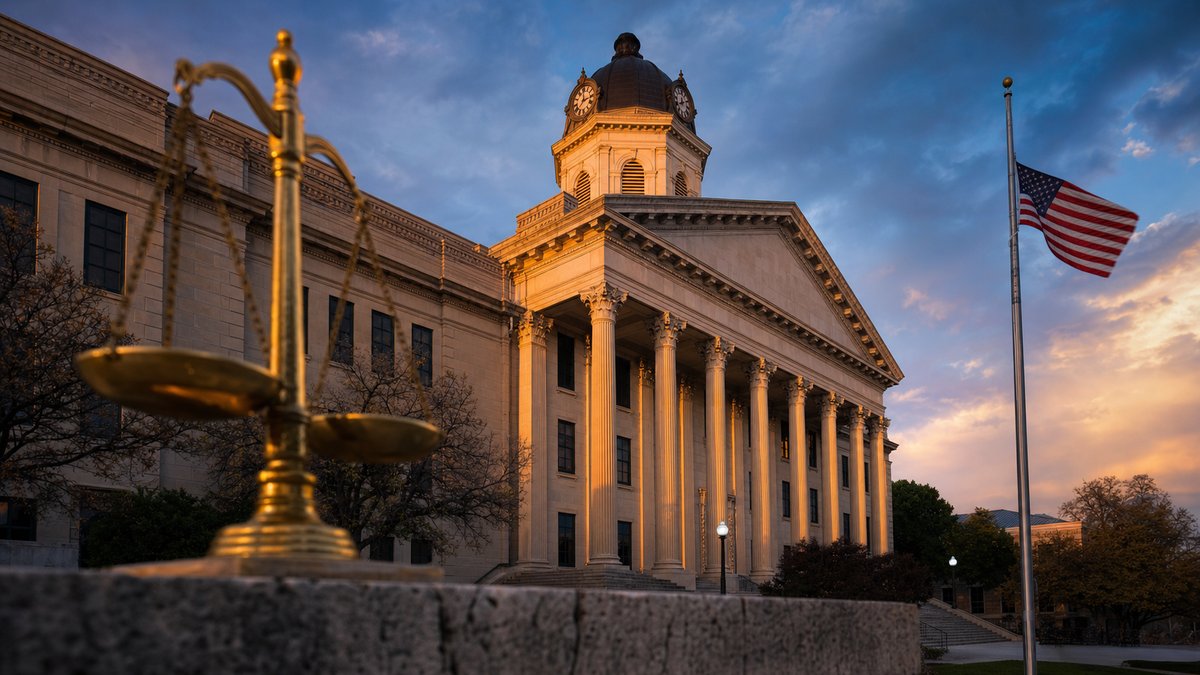
The murder trial of Karmelo Anthony — the North Texas teenager accused of fatally stabbing 17-year-old Austin Metcalf during a district track meet at Frisco's Kuykendall Stadium — began with jury selection on June 1, 2026, at the Collin County Courthouse in McKinney. The case has drawn national attention, in part because Anthony has admitted to the stabbing but maintains he acted in self-defense. Because this case is unfolding in our own backyard — Collin County, minutes from our Frisco office — it offers a rare, real-time window into how Texas treats one of the most consequential questions in criminal law: when is the use of deadly force legally justified?
At L & L Law Group, we defend people accused of violent crimes across Frisco, McKinney, Plano, and the broader DFW area. We are not involved in the Anthony case, and nothing here is a prediction about its outcome or a comment on the evidence. Instead, we use the headlines as a teaching moment: how a self-defense claim actually works under Texas law, and what any defendant facing a murder charge in a Collin County courtroom should understand.
The charge: murder under Texas Penal Code §19.02
Anthony is charged with murder, a first-degree felony in Texas. Under Texas Penal Code §19.02, a person commits murder if they intentionally or knowingly cause the death of another, or if they intend to cause serious bodily injury and commit an act clearly dangerous to human life that causes death. A first-degree felony in Texas carries a punishment range of 5 to 99 years, or life, in prison, plus a possible fine of up to $10,000. That is the same range reported in this case.
It is worth noting what Texas law also allows the jury to consider. In many homicide trials, a jury may be instructed on lesser-included offenses such as manslaughter (§19.04, recklessly causing death — a second-degree felony) or criminally negligent homicide (§19.05, a state jail felony). Whether those instructions are given depends on the evidence and the judge's rulings.
How self-defense works in Texas
The heart of a case like this is Texas's self-defense statutes. Under Penal Code §9.31, a person is justified in using force against another when and to the degree they reasonably believe the force is immediately necessary to protect against the other's use or attempted use of unlawful force. Section 9.32 governs the use of deadly force, which is permitted when a person reasonably believes it is immediately necessary to protect against another's use or attempted use of unlawful deadly force, or to prevent certain violent felonies.
Texas is also a "stand your ground" state. Under §9.32(c), a person who has a right to be present, has not provoked the other person, and is not engaged in criminal activity has no duty to retreat before using force. The reasonableness of the defendant's belief is judged from the standpoint of an ordinary, reasonable person in the same circumstances — not in hindsight.
Who has to prove what?
This is the part most people misunderstand. In Texas, self-defense is a justification defense, not an element the State must disprove from the start. The defendant must first produce some evidence raising the issue of self-defense. Once that threshold is met, the burden shifts back to the prosecution: the State must persuade the jury beyond a reasonable doubt that the defendant did not act in self-defense. The defendant never has to prove self-defense by a preponderance or any similar standard — the ultimate burden of disproving it stays with the State.
Practically, that means a Texas jury in a self-defense murder trial is asked a layered question: Did the State prove the killing? And did the State also disprove the justification? If jurors are left with reasonable doubt on the self-defense question, the law requires an acquittal.
Why jury selection matters so much
In a high-profile DFW case, jury selection (voir dire) can be as pivotal as the trial itself. Defense attorneys probe whether prospective jurors can fairly consider a self-defense claim, whether they hold fixed views about when deadly force is justified, and whether pretrial publicity has shaped their opinions. Collin County's large population gives both sides a deep pool to work with, but seating an impartial jury in a nationally covered case takes time and care.
What a DFW defendant should take from this
Cases like this underscore a few truths about Texas violent-crime defense. First, admitting an act is not the same as admitting guilt — the legal question of justification can be decisive. Second, the earliest hours matter: statements to police, the preservation of scene and witness evidence, and the framing of self-defense can shape everything that follows. Third, the punishment range for a first-degree felony is severe, which makes experienced trial counsel essential from day one.
Frequently asked questions
Is "stand your ground" the same as self-defense? Not exactly. Stand-your-ground (§9.32(c)) removes the duty to retreat in qualifying situations, but the core self-defense analysis — reasonable belief that force was immediately necessary — still applies.
Does the defendant have to testify to claim self-defense? No. Self-defense can be raised through any evidence in the record, including the State's own witnesses, physical evidence, and cross-examination. A defendant has an absolute right not to testify.
Can a murder charge be reduced to manslaughter? Sometimes. If the evidence supports it, a Texas jury may be instructed on lesser-included offenses like manslaughter or criminally negligent homicide, which carry lower punishment ranges.
What is the punishment range for first-degree murder in Texas? 5 to 99 years or life in prison, plus a possible fine of up to $10,000.
How L & L Law Group can help
If you or a loved one is facing a violent-crime or homicide allegation in Frisco, McKinney, Plano, or anywhere in the DFW area, the decisions you make in the first days can shape the entire case. At L & L Law Group, PLLC, we build self-defense and justification strategies from the ground up — investigating the scene, securing witnesses, scrutinizing the State's evidence, and holding prosecutors to their burden of proof beyond a reasonable doubt. Call us at (972) 370-5060 for a confidential consultation. This article is legal commentary on a publicly reported case and is not a prediction about its outcome, nor legal advice about any specific situation.
Talk to a real attorney
Send a few details and a defense attorney will reach back within an hour, day or night. No call center. No paralegal screen.